
blood and celluloid // MAN v. MACHINE CHAMPIONSHIP
KILL BILL gives american cinema a blood transfusion // kleber mendonça filho performs dialysis on brazil's past in THE SECRET AGENT // MAN v. MACHINE FINAL FOUR results

My goal with this newsletter is to write about new films as they reach general release, along with seasonally appropriate commentary on other cinematic events and interests. This week we’ve got the (re?)release of Quentin Tarantino’s Kill Bill: The Whole Bloody Affair, Kleber Mendonça Filho’s The Secret Agent, and the MAN // MACHINE CHAMPIONSHIP. This newsletter comes out every Friday, which this week means Friday.
If you’re here just to vote for the M//M CHAMPIONSHIP, go down about halfway for more information. Or if you think you know what you need to do, press this button and vote:
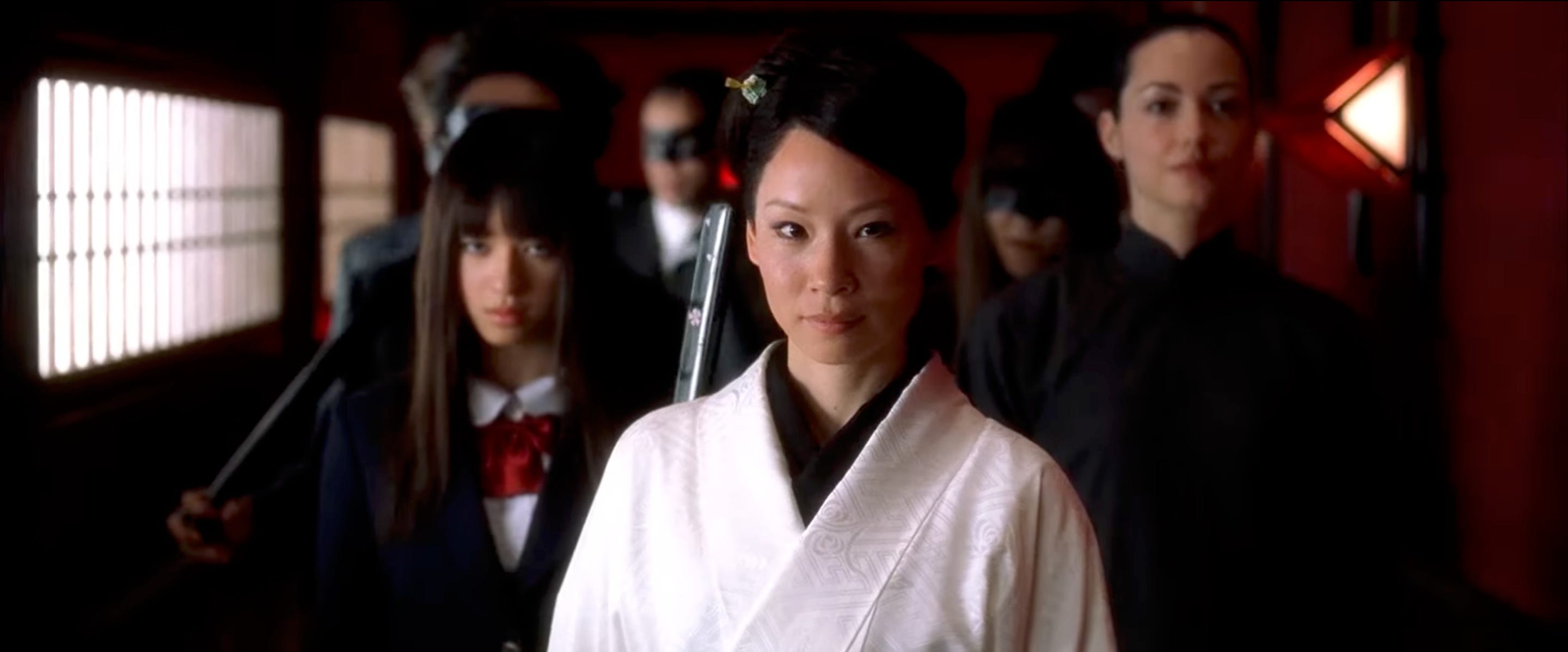
At least one American cineplex took a break from dying last weekend and screened a five-hour matinée to an all-but-sold-out audience on a subzero afternoon. From the ponytailed codgers to the six-year-old sitting next to me who probably shouldn’t have been admitted, Minnesotans far and wide left the comfort of their homes to sit through all 275 minutes of Kill Bill: The Whole Bloody Affair. No one was on their cellphones, no one engaged in inappropriate laughter, no one even really got up to go to the bathroom. It sort of felt like going to the movies.
I didn’t see Kill Bill: Volume 1 when it was in theaters the first time, and for reasons that I can now pretend were artistic purity, I never got around to seeing Volume 2 at all. I’m glad I held out all these years - I hate to fall for Tarantino’s bullshit, but an all-afternoon theatrical marathon is the way Kill Bill was meant to be seen. Moments so overcooked they’re corny to even think about play on the big screen like the completion of a global b-movie project, as if every kung fu/gangster/Western trope was destined by God to lead up to the moment when O-Ren Ishii and co. walk into the arena to “Battle Without Honor or Humanity.” A lot of stupid things have made me cry this year, but the triple jump zoom to Lucy Liu’s face was by far the least justifiable use of my precious bodily fluids. I don’t know what’s wrong with me. People achieving what they are so clearly supposed to be achieving really hits.
Kill Bill is a blatant pastiche of the many ways action cinema disregards human life. It never once pretends to have an original idea and actively leans into its universalist approach to appropriation. It was made at a time when Girl Talk was starting to make its way across the internet and radio hip hop was defined by big, sacreligious samples. By the time we got to Volume 2, millennial identity was crystalizing as the generation that didn’t care that Burzum played next to Dem Franchize Boys on their iPods. Some people get joy from seeking out Kill Bill’s deep-cut references and uncovering hidden gems in their juxtapositions. But more people have just accepted that Ennio Morricone mashed up with Lady Snowblood feels really good. Sometimes you do it in order to say something. Sometimes you do it because it’s the right thing to do.
I’m not sure if there are any revelations to be had from watching The Whole Bloody Affair that weren’t already apparent to anyone who’s seen Volumes 1 and 2 back-to-back. It’s mostly the full realization of an already proven concept. The climax of the first half is so exhilarating that it feels impossible for the conclusion to top it; the only mode left is a shift to emotionalism, and Tarantino does it so unexpectedly and effectively that you don’t have time to accuse him of manipulation. The pay-off is helped along by the scrambled timeline, which normally bugs me as a cheap way to disguise inanity as intellectualism, but here it’s a necessary storytelling device to make a 4.5-hour film tolerable. I barely fidgeted the entire time, and the child to my left didn’t either.1 I’m not sure which is the greater testament to Tarantino’s success.
I think we’ve pretty much conceded that there will never be another movie like Kill Bill - and that’s OK, because Kill Bill already exists. If you want to save theaters from their demolition by Netflix or whatever, make this a holiday tradition and put it out every year as the weather turns bleak. People will go and see it and it will make them feel alive. Studio consolidation is obviously bad and evil and will be subpar for well-funded creative expression, but it’s hard to imagine that even the most tech-pilled executives would want to abolish such a low-risk/high-reward opportunity. Legacy screenings are free money, and the executives know it, and the people love it. Never make a new movie again for all I care. We’ve got plenty of them.
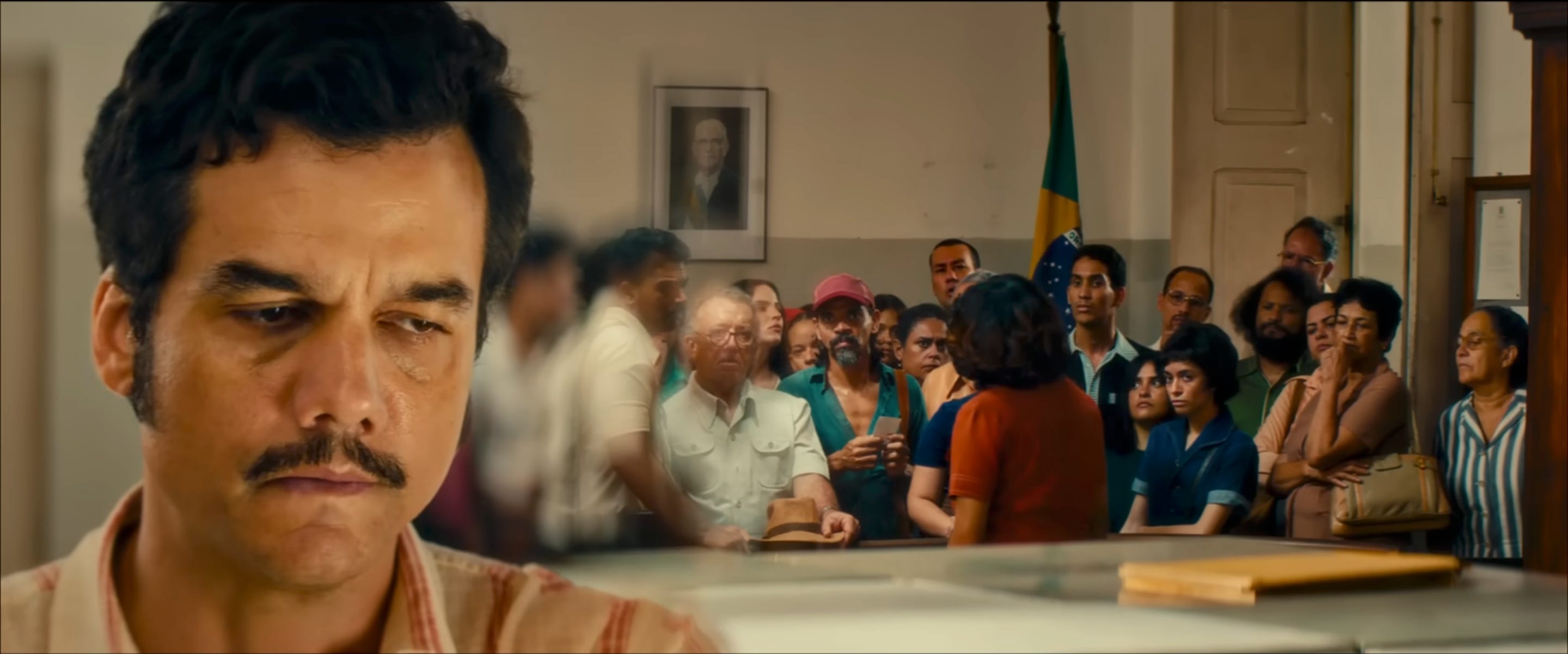
But if you want to see a new movie about the death of the movie theater, you’re in luck. Kleber Mendonça Filho’s The Secret Agent is sort of the thinking man’s Kill Bill, every bit as shaggy with its run time and references but significantly more restrained in its perception of fun. The premise — man on the run in military-dictatorship Brazil during Carnival — is undeniable; the problem is Kleber Mendonça Filho never cues us into the plot. A character with a couple different names (Wagner Moura) encounters a dead body, gets shaken down by some cops, checks into an apartment, and gradually discovers that someone wants to kill him. Who’s pursuing who and why we should care is anybody’s guess, but there’s a child involved, and there are also a lot of sharks. Usually a chase movie offers at least a few minutes of expository hand-holding, but Filho throws us into the deep end without so much as a pool noodle and only gives us the vaguest suggestion that we should swim.
The details eventually surface, not in a Christopher Nolan puzzle-box way but scattered piecemeal without pins or red strings. Bizarre interludes cut in and out between pedestrian conversations. Action ebbs and flows without resolution. The chronology is scrambled and sometimes doubles back on itself. And there’s a creeping sense that everything you’re watching is a reference to a ‘70s b-movie you could look up on the internet and pretend to recognize when someone tries to one-up you at a party.
In other words, The Secret Agent is a mess. Some of its most irrelevant digressions are its most exciting, but it’s hard to know where to draw the line between indulgence and exuberance. On one hand is a collection of images I’ve never previously imagined - a two-faced cat, a gutted shark with a rotten leg hanging out of it, that same leg hopping around and murdering cruisers in a nighttime sex park - and on the other is the ever-present question of where any of this is going and why. It looks incredible, and Filho’s direction keeps things lively, enough that plenty of people will make it through on vibes alone. But two hours and forty-five minutes is a long time to ask an audience to put up with a thriller with no coherent thrills. I like Filho and I love that he’s living out the New Wave dream of turning his film-critic obsessions into actual films - but even his best projects could benefit from fat-trimming, and The Secret Agent gives the sense that he’s actively weaponizing his self-indulgence against his audience.
AND - he really is doing something, and it’s really cool, and if you can deal with not exactly having fun for an hour or two you’ll end up with one of the most interesting movies of the year. Outside the pleasure of the visuals and the top-tier soundtrack, the most compelling driver in this movie is trying to figure out what the heck Filho is doing on a structural level. It has something to do with the myriad background references to Kodak, something to do with occasional instructions chopped into the dialogue, and probably something to do with all those sharks. When it finally clicks, the reveal isn’t quite as satisfying as the denouement of a proper spy movie, but if you have a certain sort of brain disease, it’s pretty darn close.
SPOILERS FROM HERE ON OUT. I don’t think I’m exactly selling this movie, but it’s really cool and will probably be nominated for a few Oscars, so go see it.
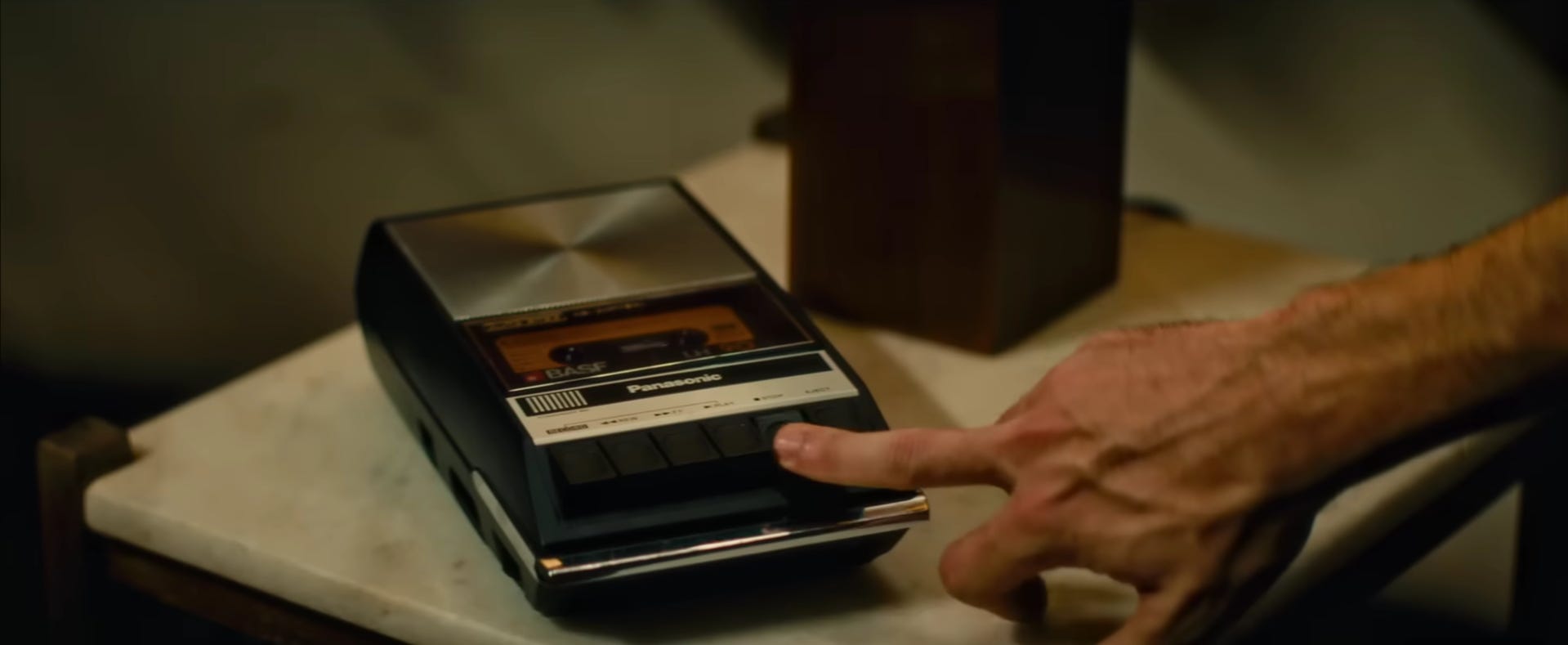
The Secret Agent holds its cards until it’s final scenes - really, it’s final shot. In its denouement, it reveals that it’s a film about how we create history - on one hand through imperfect artifacts and rememberings, and on the other, through narrative cinema. In other words, this is a movie about research and film analysis - in other words, candy for comp-lit-adjacent majors with graduate degrees. No one reading this can relate, so I guess you can just stop here.
Filho achieves his meta-narrative twist in two strokes. First comes the rug pull. We’ve been led to believe that Wagner Moura is our audience surrogate, but in reality, our stand-in is someone introduced in an almost instantly forgettable flash-forward at the end of Act One. Flavia, a modern-day researcher tasked with transcribing a collection of archival audio tapes from the 1970s, doesn’t know anything about the tapes she’s processing. She only gets invested as she starts to make connections. She fills in the gaps through cross references, newspaper microfiche, and surviving legal documentation. When she hits a dead end, she tracks down her main character’s son - also played by Moura - who tells her what he knows but ultimately admits that he has no memory of his father. “In fact,” he concludes, “you now remember him better than I do.”
If you can let yourself be gut-punched by this sort of thing, it throws into relief all the confusions and frustrations with The Secret Agent’s storytelling defects. The audience experience mirrors Flavia’s. We start in media res without context. We gradually gain clarity as Flavia find details to hang onto (at one point, the film cuts to her saying to her friend, “I just realized, ‘Marcelo’ is ‘Armando’” - shortly after we, as audience, figure out the same thing). But more often we get lost in the bizarre side quests (most significantly, the Hairy Leg story) familiar to anyone who has ever spent too much time in an archives library. Sometimes the narrative veers toward sentiment and speculation; other times it gets documentarian and cynical. Ultimately it spits us out out with no sense of who our lost hero is other than a vessel on which to place the familiar face of his living son.
All of this sets up the final reveal: this is a movie . . . about movies. Flavia’s research can only go so far, so she fills in the holes in her research with trope-addled cinema. It’s a relatively universal experience (I think?) to learn about a story, historical or otherwise, and re-imagine it as a movie - and because most of us aren’t highly original filmmakers, our imaginings generally follow the beats of previously existing movies. The Secret Agent makes a daydream into a reality and recreates a scrambled history in the eyes of someone who can only see the world through cinema. It’s shot on digital (i.e. modern eyes) processed to look like 1970s Kodachrome (i.e. nostalgia) and hits the paces of familiar 1970s genre tropes: sometimes a slasher, sometimes a neo noir, sometimes a paranoid thriller, sometimes a budy cop movie. Crash zooms, split-focus diopter, Donna Summers drops, pervasive references to Jaws: I’d have to watch it a few more times to even begin to ID the allusions, but it’s clear that, not unlike Kill Bill, The Secret Agent is a movie made up of references.
Filho could probably have put a finer point on it, but the final shot - Moura-as-son, standing alone in front of a blood bank built on the foundations of his grandfather’s cinema palace - drives the meta-narrative home. Narrative cinema is the blood of this movie, the material that gives life to a history that can only be partially uncovered through research. Movies bridge the gaps of imperfect memories. We write the past in their image. When we can’t figure out how to tell the true story, we fall back on their tropes.
I have some quibbles with the execution, but I want to see more films take on narrative with anywhere close to the frankness of The Secret Agent. Filho plays his cards plain and for the most part doesn’t break from them. If you want to explore how narrative art can continue to evolve, this is at least one place to start: this is what I’m working with; these are their limitations; this is what can be made. The starts and restarts, the assumptions, the loose threads, and the cliches are all results of the method, and the audience’s frustration is part of the story. We want just a little bit more (or maybe quite a bit less) but what we get is the story that can be told with the scraps that are available. A handful of tapes, reams of bullshit newspaper stories, a few surviving photographs, the empty memory of the only survivor - and a whole bunch of old movies to suture the holes. History is built on scraps, and some of those scraps are fiction. There’s no other way to reconstruct the past. We do better when we admit it.
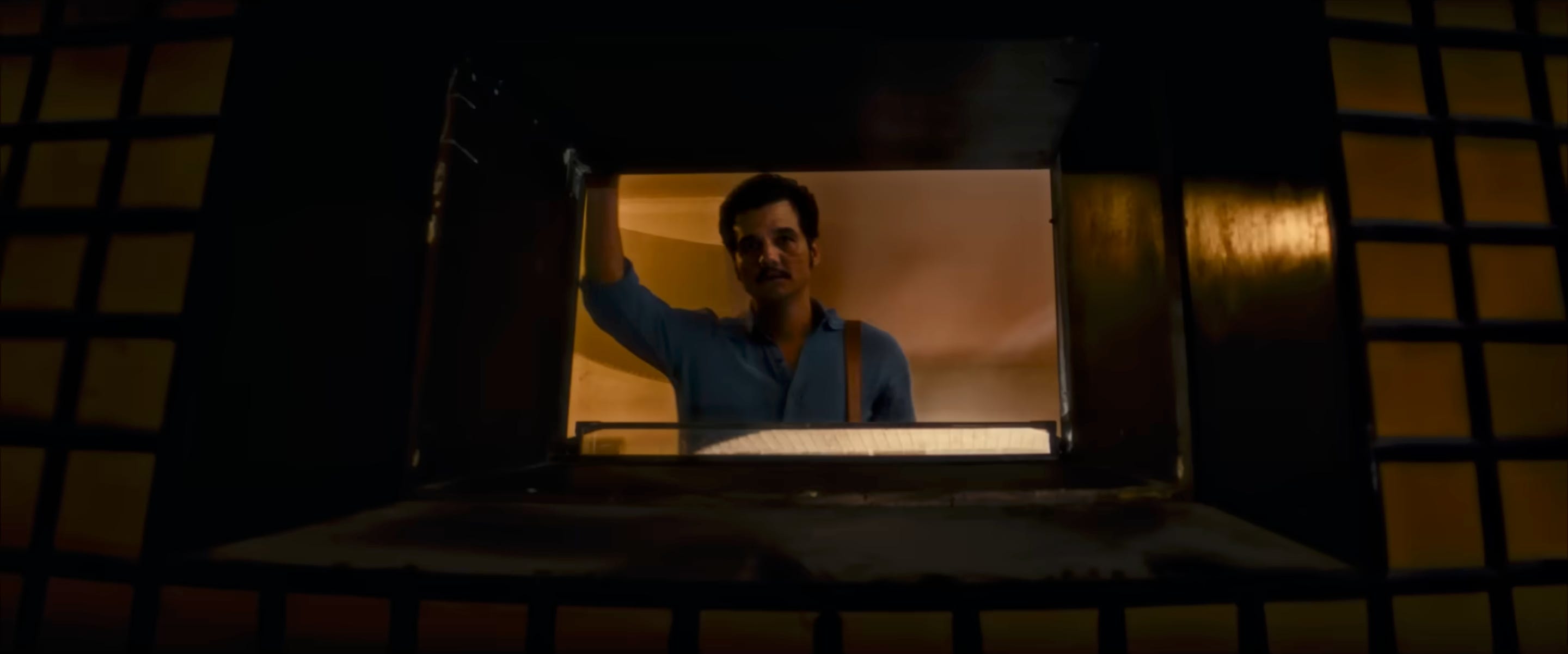
ROBOT v VEHICLE. Heady intellectualism v. chud-brain tension. Neon on black vs. grey on tan. Robot who acts like a human v. human who acts like a robot. Hauer v. Hopper. Young v. Bullock. Ford v. Reeves. But in the end, it’s all LA v. LA.
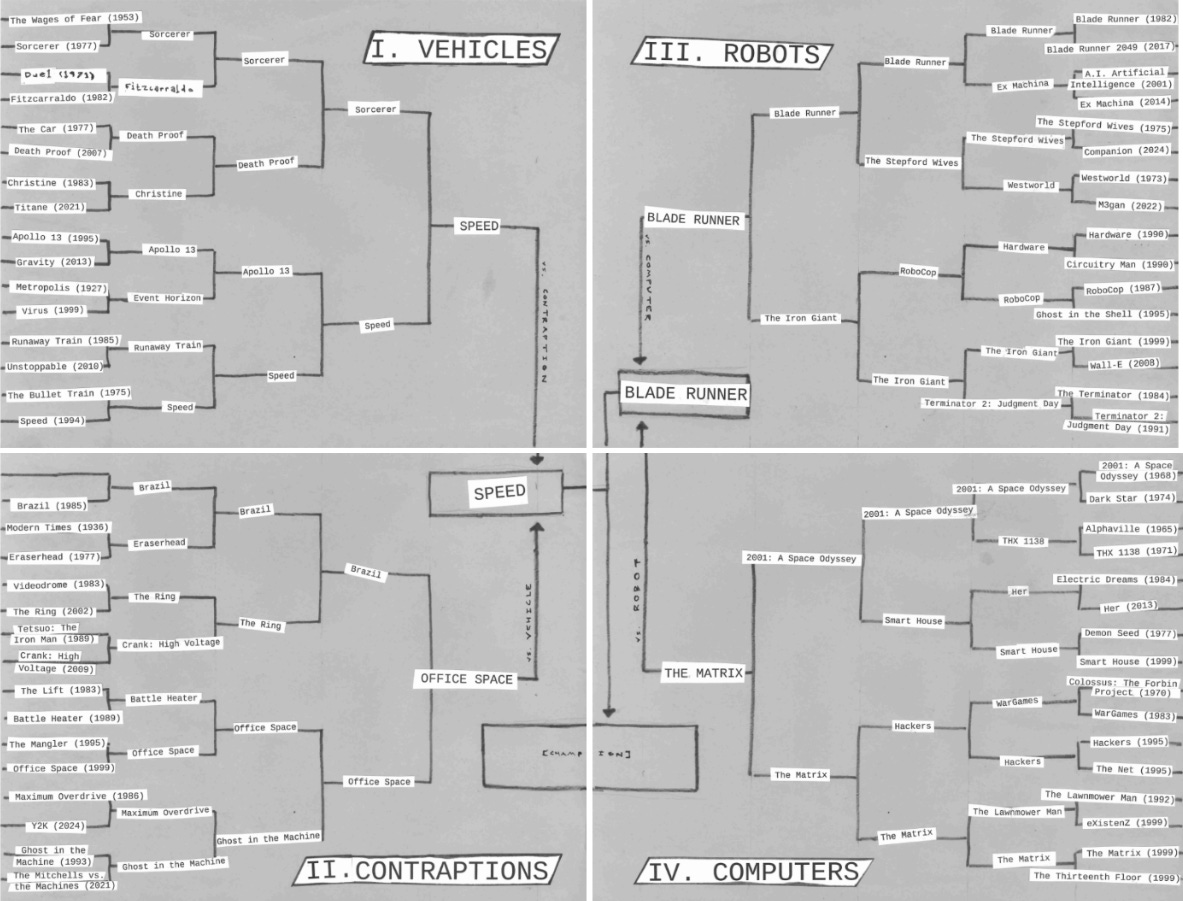
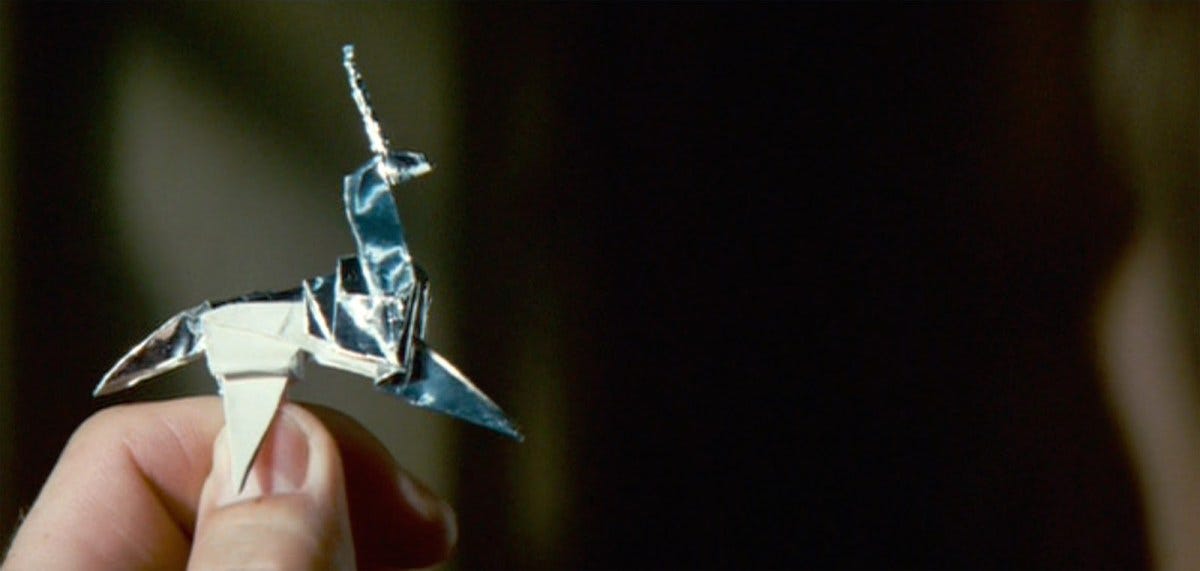
I’m pretty surprised The Matrix didn’t win - I figured the coalition would have come out and made this a Keanu // Keanu finale. Maybe people are tired of the meme. Or maybe it’s just undeniable that Blade Runner is the smarter, cooler, more enduringly rewatchable movie.
I’ll wait for next week to force something profound about what this election tells us about ourselves, but I guess DECISION 2025 comes down to whether you think the greatest threat to mankind is public transportation or the MACHINE inside us. That pretty much sums up most of the mayoral elections we had this year, so I guess we’re right on track. LA didn’t vote for mayor in 2025, so this is their opportunity to decide like the rest of us. Actually I don’t think I have a ton of readers in LA, so I guess we get to decide for them. Are they doomed to a city where buses run rampant with no regard to street signs or pedestrian infrastructure? Or one where beautiful robots eat noodles, have dreams, and rampage through Renaissance Revival masterpieces backlit by moving billboards? Either way they’ll need a MAN to save them - and that MAN, gender inclusive, is you.
BRACKET LEADERS
Sam S. (131 pts)
“Mad” Max (116 pts)
Mike H. (115 pts)
It’s not over till it’s over, and our models tell us there’s at least one opportunity for disruption. Argue it out across your holiday travels, watch both movies alongside The Holiday and Christmas with the Kranks, vote with your family around the Christmas tree, and come back Boxing Day for the results.
Thanks for reading *life is disappointing.* If you found this newsletter slightly less disappointing than the rest of your life, consider liking, commenting, sending me money (thanks!) or subscribing. Subscribing will get you exactly what you get here but sent to your email inbox. We’ll be back next week with some imperfect year-end lists and the MAN // MACHINE CHAMPION.
She did wave her arms around in the air whenever Uma Thurman did something cool, which was either an expression of approval or an attempt at audience participation. At the end she said it was “erserm” and gave it a 10 out of 7. Children are the future.