
despite market downs, love continues to conquer all
the state of the romantic comedy in 2025, ft. splitsville, the roses, and a postmortum of the materialists media cycle

My goal with this newsletter is to write about new films as they reach general release and to feature seasonally appropriate commentary on other cinematic events and interests. This week we’ve got a State of the Romantic Comedy Address, featuring Jay Roach’s The Roses, Michael Angelo Covino’s Splitsville, and a look back at Celine Song’s Materialists. Light spoilers for all of them! This newsletter comes out every Friday, which this week means Saturday.
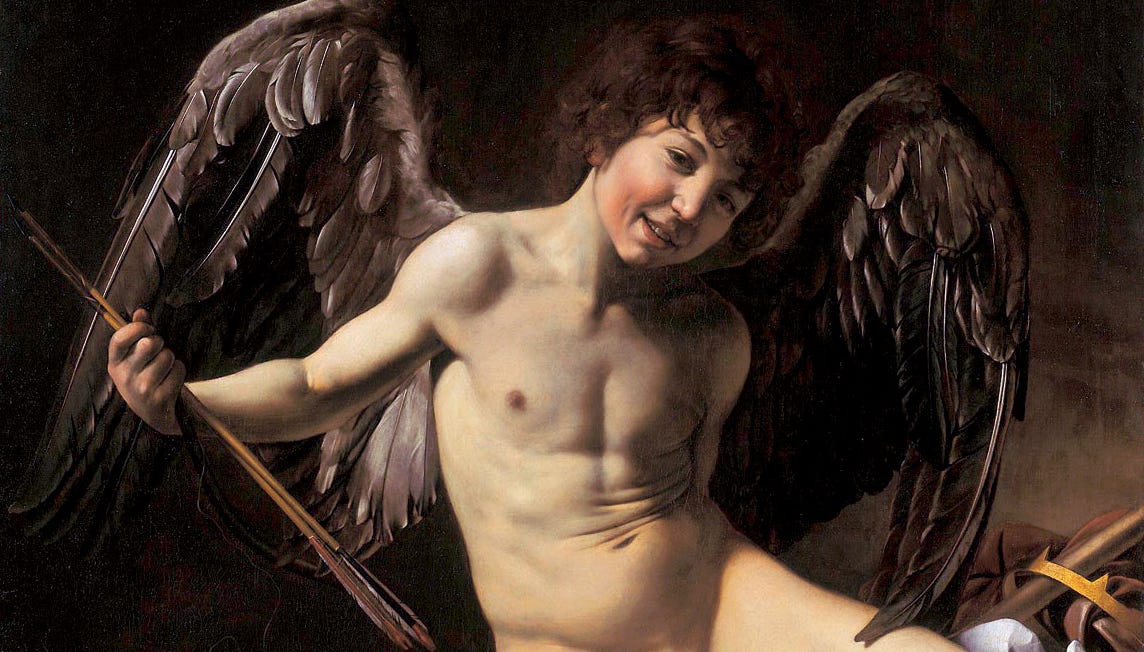
Plenty has been made (by the PR team at Paramount) about the threatened status of the studio comedy, but the real endangered genre is the romantic comedy. Once upon a time we lived in a world where Nora Ephron and Nancy Meyers put out a new romcom every weekend. Now all we get are horror films, political thrillers, and A24 thinkers designed to make date night as unsexy as possible. In this age of the chatbot romance / doomscroll dating app / escalating polyamorous divorce rate / kids who don't like sex supposedly . . . is the romantic comedy dead?
Actually, I don’t think any of that holds up. The romantic comedy, contrary to popular belief, is doing just fine. Based on statistical powerhouse Wikipedia’s "List of romantic comedy films,” twelve romantic comedies have been released in 2025. Twenty came out in 2015, fourteen in 2005, and ten in 19951. You could spend a lot of time getting better data on this topic, but the numbers at hand suggest that the glorious age of romcom abundance is a lot like every other memory of a past Great America. It’s true that there were lots of by-the-numbers, star-driven romcoms between 1985 and the early 2000s, but the reality is less that the romcom is dead and more that a particular era of romcom has passed.
If someone were to break down some actual data, I think they’d find that the real trend is the streaming-era split between theatrical releases and straight-to-streaming features. Romantic comedies haven’t died so much as they’ve migrated out of theaters. And they’re thriving in their new habitat. For starters, there’s the Hallmark Channel, which has already put out 37 original romcoms in 2025; September alone features all three parts of the Groomsmen Trilogy, the latest installation of Mystery Island, and what is sure to be a mammoth hit in the recently-turned-30 crowd, Adventures in Love & Birding. At a significantly lower but slightly more refined clip, Netflix is pumping out b-movie crap with names like La Dolce Villa, The Wrong Paris, and Champagne Problems. The star-driven romcom is also doing fine: there’s You're Cordially Invited on Prime, starring Reese Witherspoon and Will Farrell, and there’s the international box office smash Bridget Jones: Made About the Boy on Peacock, starring everyone who was ever in a Bridget Jones movie and then some.2 And even if none of this streaming stuff convinces you, there’s still quite a bit happening at the box office: this weekend’s Downton Abbey: End Game (my mother-in-law went to an influencer screening a couple weeks ago and said it was pretty good), next week’s A Big, Bold Beautiful Bill Journey, last month’s Freakier Friday, the Wedding Banquet remake, the French indie Jane Austen Wrecked my Life (also mother-in-law approved), the Scandinavian indie The Dance Club, The Battle of Wallis Island, Eternity, Heart Eyes . . .
All in all, plenty of romcoms available on your TV, and even a few at your local cineplex. So if we abandon the apocalyptic narrative and agree that the romcom is not dead but actually rather too alive, we can instead focus on the content of an evergreen genre and see what its current foliage tells us about our cultural moment.
Let’s look at three major releases of Summer 2025: The Roses, Splitsville, and Materialists. It would be easy to say these three films are manifestations of a new age of cynicism, and that the only romcoms possible in the current climate are about money, divorce, and botched polyamory. But we only hand out nuanced takes at *life is disappointing*, and I’m here to tell you that the only cinematic romance 2025 has to offer is the same old, comfortably vanilla bullshit.
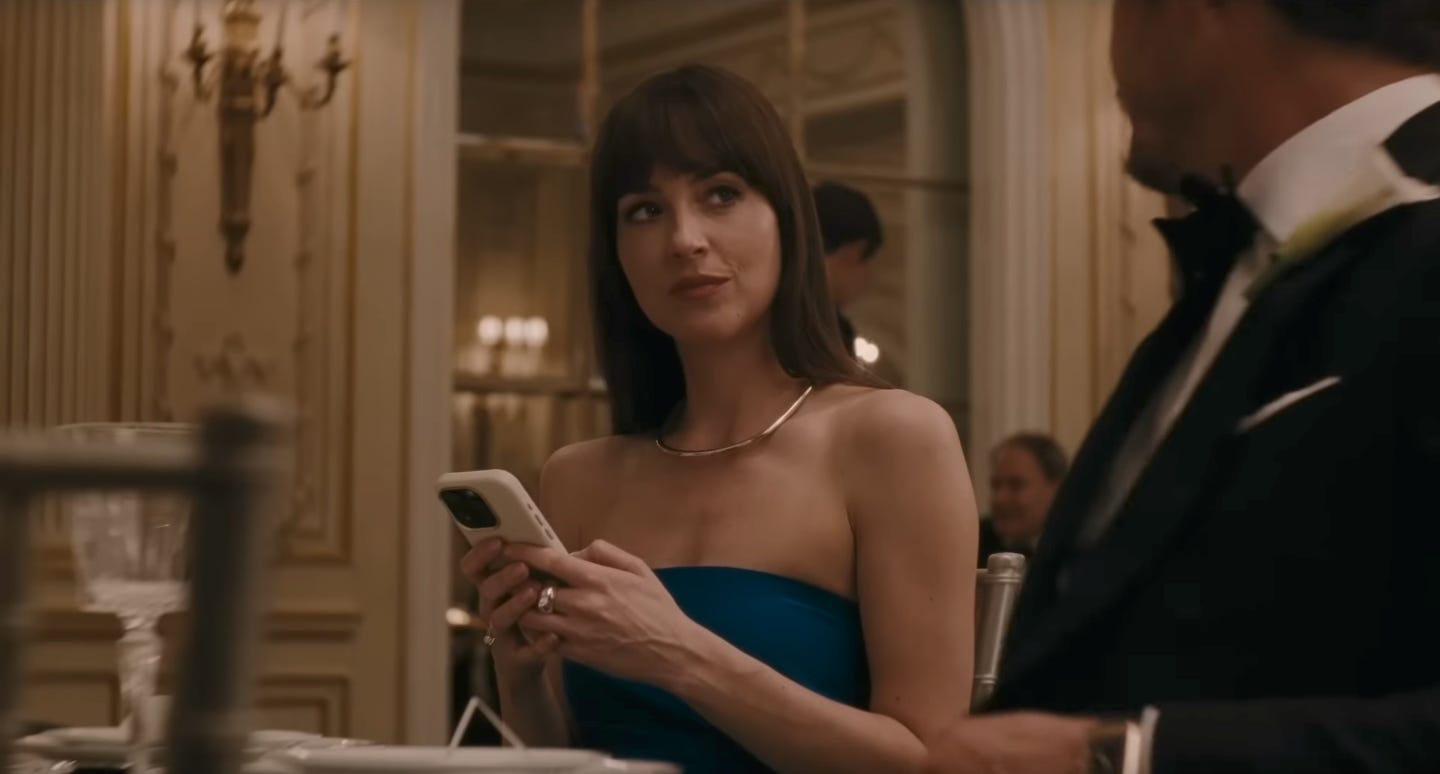
We've made it through a full media cycle and the requisite forgetting and cooling period, and I think we can finally treat Materialists like the extremely normal movie it is. I liked it while I was watching it, had more mixed feelings by the time I got to writing about it, turned against it through the power of cultural osmosis, and am now back to thinking that it was a nice-to-look-at movie that isn’t worth thinking about. It’s about two people who break up because of feelings about money and material satisfaction, mess around a little bit with other means of fulfilling those wants, and ultimately realize that they were meant for each other despite their imperfections - in other words, pretty much the plot of every romantic comedy ever. I get a “that was boring” or a “that was tonally inconsistent” or a “looking at Dakota Johnson’s face for two hours is like staring into the black void at the heart of the universe” take. But to be apopleptic about a film where the protagonist tells us that her big problem is that she only cares about how much money her potential partner makes and then, after living in that stew for too long, decides that love is a disruptive enough force to transcend money anxiety? That requires a fundamental misunderstanding of what romcoms were put on this earth to do.3
I think part of what got people so cranky about Materialists is that it looked like either a critique of romcoms or an unambiguous embrace of their bullshit. Instead, it was something in-between: a film that spends most of its runtime criticizing the naivity of romcoms but ultimately gives up and becomes one. People who were looking for a cute time felt insulted for 90 minutes and then got a happy ending dumped on them as a consolation prize. People who were looking for a critique got what they wanted - until they didn’t.4
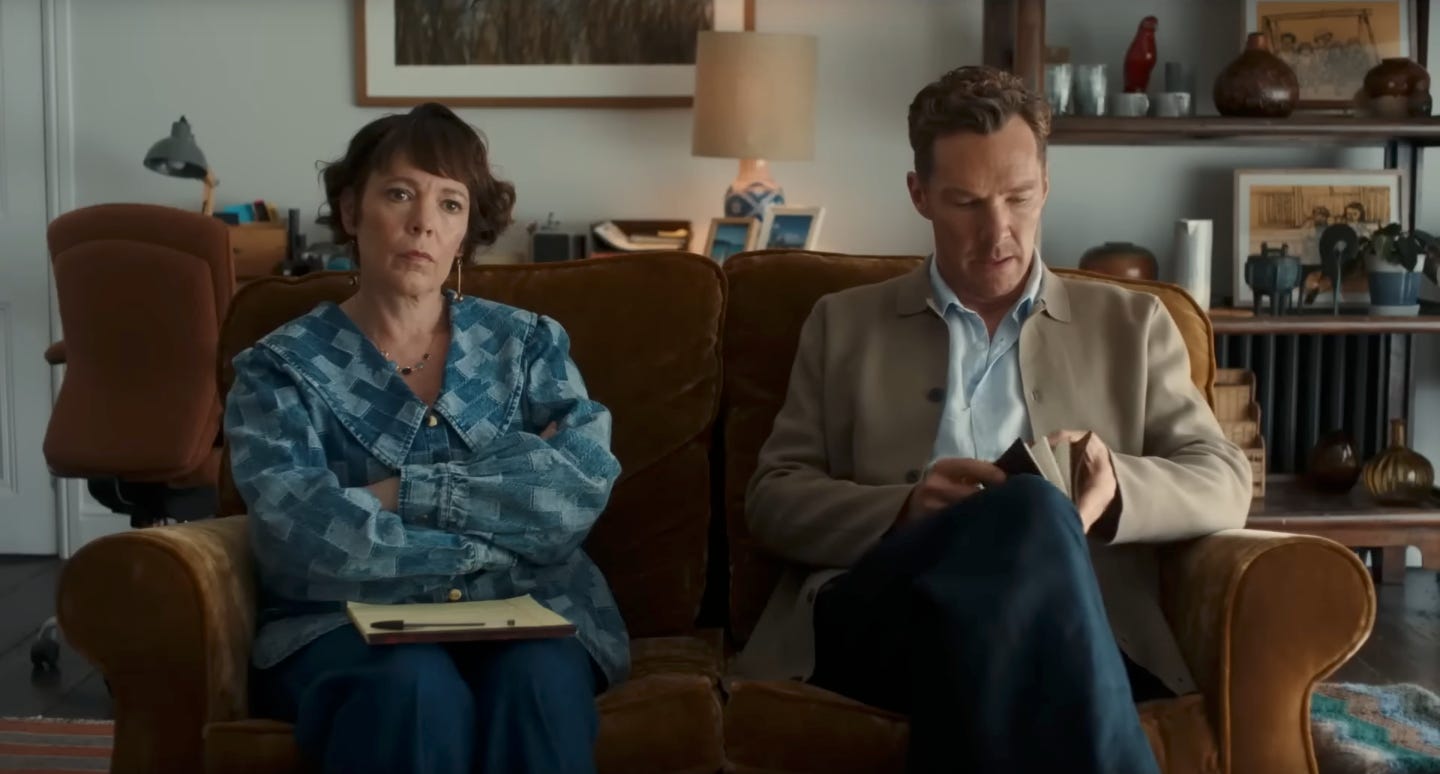
I think that desire for critique - and also the inability to carry it through to the end - is part of what’s going on with the late-summer anti-romcom double feature of The Roses and Splitsville. Contra the traditional marriage plot, both films begin with divorce: The Roses in a DOA marriage therapy session, Splitsville immediately after an anniversary handjob leads to a highway fatality. The comedy comes not from the will-they-or-won’t-they as the two characters gradually stumbling together, but the oh-they-definitely-won’t of two characters who never should have met.
The Roses is the more conventional of the two, and ultimately the less successful. Directed by the guy who brought you Austin Powers and Meet the Parents, it’s a film with great component parts but no ambition to pull them together. In someone else’s hands, Olivia Coleman and Benedict Cumberbatch reading from a Tony McNamara script could have been an absurdist follow-up to Poor Things and The Favourite. Instead, Jay Roach shoots it like knock-off Nora Ephron, complete with b-character reaction shots, dopey music, and frequent telling-not-showing that sucks all of the English humor out of Cumberbatch and Coleman’s performances.
The Roses wants to and should be a divorce satire where the best part of making up is breaking up, a film in which the titular Roses only realize how much they love each other after they’ve thrown knives at each other and dropped lobsters in each others baths, etc. But Roach loses his thread almost immediately by stuffing in a flashback meet-cute between the divorce-cute cold open and the opening titles. The next thirty minutes show the Roses in marital bliss; the following thirty show them will-they-or-won’t-they-ing, and it’s only the final act in which we get the falling to pieces that make up the trailer. The stakes of the divorce don’t make any sense, and what should have been the central point - that for some people, the combat of breaking up is the realest love language of all - gets muddled by Roach’s laborious depiction of a happy household.
I’m not sure what The Roses wants to tell us about love. It’s the kind of film where the journey needs to be the destination, and unfortunately that journey isn’t funny or interesting enough to be worth the blisters. It wants to say that cynical is the new cute, but it’s too scared to commit to the bit. By lavashing all its cinematic love on two-child hetero bliss at the sacrifice of a coherent divorce narrative, it waves its hands in the air and decides that marital discord is too dangerous a kink to indulge in.
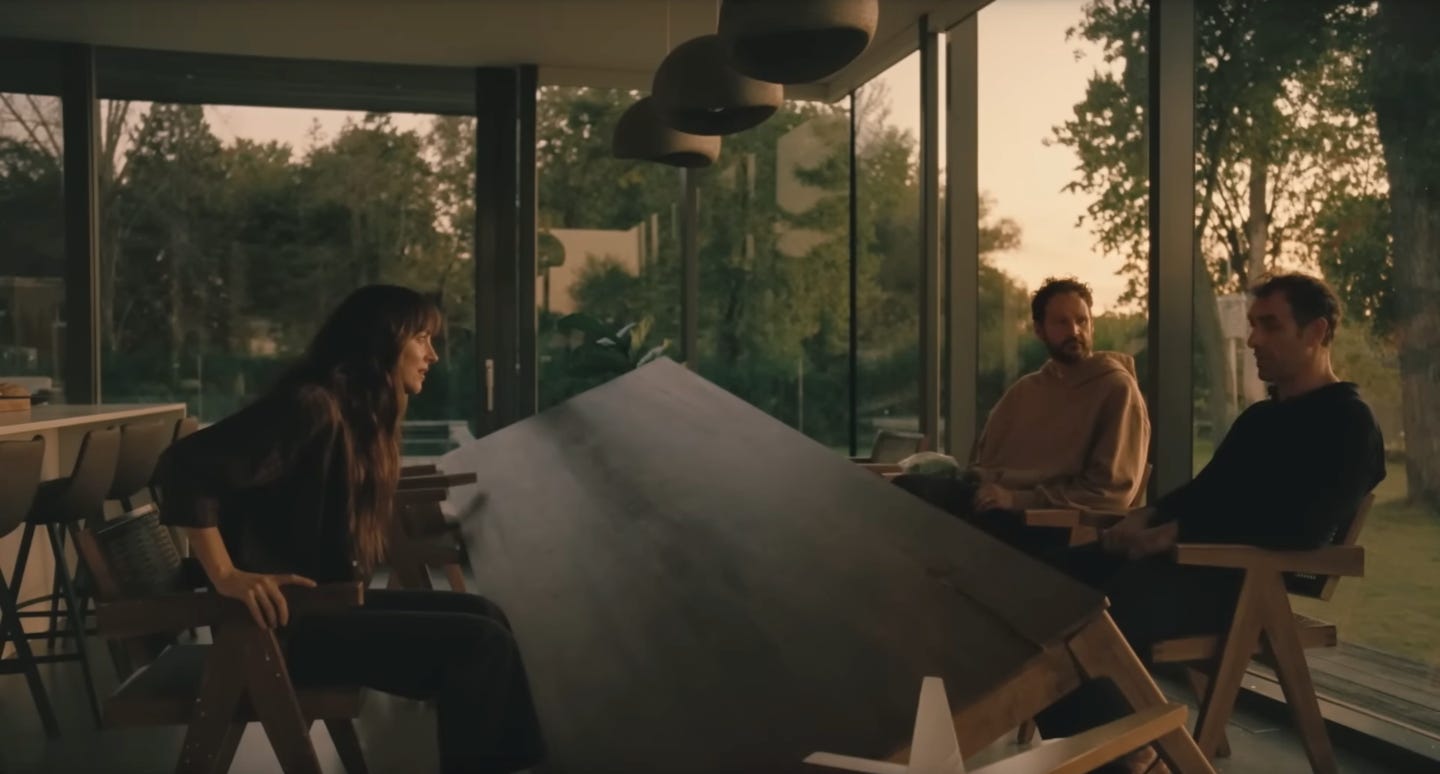
Splitsville takes a more enjoyable approach to divorce kinks, but ultimately arrives at a similar conclusion. A love-quadrangle about one mismatched couple on the outs and another navigating a newly opened relationship, Michael Angelo Covino and Kyle Marvin’s Splitsville is a screwball comedy that, if it matches your humor, is probably laugh-a-minute funny. The cast is beautiful and it looks fantastic, set piece after set piece filmed with extended tracking shots around the tight corner and lofted spaces of sububan houses. There's a beautifully shot fight scene, there's a perfectly timed children’s birthday party featuring Cousin Greg as a mentalist, and there's a lengthy surrealist sequence in which a one-bedroom bungalow gradually fills up with Adria Arjona's ex-lovers and culminates in probably the first-ever instance of an onscreen Lorenzo's Oil joke.
Covino seems less interested in the power of love than its ability to inspire chaos. Beyond a series of therapeutic platitudes and some recitations of The Fray lyrics, there are no grand statements about love or what it means. Splitsville could have been a slam dunk if it committed to a Tati-esque panorama of four idiots' lives, a gradual fade from one setpiece to the next with no interest in resolution or serious character development. But either because of Covino and Marvin’s nervousness or some nudges from Neon, it bends a bit too heavy toward plot conventions. The result is an unfortunate crimping at the edges, a slip into a sweetness that it hasn't earned for an unsatisfyingly satisfying conclusion.
The biggest joke of Splitsville is that, despite all the permissions for bad behavior, no one actually wants to act on them - the chaos stems from misperceptions more than actual infidelity. All four characters just want monogamy: it’s only feelings of inadequacy and the perceived dissatisfaction of their partners that bring them to opening up their marriages. This is a pretty conventional conclusion for a movie that presents itself as an “un-romantic comey”, suggesting once again that the main reason we seek out cynical love stories is because they offer a novel obstacle against which marriage can prove its legitimacy.
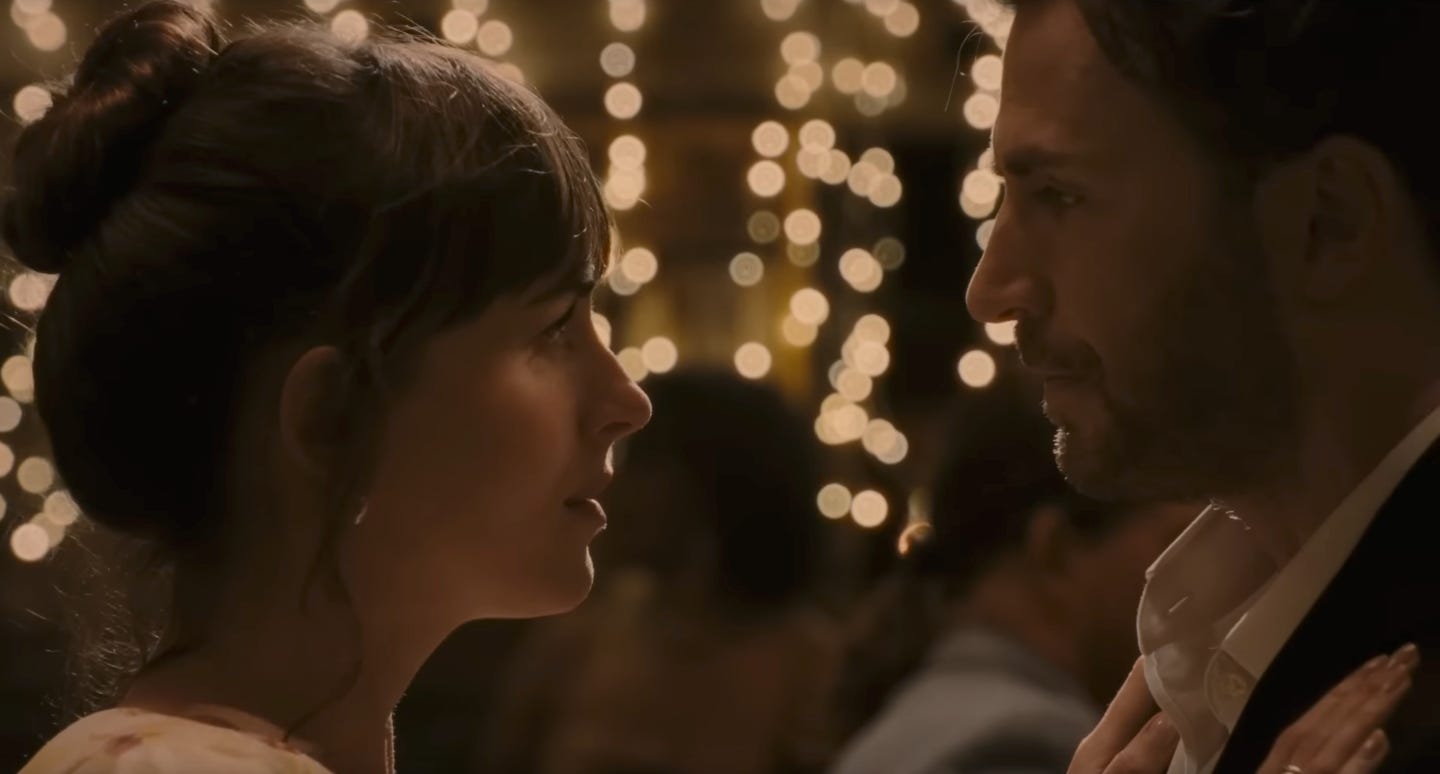
Because - as Celine Song gets at in Materialists, people do want to see people get married, even when all the evidence suggests that marriage shouldn’t actually exist. It’s not perfect, it can actually be quite unpleasant, but people love and care for each other and put up with a lot of bullshit because of it. In The Roses and in Splitsville, like in Materialists, the barriers are modern and the framing is novel, but the conclusions are evergreen: love conquers all because, unfortunately or not, love really does conquer all.5
In the end, I think these three films tell us less about modern romance and more about the present state of cinema. The romcom isn’t any more dead than the comedy in general - what’s actually endangered is the big, stupid theaterical release. Streaming provides the equivalent of an airport smut shelf and clears up the theatrical release schedule for Serious Cinema, which in the post-structuralist era means "movies for people who at least sort of like to think about movies." The people who go to movies are the people who know movies. It makes sense that we get a bunch of deconstructions of the iconic romcom, where romance is dissected and the script is cemented in a knowing joke that Hollywood love was never real.
I don't think the theatrical experience should be limited to the middle-brow experience of the post-strucrual cinephile. It’s great to think and to appreciate, but we also want all of those experiences that Nicole Kidman tells us about at the AMC. My wife pointed to the experience of seeing the 20-year screening of Pride and Prejudice earlier this year and the social goodness of leaving a theater with a crowd of women all choked up that Elizabeth and Darcy made it. I do think we're rather low on that in 2025. It’s good to have big, dumb feelings with strangers in the dark, whether that’s laughter or sobbing or fist-pumping triumph.
And - our fetishization of the particular beats of the 90s/2000s romcom makes us forget about the other triumph-of-the-human-spirit films that celebrate the power of love or something like it in less conventional ways. I’d like to think we’ve expanded our views on love and family a bit in the past quarter century, and I’d hope that we can appreciate the cinema that reflects that. Sorry, Baby has many of the beats of a romantic comedy plus quite a few more. Best Picture-bait Sentimental Value seems more like a family dramedy than a romance but has already gotten me teary from its trailer alone. Kill the Jockey is pretty much a love story and a small, unsung triumph. If you’re into freakier stuff, there’s Pillion (and, depending how you read it, Misericordia). And if you have more patience for Noah Baumbach than I do, Jay Kelly is coming around the corner and getting described as his most straightforwardly sentimental film to date.
All in all, uncynical and non-crap statements about the triumph of love in all its forms are alive and well. Maybe the 20th-century romcom is washed, but there’s still a lot of normal, optimistic, and emotionally grounding stuff out there, at home and in theaters. Some of it is stupid, some of it is edgy, some of it is unromantic. But a lot of it is a pretty nice time. You just have to go out and see it.
Thanks for reading *life is disappointing.* If you found this newsletter slightly less disappointing than the rest of your life, consider liking, commenting, sending me money (thanks!) or subscribing. Subscribing will get you exactly what you get here but sent to your email inbox. We’ll be back next week with some early fall filler before One Battle After Another comes out.
1985 produced nine; 1965 and 1975 apparently had zero. This list might be bad.
Mad About the Boy is the 23rd most successful worldwide box office release of 2025. Universal sent it straight to Peacock in the United States.
The real cynicism is the (very online) reaction that Materialists is “broke man propaganda,” an opinion that dominates a significant percentage of the top reviews on Letterboxd. I started reading a Cosmopolitan article about this topic but stopped because life is too short. People pretending on social media that they have enough social status to only date rich people is one of the many reasons I only go on the internet to write this stupid newsletter.
I am also pretty open to the possibility that the entire discourse around Materialists was astroturfed. A24 seems to have put a ton of money into promoting it, and it worked (nearly $100,000 worldwide). Is it crazy to think they used some of their marketing budget to churn up online controversy in order to boost a pretty boring film? I don’t know, we probably have enough baseless conspiracies going right now, but it’s always good to give your third eye some exercise.
Straight, monogamous, upper-middle class - and, let’s really hit the point over the head, white - love conquers all.