
green, black, and blue make the colors in the sky
i have nothing to say about NO OTHER CHOICE // i dont know what to say about RESURRECTION // some perverted bonus content you didnt ask for

My goal with this newsletter is to write about new films as they reach general release, along with seasonally appropriate commentary on other cinematic events and interests. We’ve got a short one this week because my brain is broken!! A few words about No Other Choice, only a handful more about Resurrection, and then some slashfic I made this week because people subscribe and pay for this this so I’d better share something. This newsletter comes out every Friday, which this week means Friday.
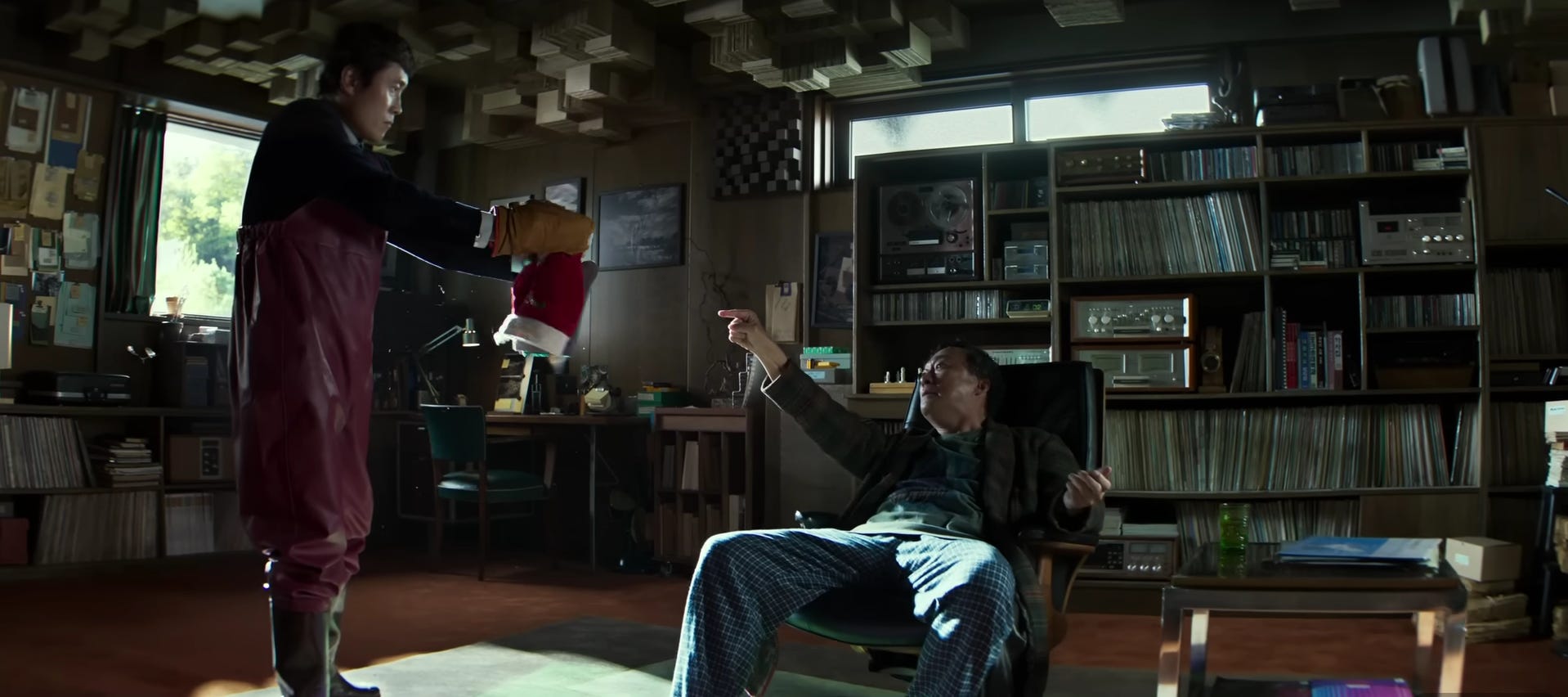
I was excited to start off the new year with a joint essay about two recent masterpieces of East Asian cinema, but for some reason I’ve been struggling to summon enough focus to get that done. Maybe it’s because I’m reading Deleuze and my brain is getting restructured by his schizophrenic approach to criticism. Maybe January is a bad time to write about movies. Or maybe there’s something off about the Twin Cities right now that I can’t put a finger on but is for some reason making it impossible to thread together more than three coherent paragraphs.
Whatever the reason, I’m struggling to write about No Other Choice, Park Chan-wook’s latest film about a man seeking vengeance for reasons that have something to do with capitalism. I have nothing bad to say about it. I found it somewhere between workmanlike and virtuosic. The story is solid and self-explanatory. The politics are agreeable. There are a collection of incredible shots that I could describe in writing, or you could go check them out yourself. Everything looks good, the performances are solid, it mostly justifies its runtime.
I just wasn’t particularly entertained by it. Park Chan-wook rarely does anything for me intellectually or emotionally, and No Other Choice is no exception. The funny parts are funny and the smart parts are smart, but the overall plot of “middle-class family man goes on killing rampage to secure job interview after getting fired b/c corporate restructuring/AI” feels - not necessarily overdone or irrelevant, but obvious? The same goes for Park’s now quite familiar camera choreography and his palette-perfect visuals. No Other Choice is getting sold on its “how did they do that?” shots, but I’m pretty sure the answer is “drones” and “post production.” I couldn’t possibly knock the incredible composition, the grace of movement, the beauty of the transitions, the color - but I’m somewhat at a loss for what all this virtuosity does for everybody.
Example one. There is an incredible aerial still shot of a coastal highway, filmed at nighttime, in which a rocky outcrop divides the screen in half. On one side are deep blue waves; on the other is a road bathed in red light that barely reveals the remains of a crime scene. How do you accomplish this angle, let alone at night, let alone with this color composition, etc.? Left vs. right, blue vs. red, nature vs. machine, zen vs. violence. OK. But what does this accomplish? Some movies just want to be beautiful, but there’s such a sense of destination in No Other Choice, and so little space for meditation, that I struggle to accept mere beauty as a justification for the showiness.
Example two. At one point, Lee Byung-hun digs a hole in the ground for reasons I won’t spoil but you can probably make an educated guess. The film cuts to his wife, tossing in her sleep. In a nearly perfect superimposition, she turns over in such a way that it looks like Lee Byung-hun is rolling her into a grave. Masterful. Clever. Sort of saying something - but not really that much, because Lee Byung-hun isn’t thinking about killing his wife or putting her at risk of death. If I’d been in a better mood I would have thought this trick was awesome, but I was so out of the movie by that point that I found myself rolling my eyes right along with Son Ye-jin’s non-corpse.
Gosh, I’m reading this over and realizing that I’m just being an asshole. Criticizing a movie because its shots are too good is an outrageous take. No Other Choice probably rules. I just want more than an adaptation of a stupid American crime thriller from a filmmaker as talented as Park. Maybe I’m tired of anti-capitalist critiques with no solutions, maybe I’m tired of murderers who are actually great dads/husbands, or maybe I’ve just reached my capacity for sequences of people stuffing bodies in trunks. I don’t need staggering innovation and radical challenges to the art of narrative to have a good time at the movies. But I do need something to shake off the sense that I’ve seen this one before.
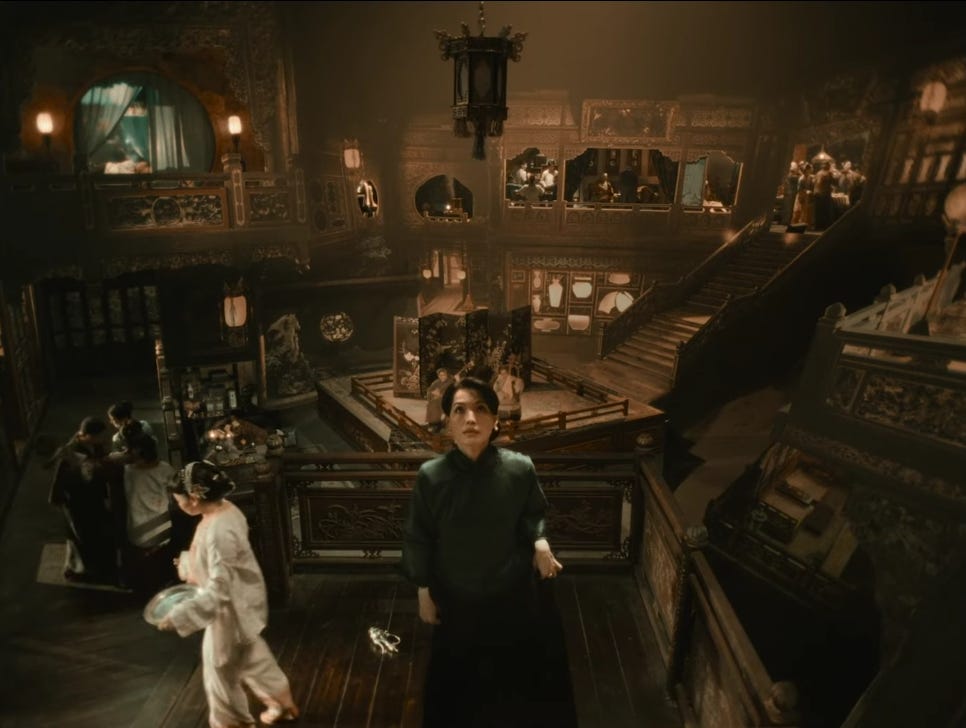
I can say with confidence that I’ve never seen anything like Bi Gan’s third film Resurrection. Unfortunately I don’t have very much to say about that one either, not because it’s boring1 but because I’m not smart enough right now to offer up any words. I am confident that Resurrection accomplishes a lot of extraordinarily interesting things, but it requires a working understanding of China, familiarity with Chinese cinema, and advanced knowledge of the history of film to access it. I’m a “no” on two of those and only pretend to be a “yes” on the third, so despite being in awe of Bi Gan’s talent I’m under-equipped to even write a summary.
Resurrection tells the story of a political dissident of the future who hides from some sort of thought police within the reels of 20th-century films. The dissident is caught by the feds at some point in the early silent era but, before his erasure, he’s given the chance to drift through the next hundred years of film, exploring five additional stylistic periods that also correspond to the Buddhist senses. If this doesn’t make sense to you, I don’t have the capacity to change that. Unsurprisingly, the result is a chin-scratching meta-film, but it’s saved from its own intellectualism by Bi Gan’s mastery of the cinematic form. For a cinephilic audience that’s so thirsty for spectacle that they’re willing to put up with Avatar movies, Resurrection should be the way, the truth, and the light. The astonishing inventiveness and beauty of Bi Gan’s 16-fps opening sequence, predominantly if not entirely composed of practical effects, is worth whatever million gallons of water were required to render James Cameron’s fake oceans.
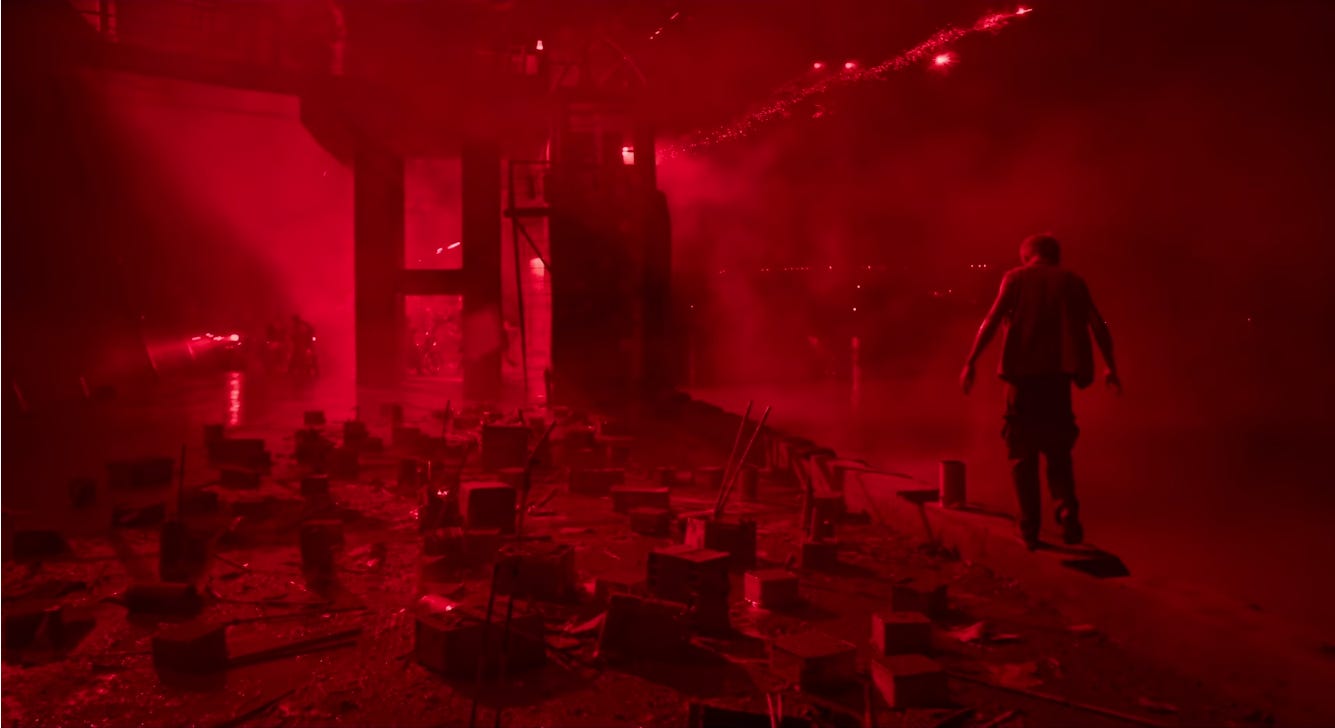
I found the middle 90 minutes of Resurrection’s nearly three hours to be interminably difficult, but any sense of frustration was completely overcome by the final 45. Bi Gan’s signature has become his prodigious long takes: his first film includes a 45-minute oner, and his second, Long Days Journey into Night, ends with a one-hour 3D shot that at one point travels down a zip-line type apparatus and then, as if that isn’t enough, flies away in what I believe is a hot air balloon. Resurrection’s long take is just over 30 minutes but runs through five hours of uncut footage. It supposedly took a month of planning and reshooting, and it is one of the most extraordinary things I’ve ever seen. If Long Day’s Journey’s conclusion is deliberately alienating, Resurrection’s has all the vitality of a Quentin Tarantino movie mixed with the stylistic precision of a Y2K dance music video. It moves inside, outside, out windows, up stairs, through karaoke sequences, into a dance party to Smile.dk’s “Butterfly,” onto a boat, and ends in perfect time to an astronomical phenomenon that proves it’s 100% real. I get the ardor for Park Chan-wook’s composition, but Bi Gan’s is so much more worth it to me, in part because it clearly plays into a cinematographic thesis, even if that thesis is too complicated for me to summon into words at the present moment. If this is where cinema can go now, where could it possibly go next?
Bi Gan doesn’t answer, and the conclusion of Resurrection is elegiac, sort of a Goodbye, Dragon Inn ending but the theater is made of melting wax. If the movie wasn’t called Resurrection, and if it wasn’t made in such a way where every shot seems to be exploring new frontiers of cinematography, it would feel like a goodbye to cinema. Instead it feels like a provocation. If its premise celebrates a certain form of nostalgia, its delivery manifests an exploding-outwards of the limitations of the past. Each of its phases represent an era of film that has supposedly come and gone. But none of those eras achieved a product remotely like Resurrection. We have so much left to do with the pieces we possess, and there are new pieces out there we can’t even imagine. Wax might melt, but it doesn’t all burn away.
I’m not doing Resurrection justice, and I wish I’d seen it at least two more times before it left local theaters last night. And as much as I don’t really care for Park Chan-wook, I’m underselling No Other Choice too. Both of these films are worth much more than five paragraphs, and I’d encourage you to go see them to find out why (getting to Resurrection might be tricky). Read some criticism after you go, and then maybe send me some links so I can get a new lease on life and remember how to write about movies.
As it is, my brain is fried and I have nothing else to say. I guess it’s exciting living at the heart of national attention for the second time in five years, but it doesn’t do much for your ability to do your job. Much less your fake job. Much less your chores. How many people in Minneapolis still have their Christmas trees up? I would venture a lot.
In case you want to see where my head is at right now, I present without commentary the complete discography of Lana Del Rey but instead it’s Kristi Noem:


There are a lot of ways to process. Stove comes out at the end of the month, supposedly? Don’t lose heart, good things are yet to come. Until then, it’s gonna get cold this weekend in Minnesota. If you’ve been visiting, consider going home.
Thanks for reading *life is disappointing.* If you found this newsletter slightly less disappointing than the rest of your life, consider liking, commenting, sending me money (thanks!) or subscribing. Subscribing will get you exactly what you get here but sent to your email inbox. We’ll be back next week time with thoughts on either Bone Temple, the new Jim Jarmusch, or both - or maybe neither, who’s to say.
Though honestly, it’s a film that includes a two-minute shot of snow falling set to the sound of someone snoring. It’s hard to describe parts of it as anything other than boring.
Ben, my heart goes out to you. Reading this essay through tears, and yet, I endorse your closing words: Better times will come, and you'll live to see them.