
makin movies, big adventure
brad pitt divorced-dads his way to the deutsche bank in F1 // jurassic world: rebirth solidifies steven spielberg's legacy as the only person who knows how to make movies

My goal with this newsletter is to write about new films as they reach general release and to feature seasonally appropriate commentary on other cinematic events and interests. This week we’ve got an attempt at saying something constructive about two of the summer’s most successful movies, F1: The Movie and Jurassic World: Rebirth. This newsletter comes out every Wednesday, which as usual means Friday.
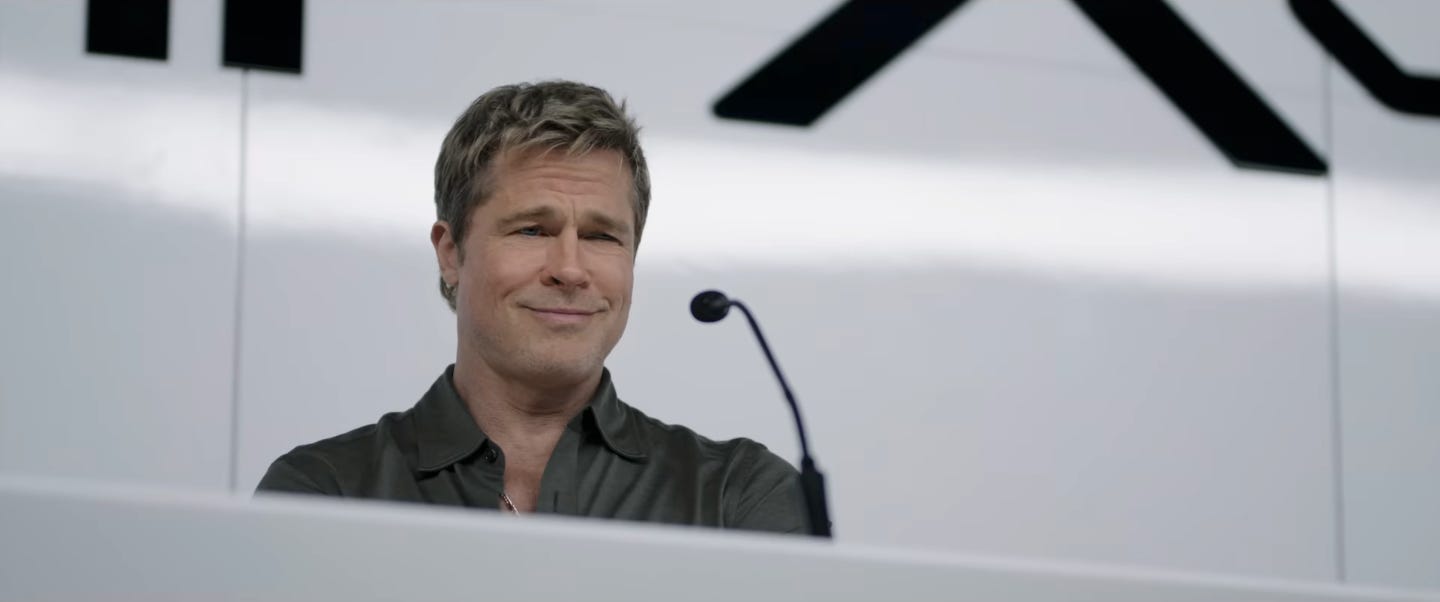
Of all the disturbing components of the F1: The Movie media blitz, this is the one that haunts me:
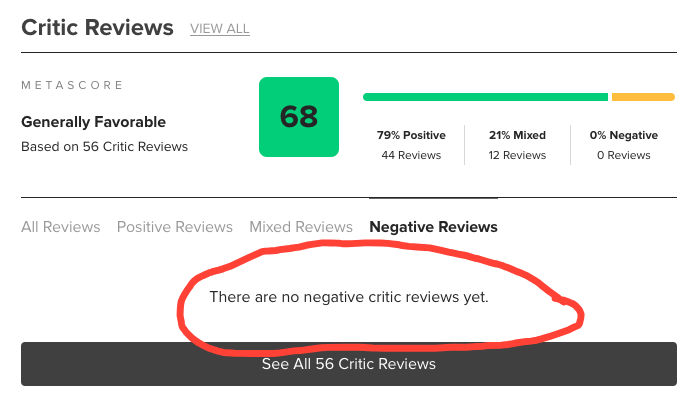
It's not out of the question for a massive blockbuster to have no negative reviews on Metacritic (Sinners, Final Destination: Bloodlines, and How To Train Your Dragon are all in the same boat), but it's still upsetting to see such blatant evidence of critical payola1. Film reviews exist to endorse crap with good press packets, but we rarely get a movie whose reception is so obviously defined by the success of its PR objectives at the sacrifice of consumer entertainment.
Other than nominally being a movie, F1: The Movie (directed by Top Gun: Maverick’s Joe Kosinski) is two things: 1.) a two-and-a-half-hour advertisement for the Fédération Internationale de l'Automobile (FiA), an organization that hosts a car-driving activity called Formula One - and 2.) a major component of the summer reputation laundering of Brad Pitt, an American actor who recently tied up an eight-year divorce trial that includes multiple abuse allegations and has resulted in all of his adult children removing Pitt from their surnames. As an American, I reserve my right to not give a crap about Formula One racing and to know all of the lurid details of Brad Pitt's personal life. F1 seeks to deny me of both.
I learned from F1 that Formula One is an activity in which a group of extraordinarily wealthy people pay automobile manufacturers to produce car-esque machines that drive fast around an etch-a-sketch attempt at a circle 30 or 40 times. In that it’s a competition to determine which corporation can amass the best technology and deploy it most efficiently, it seems pretty contradictory to the American definition of sports. I have never successfully completed a three-point turn, so I get that driving is hard and requires a fair amount of physical prowess. But F1 seems to be less about driving and more about finding out who can spend the most money on car parts. To admit that it could be a viable sport in America is to subsume ourselves to the cultural hegemony of investment capitalism, which I realize is sort of what we are into these days, but I think we still have the decency to say the quiet part just a little bit quietly.
Kosinski unintentionally exposes this tension by building F1 around the classic American sports plot: Sonny Haze is a washed-up loser with an ambiguous country accent who gets called out of Daytona by a European investment ghoul (Javier Bardem) to pull his floundering F1 team out of a $350-million hole.2 Bardem’s team thinks Sonny is an American loser, and Sonny thinks the rest of the team are European douchebags. Eventually they learn to work together by manipulating the rules of F1 in a way that won’t get them called out for cheating, sort of the car equivalent of the Oklahoma City Thunder. In the end, Sonny ends up in a situation where he needs to use his God-given talent and emotional drive to win a race on his own merits. You won’t believe what happens.
If you need to sell a mega-capitalist European leisure activity to Americans via a corn-fed audience surrogate, you’re kind of whiffing your sales pitch. Maybe I’m missing something, but the idea of Brad Pitt The Rookie-ing his way to victory seems contradictory to the Davos-y landscape of Formula One. A story that was invented for baseball and football movies grafted onto a game for princes doesn’t make any sense. America already has a wildly popular car-driving format that leans into the seed-chewing vibe. Why would we want to bring that into a league that’s actively disinterested in democracy?
Kosinski thinks this can work because his bridgemaker is Brad Pitt, an actor with a unique ability to play bumpkin and cosmopolitan sex symbol at the same time. The problem is that Pitt learned to do this in 1991, and instead of aging three decades he’s dead-set on convincing us that he’s still a late-20s louche and not the divorced dad of six. I don’t understand how these ‘90s guys missed the memo that becoming a grizzled mid-60s action star is pretty much the coolest/sexiest/easiest thing for an inherently beautiful man to do, but none of them seem to know who Harrison Ford is and take all their skincare tips from Mickey Rourke instead. Pitt’s charm is burnt out, his face is lifted like Elphaba at a community theater production of Wicked, and he regularly gives off the energy of a guy who’s one step away from saying that his favorite part of being a father is makin’ movies big adventure.
If I was writing this review on time I would say that this movie has no chance of critical or box office success. Obviously I’m not, and I’m wrong: F1 is doing great. Plenty of people will never see this movie but will nevertheless be affected by the shrapnel of its campaigns. Formula One will continue to scrounge for American streaming deals, hanging around hoping on futures until it either fakes it into making it or ends up on Fubo. Meanwhile Brad Pitt will linger on the A-list as he smooths his face past the point of familiarity, hoping that proletarian fears of adrenochrome will be outmatched by an aesthetic shift toward plastic transhumanity as Gen-X enters old age.
This is the wretched future that the entertainment press wants us to accept, but I have a fundamental belief in the American people's ability to not give a shit. People are going to see F1 because it's something to see, and the coverage is going to insist that it's a resounding success because it has an incredible PR team boosting it up. Don't believe these lies, even if they're true. F1: The Movie is boring and it sucks. F1: The Activity is a reminder that European capitalism is every bit as crass as its American cousin. Brad Pitt is a loser whose best days are behind him. Affix your tinfoil hat firmly and don't let the chemtrails get in to convince you otherwise: nobody needs this. It is your duty as an American to refuse it.3
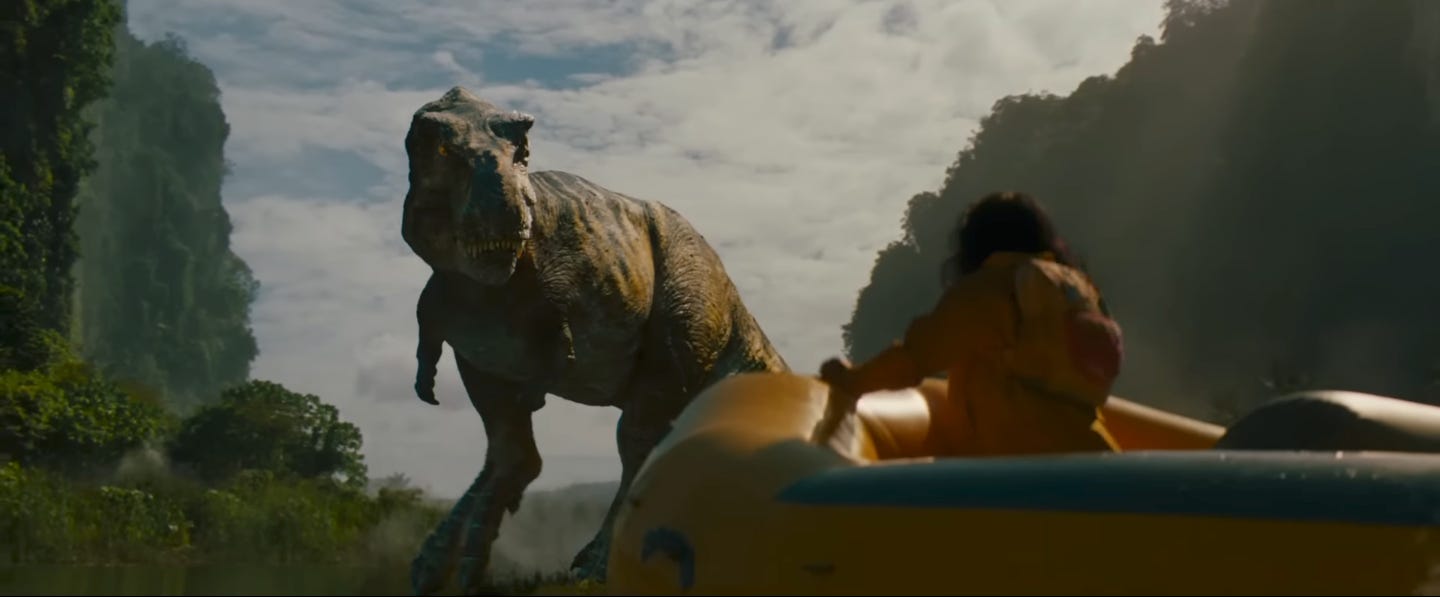
I'm not going to waste my fingers or your time with a genuine assessment of the cinematic merits of Jurassic World: Rebirth. You already know: it’s a sloppy re-re-reboot composed of callbacks to the (2023 Movie Bracket winner!) Jurassic Park, written by David Koepp (who could only manage one good screenplay this year, I guess), directed, if you can call it that, by CGI guy Gareth Edwards, and featuring the moving bodies of Scarlett Johansson, Mahershala Ali, and Jonathan Bailey. It’s a nearly scene-for-scene recreation of the original except for a plot about extracting blood from the three biggest dinosaurs in order to cure heart disease, a premise that I struggle to discuss in a way that doesn't include words that shouldn't be put into writing.
That said, the synergies between Rebirth and the original provide a great opportunity to explore what separates a perfect action movie from a middling one. Jurassic Park isn’t exactly an incredibly written film either - but it's still a taut and deeply coherent action masterpiece that holds up just as well in 2025 as it did in 1992. Why does it work? The answer (or at least one of them) is continuity editing, the art of mashing together a montage of shots to create the sense that something comprehensible is happening onscreen. Steven Spielberg is extremely good at this, and it’s worth it to look at how he does it - and how many modern action movies do not.
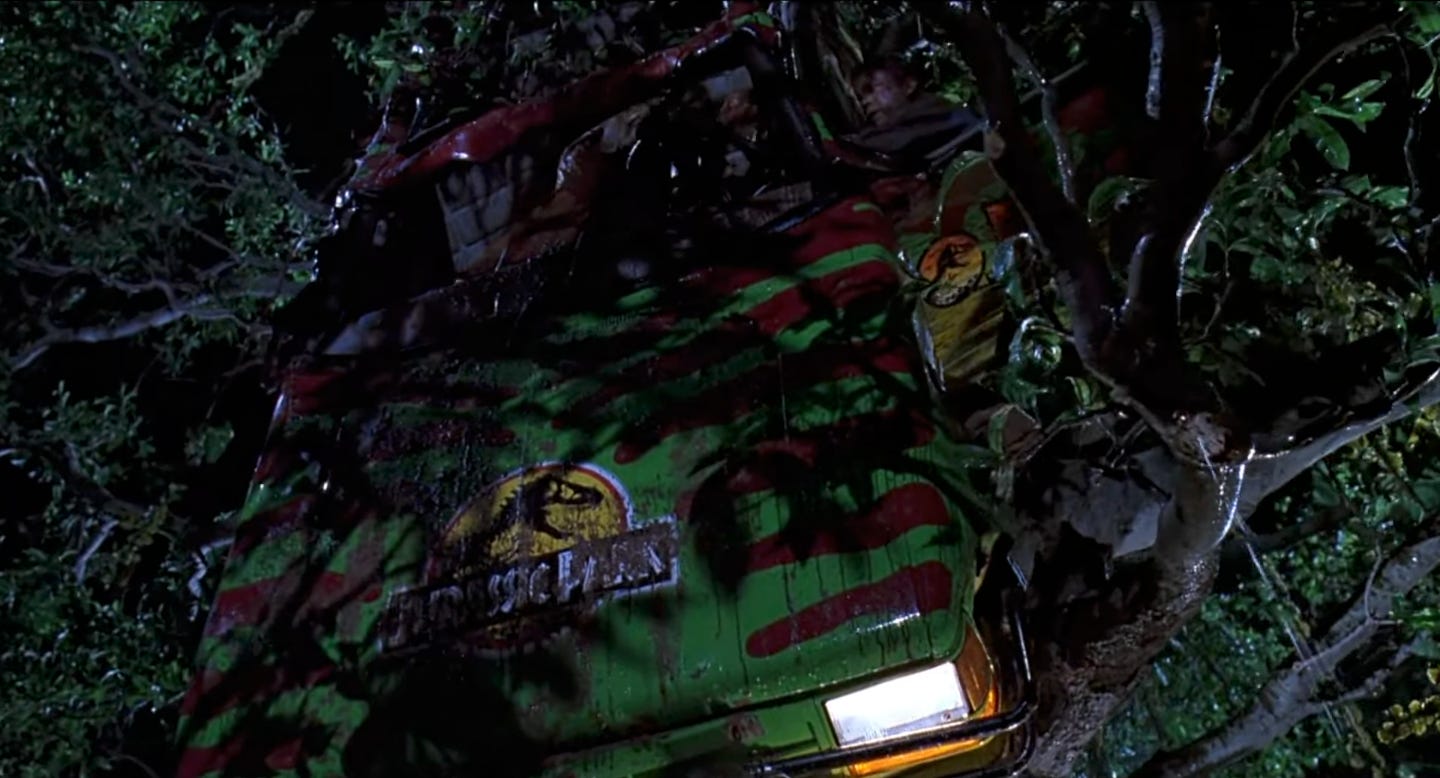
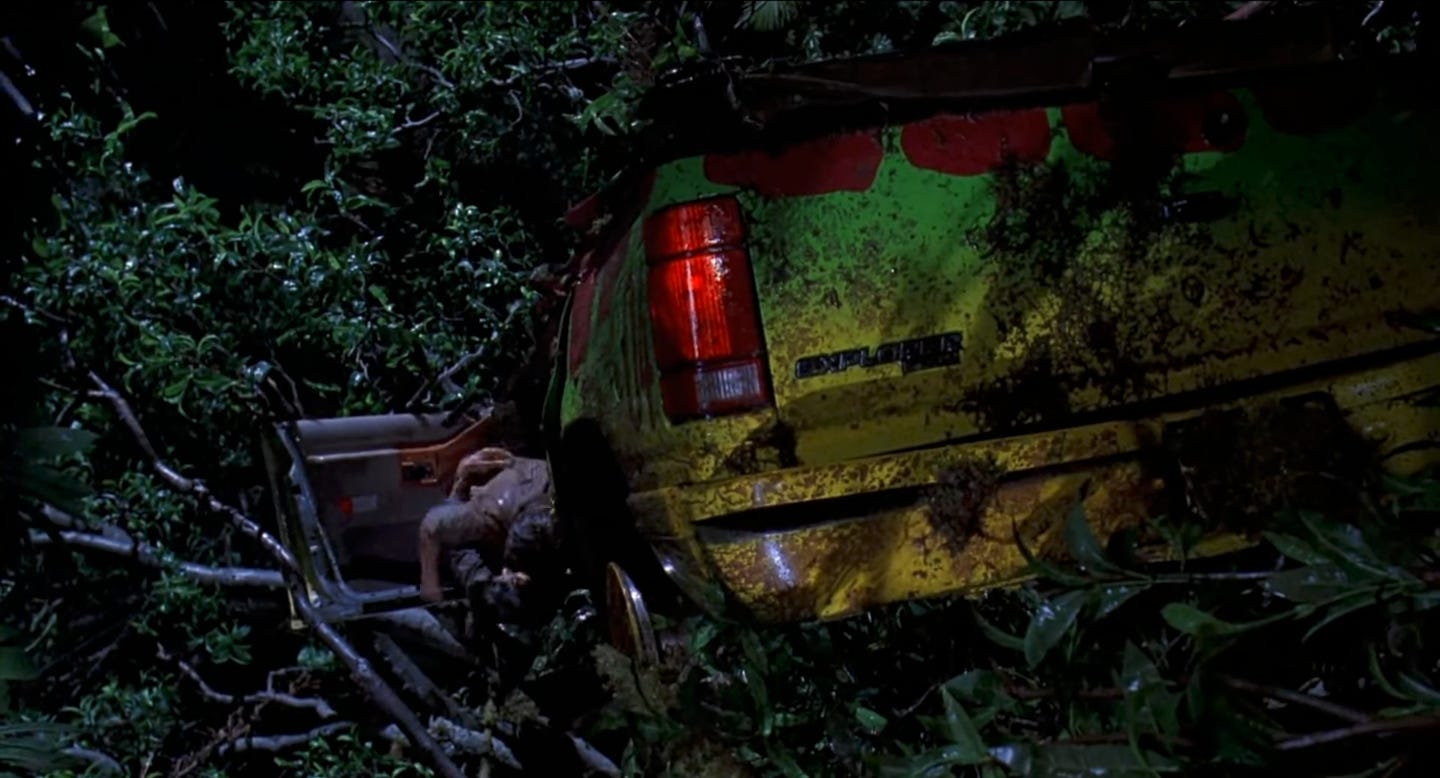
One of my favorite sequences in Jurassic Park is the scene in which Timmy and Alan race a plunging Ford Explorer down a tree. This is an insane scenario that no one other than Steven Spielberg had ever thought about. Spielberg knows that, so he uses baby-brain editing techniques to guide us along. The sequence is edited like a classic shot/reverse-shot conversation scene, repeating the same angles over and over again (Explorer from below with actors in the foreground, Explorer from above with actors in the background, Explorer and actors shot level as they descend through the frame) to give us a clear sense of space in an outlandish situation. Movements and the characters' awareness of those movements are conveyed through reaction shots that are immediately followed by cutaways to the changes that brought them about (Alan bumps the steering wheel; cut to the front wheel turning, loosening itself from the crook of the branch). When the physics shift at the end of the sequence (the car falls forward, landing upside down) there’s a shot from above to clearly establish the unfamiliar motion, setting us up for a Buster Keaton finale that’s both surprising and completely comprehensible. That all of this also develops character and incorporates both pathos and humor is the reason that people refer to Spielberg as "magic."
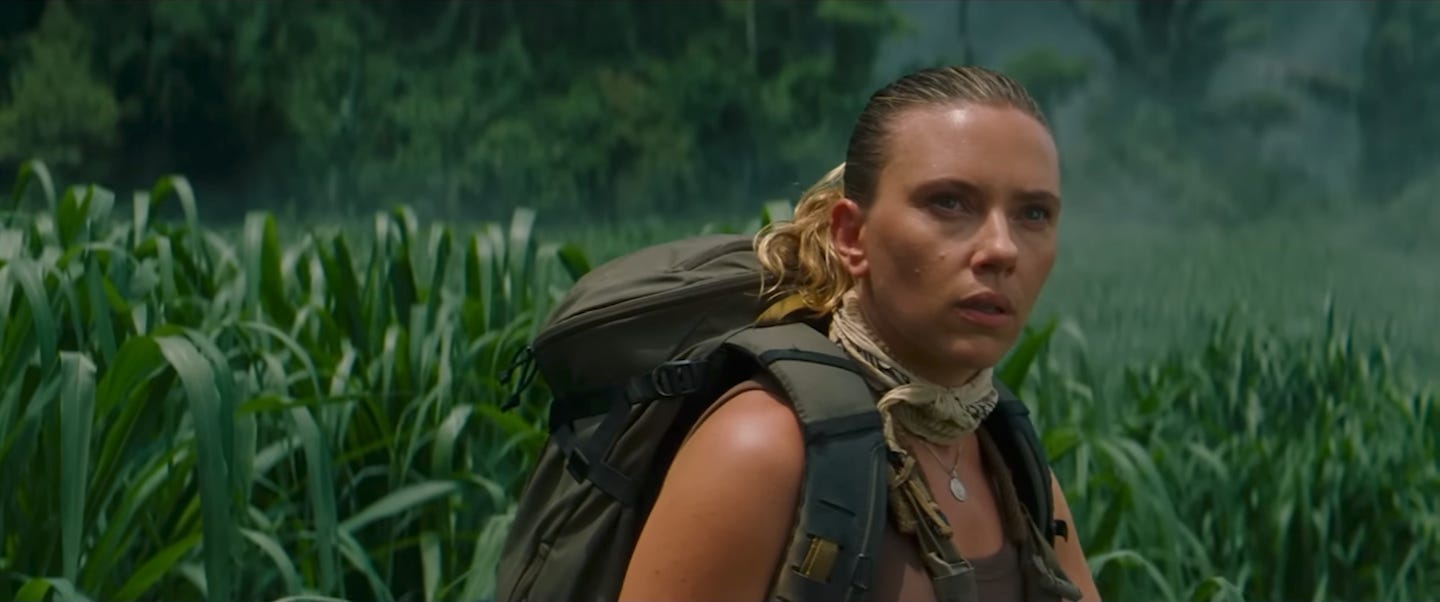
Compare this to the scene in Jurassic World: Rebirth in which Scarlett Johansson and two other characters descend a cliff face. A mix of long and mid shots are frequently interrupted by the chatter of two extraneous characters doing something else at the top of the cliff. There’s a moment when the camera pans over the cliff edge that almost captures a sense of vertigo, but it disappears intermediately as we cut to ScarJo cracking lame jokes while grappling down what appears to be the wall of an indoor climbing gym. Eventually Jonathan Bailey falls to what should be his death, but we instantly cut to some clattering tree branches that inexplicably break his fall. As if to undercut all remaining tension, the other two characters find a secret staircase and run down to meet him as he hits the ground. Never am I given a sense of the cliff’s height, what’s required to descend it, or how hard anyone is working to get to the bottom. A bunch of things happen, but I’m not sure how they’re connected or why.
What about dinosaurs? Let’s look at the famous “raptors in the kitchen” scene from Jurassic Park:
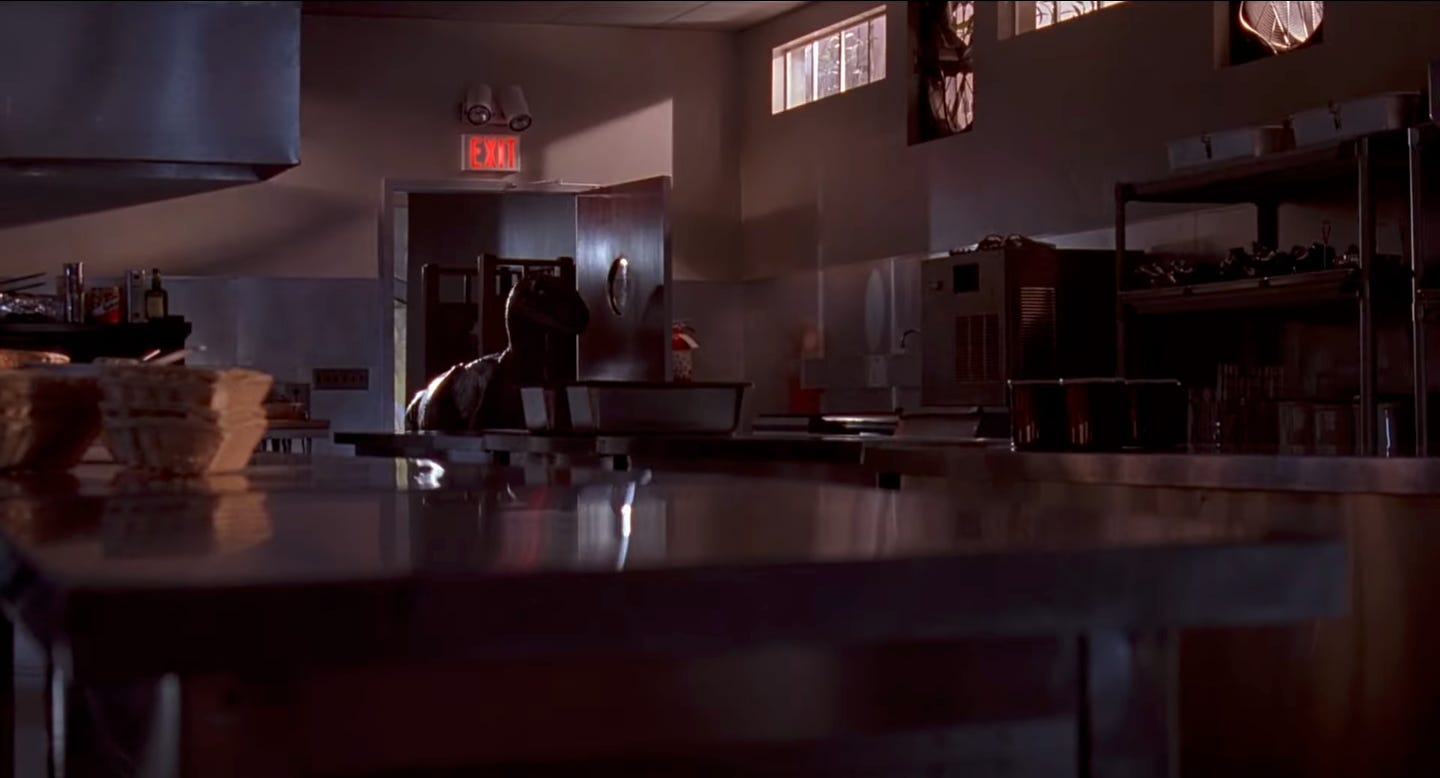
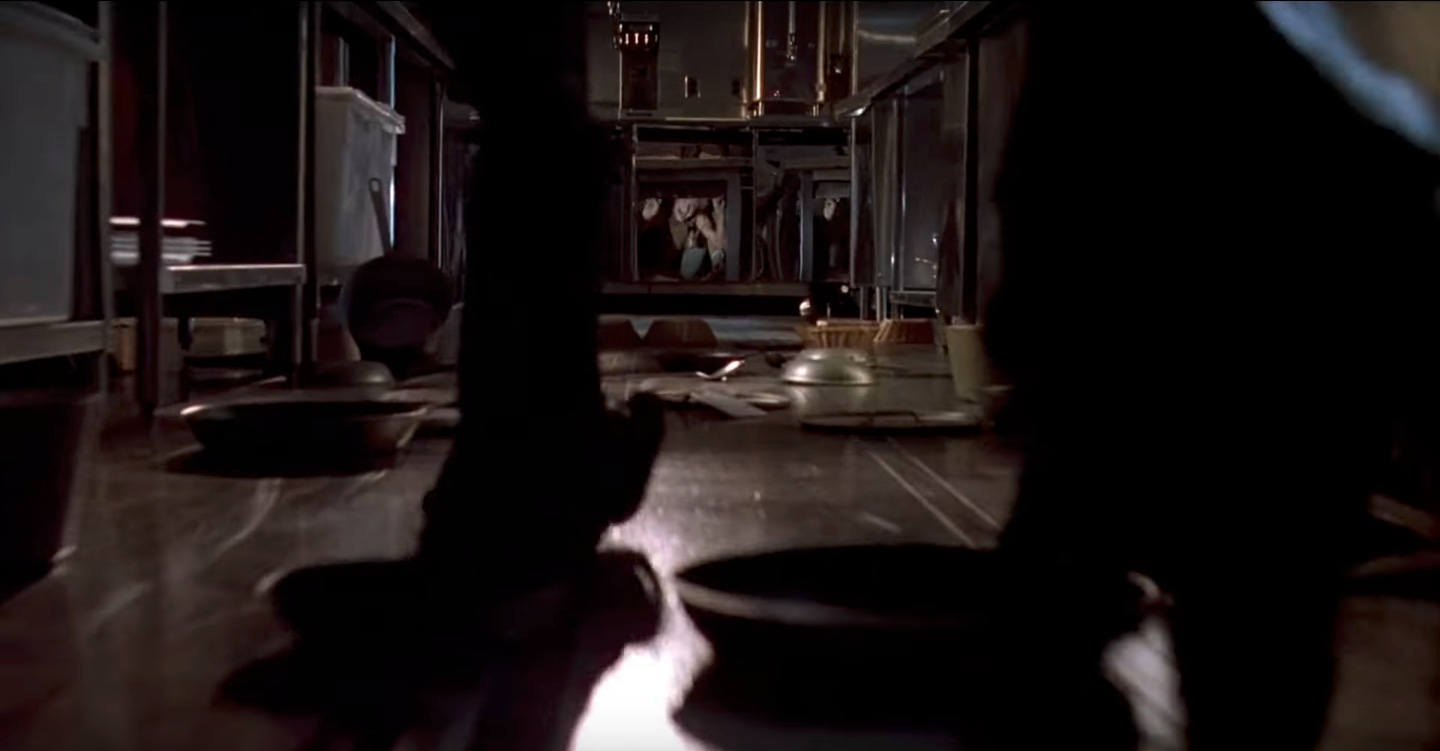
We start out with a wide shot of the kitchen as the raptors open the door. In just a couple seconds, Spielberg teaches us exactly where Timmy and Lex are in relation to the raptors and how those two parties will interact within the cramped quarters of the kitchen. An establishing shot isn’t exactly innovative filmmaking, but Spielberg uses every subsequent shot to reinforce the physical limitations of the space. When a raptor swings its tail and knocks over a bunch of pots as the kids crawl underneath, we know exactly why that happened: the raptor is big, the aisle is narrow, and the counters have a bunch of crap on them. In the scene's most elaborate shot, we watch from between the legs of a raptor as it charges toward Lex, who has gone and trapped herself in a dishwasher. We cut to a new and momentarily incomprehensible angle as the raptor slams into a metal wall; the image of Lex is just her reflection, and the camera quickly pans to catch her climbing out of the dishwasher across from the mirror, giving us no opportunity to linger in our confusion. Throughout the entire scene we’re handed constant reminders of everyone's physical and mental limitations (hobbling, screaming with your hands the air, sliding on ice, being a lizard), and we're never once confused about where we are or what anyone is capable of doing. How good is this scene? So good that you can probably remember every shot of it without having to re-watch it.
Rebirth, in contrast, has no grasp for the stakes or spatial realities of its dinosaur interactions, a major setback of replacing animatronics and real sets with digital renderings and green screens. This is most obvious in any of the many scenes in which a dinosaur sneaks up behind an unsuspecting human. The most egregious comes early on when a spinosaurus scampers past a non-existent character on the beach. Does she notice it? Is this a problem? Nothing about the camerawork indicates the vaguest sense of spatial relationship between these two entities until one is in the other's mouth. In a more important and aspirationally iconic scene, a character sneaks by a sleeping T. rex to get a life raft. Her progress is regularly interrupted by cuts to her anxious family. Does she notice the T. rex? Unclear. Eventually she gets the raft and inflates it with her back turned. The raft pops up between them just as the T. rex wakes up; when the raft falls back to the water, the T. rex is gone. What is the point of this? The girl’s body language suggests she knows about the dinosaur's presence, but everything about the semiotics of the sequence suggests that that she doesn’t. When the T. rex shows up again, any sense that the dinosaur and the girl exist in the same plane of existence is out the window, and with it goes any ability for the audience to care about what happens to either of them.
What you get from all this is a movie that looks like a high-concept Liberty Mutual commercial. The camera jumps around with no real regard for narrative and establishes nothing but chaotic scenarios that aren’t grounded in time or space. You don’t need continuity in an insurance ad, but it’s pretty necessary in a two-hour film. It’s fine if all you need is a theater to cool off for a couple hours on a July afternoon, but in a world where you can pay $4.39 to re-watch Spielberg-crafted dinosaur montages in whatever climate-controlled space you’d like, it doesn’t make much sense to acknowledge Rebirth’s existence. Is that mean? It’s already made enough money to cancel out Javier Bardem’s Formula One debt, so I’m not feeling too charitable.
Thanks for reading *life is disappointing.* If you found this newsletter slightly less disappointing than the rest of your life, (or at the very least less disappointing than this dogshit July box office), consider liking, commenting, sending me money (thanks!) or subscribing. Subscribing will get you exactly what you get here but sent to your email inbox. We’ll be back next week, probably with some reluctant thoughts about Superman.
This is libelous; there is no evidence of an actual payola. But it seems obvious to me that there is some really juicy PR work happening to get the entire world of critics to say that they aren’t bored by a 150-minute film with no character development or coherent plotting, and for all of them to turn a complete blind eye to what is clearly a career-low Brad Pitt performance.
I don’t know where these assholes get the idea that you can create a sympathetic character who is capable of being more than a quarter-billion dollars in debt, but that’s the sort of world they’d like us to live in.
H/T to Hunter Harris and Allie Jones for their relentless reporting on the Pitt’s image laundering, and to Angelica Jade Bastién for breaking the mainstream seal and calling bullshit in Vulture.