
sing to me of myself, muse
we all saw THE ODYSSEY // and also some self-indulgent thoughts about the internet, contemporary film criticism, and how i could probably benefit from therapy

My goal with this newsletter is to write about new films as they reach general release, along with seasonally appropriate commentary on other cinematic events and interests. This week I’m obviously writing about Christopher Nolan’s The Odyssey, a fairly faithful adaptation of a text that was first transcribed around 3,000 years ago and is well passed the statue of limitations for spoilers. After that I’m going to cry in public for awhile and you can read about it. This newsletter comes out on Fridays, but stick around for an exciting update to that fact.
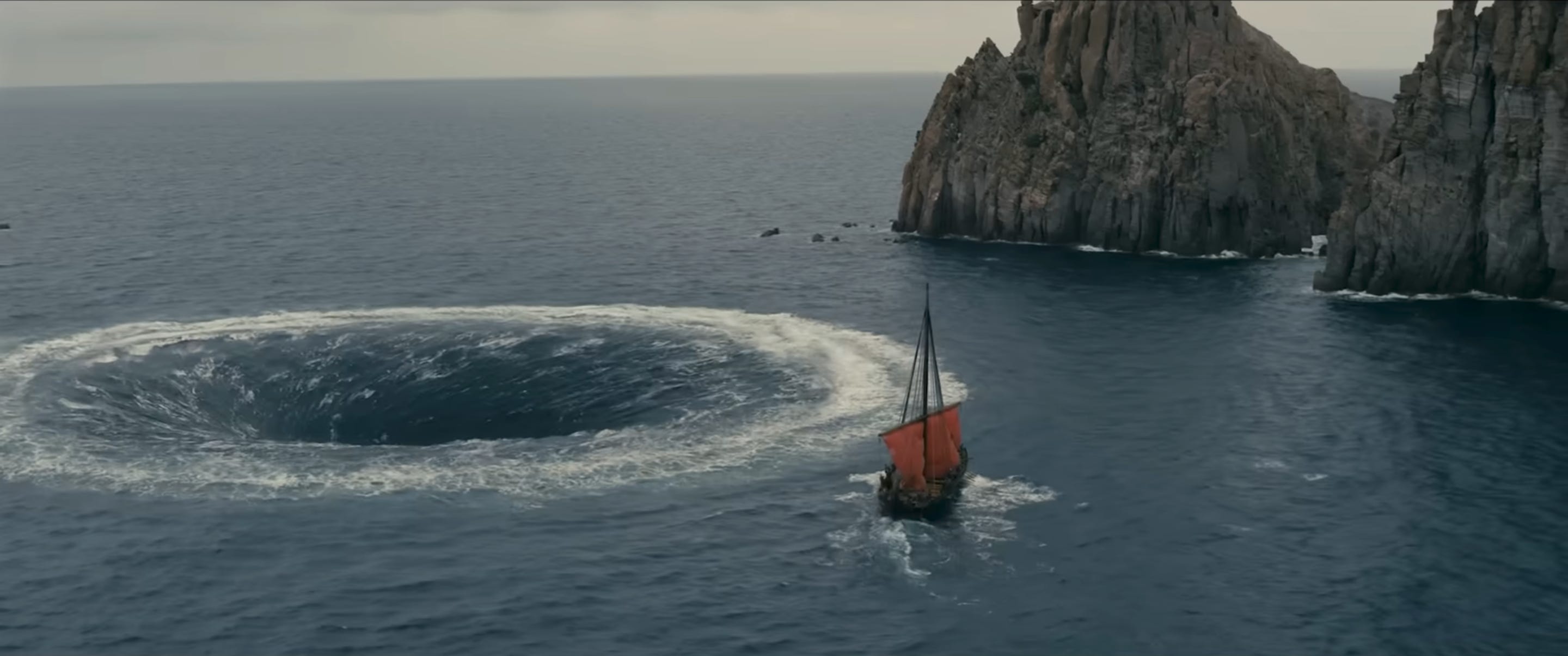
Because The Odyssey is pretty uncontroversially the foundational text of Western civilization, it’s natural that it ends up being everybody’s text - and that any interpretation of it, whether it’s a translation, a modernist novel, an Arthur episode, or a major Hollywood epic, is going to feel personal. It’s a story about every-thing, so anyone who tries is going to end up making it about *their* thing. This goes for artistic reinterpretation as well as critical interpretations of those reinterpretations. You stare into the Charybdis of the universal and it’s hard not to end up in your own Scylla’s mouth.
Artists/critics with coherent ideas can successfully escape the almost certain death of this dilemma. You’re probably going to fail, but at least you can dig into an idea and run with it - a single episode in isolation, an application to a new setting, an altered storyline that plays its tension against the canon to maximize new themes. Even James Joyce’s “book of everything” dialed in on one day, one city, one life event to demonstrate how the universal is present in the inane. The beauty of interpreting The Odyssey is that pretty much anything goes. Homer tells the simplest story possible (guy goes to work and comes back), lets it spiral in a million different directions, and then hands it over to his listeners (and eventually, readers) to do whatever they like with it for the next three millennia. The only thing you shouldn’t do is all of it. The hubris of doing all of it is one of the many things the story is about.12
Christopher Nolan isn’t a greatest-mind-of-his-generation hubristic type, and overambition doesn’t wear charmingly on him they way it might a Welles, a Coppola, or a Joyce. He’s also not an artist with coherent ideas, focus, or the capacity to develop themes. This is rude of me to suggest and there are a lot of people who hard disagree with me, I’m sorry, I regret writing it. But I comfortably maintain that none of Nolan’s movies are built around interesting ideas, and that all of them disguise this fundamental absence with choppy editing, incomprehensible sound mixing, and disorganized timelines whose deliberate confusion-making convinces people that something is happening. It’s childish to walk out of a work of contemporary art complaining that it doesn’t make sense and therefore the artist must be full of shit, but this isn’t that, an AMC is not the Dia Beacon. No one leaves a Christopher Nolan movie feeling decentered. Instead you feel like something amazing just happened because the music cues say it did, but actually at the core is an empty narrative that is only made to feel compelling because it’s been told in a way that’s contrary to actual lived experience. Every Nolan movie could be edited into standard chronological order, and all of them would be terrible if you did, because then it would be obvious that there’s no actual tension, nothing actually being said. Nolan built his gravitas on a handful of legitimately astonishing set pieces surrounded by obscurantism and middlebrow themes. If you like set pieces, puzzles, and contemporary literary fiction, then this probably works for you and that’s fine. Christopher Nolan isn’t for dumb people, he’s for normal people, which is everybody sometimes, including smart people. Would anyone thinking about film in a serious way say that a single Nolan movie is better than, I don’t know, Persona? No, but sometimes you want to take a hack at translating Linear A and sometimes you want to do a crossword puzzle. Christopher Nolan makes Thursday NYT crossword puzzles.3
Or at least he used to. The Odyssey, like Oppenheimer, is a low-difficulty Sunday, not actually harder than any other day of the week, just 35 frames bigger. Sunday puzzles are usually the worst of the week because size, when you’re dealing with something that is ultimately without substance, doesn’t make things better - it just means that the substancelessness exceeds the capacity of the construction. Like a Sunday puzzlemaker, Nolan constructs his latest puzzle around a central theme - the loss of civility and the decline of Western civilization - and fills in the gaps with ALOEs and ACAIs and ETAs and ORAs, a bunch of little ideas that fill the space necessary for the soundtrack swell but hardly amount to anything meaningful.
Some of those fillers are narrative, others artistic. One of the latter is the supposed 100% use of IMAX cameras, which Nolan engineered to be silent and small in order to work like handhelds. This is a remarkable technical feat, but one that serves - what? I believe in film as a superior capture medium, I believe in the use of ponderous cameras and the subtle effects they have on the process of moviemaking, I even think it would have been cool if Nolan had said I don’t care, let’s just release this in the forty theaters that can show it and if you can’t see it well, whatever, who said film had to be a populist medium? But how does this camera materially unite with the film that it’s creating? What does IMAX say about The Odyssey other than this story is Very Big? Why ultimately does anyone give such a shit about a 1.43:1 aspect ratio?4
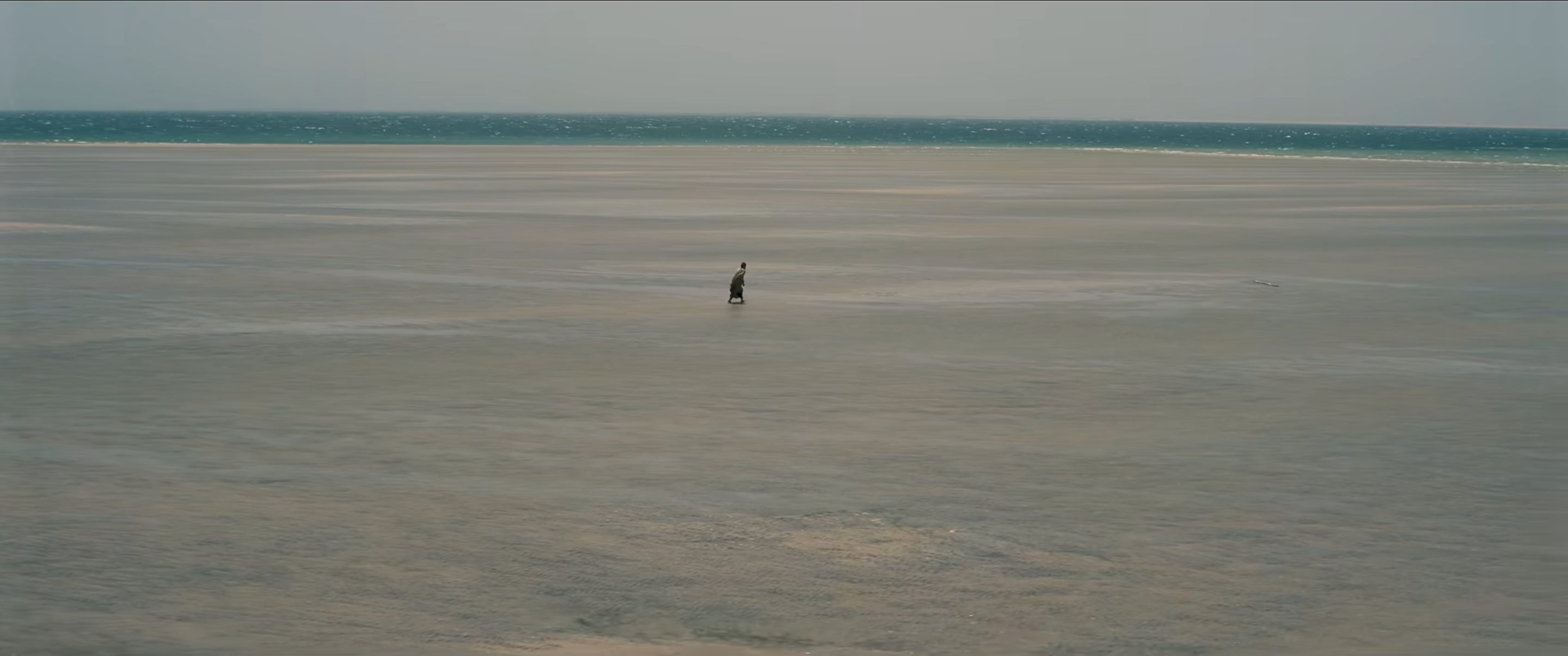
The same goes for casting. There are a million name-brand actors onscreen, a few of whom I was actually able to recognize. All of them are in different movies. Tom Holland is confused why the Avengers wear togas now. Zendaya is confused why she’s being asked to stare pensively into the camera without blue color contacts. Anne Hathaway is in a high school production of Antigone. Charlize Theron is in a perfume ad. Benny Safdie is in a WWE intro. Robert Pattinson is doing something else and we should probably just let him live. And Matt Damon is at the center doing nothing at all, which is all he’s ever done. I imagine filming a dialogue scene would reveal these incongruities, but it’s so rare that a shot of someone saying something is followed by someone in the same room responding to them that it’s not surprising it all got lost.
Everything in this movie is lost. That could have been an interesting theme to explore, the Odyssey is about a guy who gets lost, what if my cinematography, casting, and editing decisions reflected that? Instead Nolan makes it about the contrast between hospitality and brutality with the Trojan horse as his core image, I guess a fine theme to focus on but also the Trojan Horse is not actually in The Odyssey, so why did you make this movie?
There’s so much to work with here, and somehow Nolan wastes it. The Odyssey is a text with lines of staggering beauty like this encounter between salt-scummed Odysseus and teenage savior Nausicaa:
Wonder takes me as I look on you. / Yet in Delos once I saw such a thing, by Apollo’s altar. / I saw the stalk of a young palm shooting up. I had gone there / once, and with a following of a great many people, / on that journey which was to mean hard suffering for me. / And as, when I looked upon that tree, my heart admired it / long, since such a tree had never yet sprung from the earth, so / now, lady, I admire and wonder, and am terribly / afraid to clasp you by the knees.5
There was no part of me that expected the Phaeacian sequence to make the cut, and I knew all the quiet moments would be covered up by Hans Zimmer bwamps. But Homer’s text also contains lines like this:
At the same time, noble Odysseus / shot an arrow, and struck him in the chest, by the nipple, / and the speeding arrow fixed in his liver, and his sword tumbled / out of his hand on the floor, as he, sprawling over the table.
and this:
The floor was smoking / with blood, and the horrible cries rose up as their heads were broken.
Some of the most visceral gore ever written, often in hideous anatomical detail. And though Nolan spends as much time as Homer on Odysseus’s climactic slaughter, his version is a dimly lit fight without a hint of splatter, squelch, crack, or goo. I don’t think there are even any nipples.
None of the beauty, none of the quiet, none of the poetry, not even any of the guts.6 A sexless, bloodless Odyssey isn’t really an Odyssey at all. That’s not exactly true, because what’s left in Homer’s text after you remove the muses and the material is conversation, which, if you want my interpretation, is what the story is actually about. This is a poem about chatting and hanging out. It starts with a meta-textual call to sing and it ends with a diagetic conversation in bed. In between is basically nothing but transcripts of conversations - praises, oaths, recollections, visions, politicking, talk talk talk talk talk. But Christopher Nolan has always been fundamentally uninterested in the way that human beings speak to one another. If there’s one thing he truly can’t do, it’s recreate the audiovisual experience of a conversation.
So of course he couldn’t make my Odyssey, and of course I never expected him to do it. We just aren’t into the same stuff, I can deal with that. But when you’re adapting a text that includes pretty much everything there is to say about humans in the world, you might try to make a film that addresses something about humans in the world. Instead, for all his adoration of analog tech, Nolan’s films are some of our dullest reflections of digital-era alienation - simulacra of interaction, space, and time, decontextualized and mathematically recreated, hinting at some form of connection but obfuscating via false complexity an embarrassment that, at the heart of it all, there’s nothing really there.
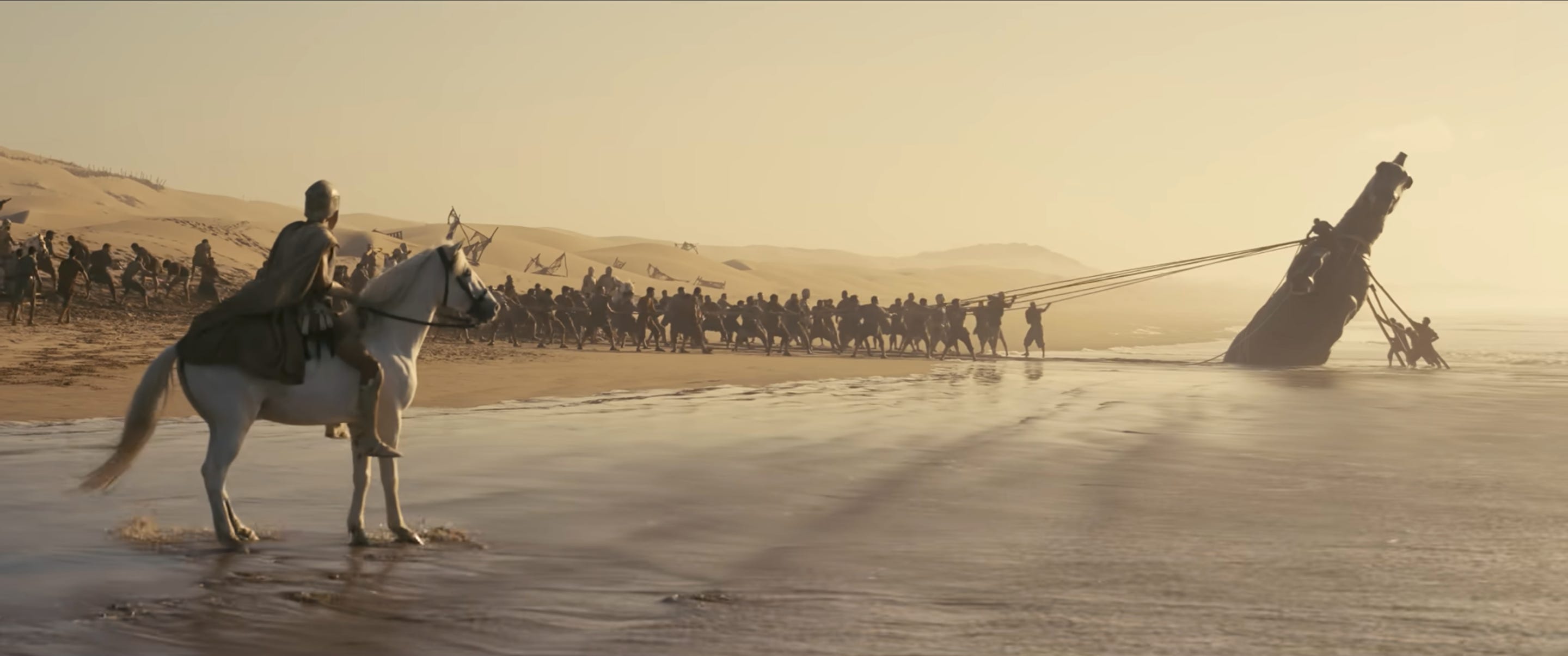
This is a mean-spirited review of a movie that should be making me happy - a large-scale, analog production starring many people I like based on a text I care about, transformed into a summer event that is trouncing Minions, live-action Disney remakes, and sequels to James Gunn movies. I’ve been having a wonderful summer and am really not about putting negativity into the world right now, especially regarding something that is allowing a lot of very fine people on both sides to have a nice time.
Clearly, I’m acting out about something. Which is that I am exhausted by the way that the internet thinks, talks, and writes about movies, and I am sick and sort of embarrassed by my participation in it. When I started this newsletter my motivations were 1., create a regular writing practice that people would be interested in reading; 2. create a portfolio to convince Condé Nast to hire me as their first ever part-time employee with health insurance, 3. put something with some intellectual integrity onto an internet that always already killed itself through striving, echo-chamber groupthink, and phony claims at expertise. My private commitment at the beginning of this newsletter was to never write about something as if I knew what I was talking about unless I actually did - no references to movies or things I hadn’t read, no looking things up on Wikipedia as I was writing to fill in elisions/caesuras with quick facts, and - most importantly - no repetition of the inherently commercial claims of mainstream film criticism, which has always been a wing of the studio system whether the writer realizes it or not, a way to take people with some degree of intellectual integrity and transform them into parrots for preferred studio stances in exchange for clout and access. I’ve since broken all of those rules. The worst was when I wrote a review of Project Hail Mary that said, a. this movie is good (I don’t really like it), b. it’s cool that this movie is financially successful (why should I care?), c. Ryan Gosling has a bad face lift (I just heard some people say that, I have no idea what Ryan Gosling’s face looks like), d. that Ryan Gosling has finally become a viable leading man (something he’s been for years, he’s a household name and the star of multiple Best Picture nominees). This last take was the one that embarrasses me most and one that I sometimes wake up in the middle of the night thinking about. It’s clearly a line from Ryan Gosling’s camp that has been fed into the ether, repeated by dozens of film critics, trade analysts, and podcasters, and eventually said so often that people with literally no skin in the game are repeating it just because it seems like its the way to be in the know. At least that’s why I said it.
This is garbage criticism, just as market analysis is garbage criticism, just as listing all the movies you’ve seen that sort of remind you of the movie you’re talking about is garbage criticism. This is sort of a targeted list of sins, if you pay attention to the world of film criticism you might know what podcasting network I’m going after. But I don’t even know why I think competitively about these things, I will never be on a podcast, I’m inarticulate and can’t pronounce the letter L.
In many ways the obligation to write about The Odyssey is the embodiment of the exact form of criticism that pisses me off. I am fundamentally uncurious about this movie and am only writing about it because it’s the number-one film event of the year, and if I didn’t write about it I would be passing up an obvious opportunity to increase traffic/readership. But I don’t think the spectacle is interesting, I don’t have any opinions about IMAX because we haven’t had one in Minnesota since the one at the zoo closed when I was like fourteen. I don’t think Christopher Nolan is interesting for all the reasons I listed above. I’m not interested in what he has to say, how he makes movies, or what they have to do with our culture. I am mildly interested in Oscars and box office numbers but only in a horse-race sense, and horse racing as all movies that feature it will tell you is unconscionably depraved.
This is a lousy review and an uninteresting post that centers on my artistic journey instead of Christopher Nolan’s, which is great if you care about me but not if you came here to read about movies. But this review will most likely get more reads than average, so I will hijack it in hopes that at least some of the people who click on it will read to the end. The point of this newsletter was to write about things that I found interesting in hope that someone else might find them interesting. Along the way it sort of became about trying to get a job. I’ve realized more and more that I already have a very good job and that I am putting all of my creative time into getting a worse one, and that is “fukkin stupid.”7
I would normally keep all this introspection to myself. But the reason you should care is that you perhaps subscribed to this newsletter with certain expectations, and I am going to change them on you now, and that deserves an explanation. The most major one is - I am shifting down from posting weekly to posting every other week. It should probably have been obvious that this was coming as I’ve been skipping off regularly for a few months, but now I’m making it official. If you are a paid subscriber who joined based on the expectation that you were going to get 50-ish newsletters a year, I will be far from offended if you unsubscribe now. If you don’t, you’ll still get 25-ish a year, which honestly seems like a pretty good deal but who am I to say.
Before you drop me though - in the next couple months I am going to start incorporating some other stuff that I’m working on into the BD Tuthill Online Experience. Some of it will be directly related to *life is disappointing* and cinema, some of it less so. I’m going to figure out how to do this in a way that is not going to flood anyone’s inbox with weird crap. It is maybe going to involve learning some HTML. It is definitely going to involve a new URL. It will hopefully require zero effort from you. I think it will be worth it and I think you’ll probably think that it’s cool, but it’s also might not be what you signed up for and I want to prepare you for that.
So that’s what’s up. I promise I will not continue to be this self-indulgent with my word count, this is a one-time outburst I swear. I have some things that I think are actually cool and insightful brewing in the batter’s box. I’m grateful to the handful of people who I’ve talked to this summer that got me thinking about all this. If you’re reading this, I hope you know who you are. Good ideas come from unexpected places and aren’t always explicitly stated. Getting out of town once every few years is good for you.
And also some very equal gratitude, hopefully not for the first time and certainly not for the last, to everyone, from home and otherwise, who has read and supported this newsletter from the beginning. And especially to the people who told me to start it in the first place. I appreciate you all, I’m grateful for your positive feedback, and I genuinely respect your inability to hit a like button. I’m not being passive aggressive, like buttons are fake. You could hit it though, it’s really easy. It might increase my clout.
Thanks, seriously, for reading *life is disappointing.* If you found this newsletter slightly less disappointing than the rest of your life, consider going to therapy. Or liking, commenting, sending me money (thanks!), and (un-)subscribing. Unsubscribing will get you a cleaner inbox. Subscribing going forward will get you . . . something, I’m not sure what, stay tuned. I’ll see you again in TWO weeks.
It maybe goes without saying, but Homer is almost certainly not a real person and The Odyssey doesn’t have a real author. The text we have today is the gradual result of transcription of an oral tradition, deemed official by early Renaissance classicists and then translated and re-translated into all sorts of languages and formats that people can actually read. Skipping ahead a bit, but when Matt Damon says “They’ll have to sing it when they can no longer read,” he’s saying the opposite of what actually happened. Which is an interesting sort of Derridian move on Nolan’s part, but also one of many moments when I nearly banged my head against the seat in front of me while watching this movie.
Also probably goes without saying, but I am neither a real nor amateur scholar of classical literature. The extent of my education in this field is that I contemplated minoring in Classics in undergrad and then decided I didn’t feel like it. I did no further research when writing this essay, so don’t take this philological summary too seriously.
There is no way to write this without me basically saying I’m smarter than you, you guys are all dum-dums, so please take my word for it that I don’t believe that, I really just find this guy’s filmography to be basically valueless and it drives me crazy that so many people value it. Watching Oppenheimer for the first time late in the awards season three years ago made me feel like Mia Farrow at the end of Rosemary’s Baby, I thought you were all my friends but actually the entire world is psycho. Liking The Odyssey makes more sense because it’s about people hitting monsters with swords and stuff, pretty satisfying content on a guttural level. I think that’s basically true of Inception, all the Batmans, Interstellar, and even Tenet if you can tolerate that level of nonsense and just get into the backwards fight scenes. I have special antipathy for Memento, which I think is based on an idea about time that is fundamentally not true (I think all the time of Ebert’s review of Benjamin Button - it applies here). I thought The Prestige was awesome when I was sixteen and I still think it’s awesome, magic is cool.
Max Read wrote a pretty good essay on this.
This and all other quotes are from Richmond Lattimore’s translation, Harper & Row, 1967. I believe Nolan based his script on Emily Wilson’s translation, hopefully because he liked its contemporary frankness and not because his PR team suggested it might present a good counterargument against anyone who says he doesn’t know how to work with women.
It’s not even worth suggesting that Nolan would ever give us any of the sex. And after seeing his attempt at depicting that activity in Oppenheimer, maybe that’s for the best.
Even though I am supposedly plowing my own way by saying all of this, I’m actually sort of participating in a trend because all four of the people I subscribe to on Substack have posted some sort of introspective or format-challenging thing recently. I am the only person who ever said I was interesting.
Even though I quite enjoyed "The Odyssey," as a nostalgic throwback to my childhood, when toga-and-sandal epics on drive-in screens were how we passed the summers, I genuinely appreciate your review as well. You're a bit too hard on yourself, I believe: the unstated reason for reviewing it is that many of us, myself included, were eager to hear what you'd make of it. I always read your essays to the end, footnotes notwithstanding, because they are uniquely rewarding.