
superman isnt woke and james gunn is a bad director
*life is disappointing* takes an official anti-populist stance and announces itself as an elitist newsletter // plus: who is the sergio leone of superhero films?

My goal with this newsletter is to write about new films as they reach general release and to feature seasonally appropriate commentary on other cinematic events and interests. This week we continue plodding through the sludge of July with a mandatory take on James Gunn’s Superman, plus an invitation to wonder about the long-term legacy of the past 25 years of superhero movies. This might be the week that I finally admit that this newsletter does not come out on Wednesday.
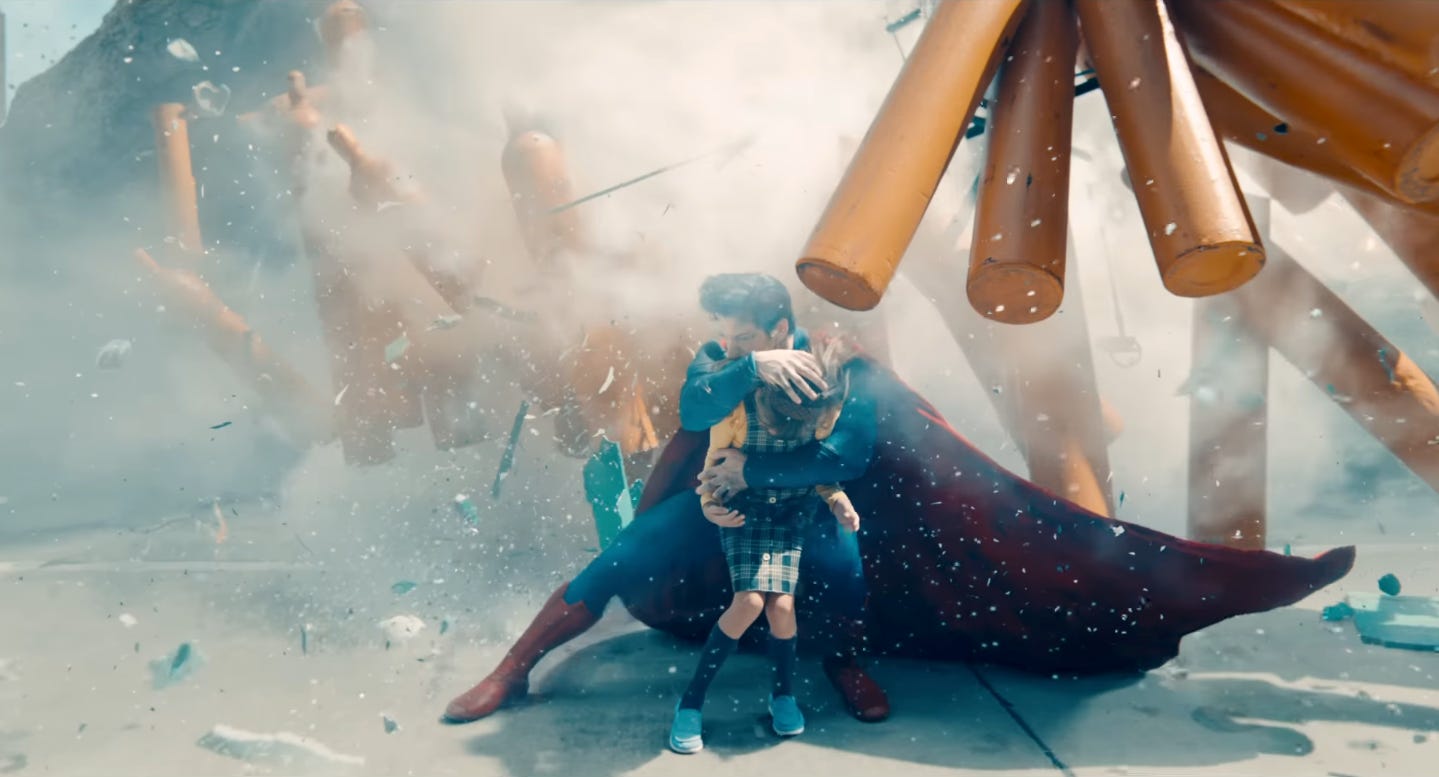
Superman is the perfect hero for the CGI era, a stakes-free vessel with no clear rules for how his body interacts with the green-screened space surrounding him. He’s as strong and able-to-fly as his rendering requires. He can transition from space to space as fast as a digital editor can cut. He can fill in an underwritten plot hole on split-second notice. And he can assure his investors that no dog, cat, baby, robot, squirrel, fish, villain, co-star, or other piece of potentially valuable IP will be killed off before the studio can spin it into a sequel.
I’m genuinely curious how anyone can garner the ability to enjoy James Gunn’s Superman, $225 million of tension-free slop that kicks off the latest reboot of the DC universe. My worst enemy Sean Fennessey said on The Big Picture last week, "I think you will love this movie if you liked Saturday morning cartoons as a kid." Sean, this is depraved. Do you still like Uncrustables? Maybe. When I was a child I woke up at six in the morning to watch reruns of Jackie Chan Adventures, but I no longer see through a TV darkly and found myself face-to-face with the physical discomforts of adulthood for all two hours of Superman. My body is a container that aches, itches, and comes into contact with foreign physical objects that create sensations when I touch them. None of those things happen in Gunn’s DC universe. I don’t think Superman even sweats.
I don’t need intellectual stimulation or logical realism to enjoy action movies, but I do need physical stakes. I can’t invest in Superman because it isn’t invested in convincing me that anything I’m watching is real. People and things shot in the real world bend to the people and things around them, which is part of why film is such a vital and compelling medium. But hardly any of what we see in Superman was captured by cameras, and the screenplay reinforces the artificiality by ensuring that nothing on screen follows any laws of reality. At one point someone introduces a piece of background scenery called an “anti-proton river” and suggests that entering it would tear a body to shreds. A couple minutes later, Superman dives in holding a CGI baby. Neither appear to be shredded, and neither are worried that they’re about to be sucked into a black hole. I guess I’m not worried either. Why does it matter if Superman, baby, or all the known universe is obliterated if none of it actually exists?
The general stakes-less-ness extends to the plot, which I’m not going to bother summarizing because Gunn doesn’t give us the courtesy of properly framing it.1 Instead of conflict or character development, Superman’s story is centered around a melange of vaguely disguised current-events topics. I don't know a better way to undercut the seriousness of a political issue than to insert it as content-bait into a movie where everything will resolved by someone getting punched. The laziest and most offensive possible depiction of the Israel/Palestine conflict - ham-fisted pseudo-analogues for tech billionaires - a tonally abhorrent representation of an ICE-style black site - a climactic speech that explores the overlap between the words "alien" and "human." If your attempt at commentary is so on-the-nose that Ben Shapiro can post about it then you know you haven’t really made a point.

All of this sucks - which is a bummer, because there are moments in Superman that almost seem good. All three leads can act, and once in awhile the script lets them do it. There’s an early scene of semi-riveting interpersonal dialogue between Superman and Lois Lane that lays out what could be a driving emotional conflict. There’s also a bizarre subplot where Superman reveals that he’s into pop-punk, which sort of tracks. Somewhere in here there’s a smart movie that explores the relationship between corny liberalism, American interventionism, and tech mega-capitalism through the lens of an alien who thinks American Idiot is the defining album of the 21st century. But all these themes are abandoned when our hero has to fight a clone of himself while coughing up nanobots in order to patch a rift in the universe that will annihilate all life as we know it.
The only interesting shot in Superman comes near the end, when Superman and another character engage in an iconic act (no spoilers) as they levitate through a shopping mall. Gunn circles around their heads, keeping the camera level as the backdrop descends behind them. It's obvious that they're standing on the ground in front of a green screen, and the camera makes no attempt to deny it. This almost looks like visual commentary on the artificiality of the superhero genre, a shot that places what actually matters - the relationship between two characters - at the center while the background slides past in obvious unreality. But then Gunn cuts to another angle that places both characters several feet below where they were in the previous shot, and it’s clear that we’re watching a movie that assumes no one is actually paying attention.
That assumption of uncritical consumption is what offends me most about these movies. Our studio overlords figure that we’ll lap up anything with nostalgic colors and clearly branded IP, and based on Superman’s rave reviews, I guess they’re right. Maybe I’m the asshole in this situation. I’d probably be a happier person if I could just sit through these movies and accept a good time. If they could just be dumb - and if the action in them could incorporate some dumb physical impact - I could be all in. Instead we get half-baked ideas and physical meaninglessness. Nothing matters in Superman - not politics, not physics, not tone, not life, not the obliteration of all existence. Gunn transforms fun into the worst kind of nihilism, a void that folds genuine care for creation into the mindlessness of stakes-free escapism.
I don't want to hear any more defenses of cultural populism or admiration for the artistic challenges of working meaningful stories into corporate blockbusters. These movies are bad. *life is disappointing* is officially taking an elitist stance against superhero films. We are adults, we have dignity, and we can make and enjoy good things. This isn’t it.
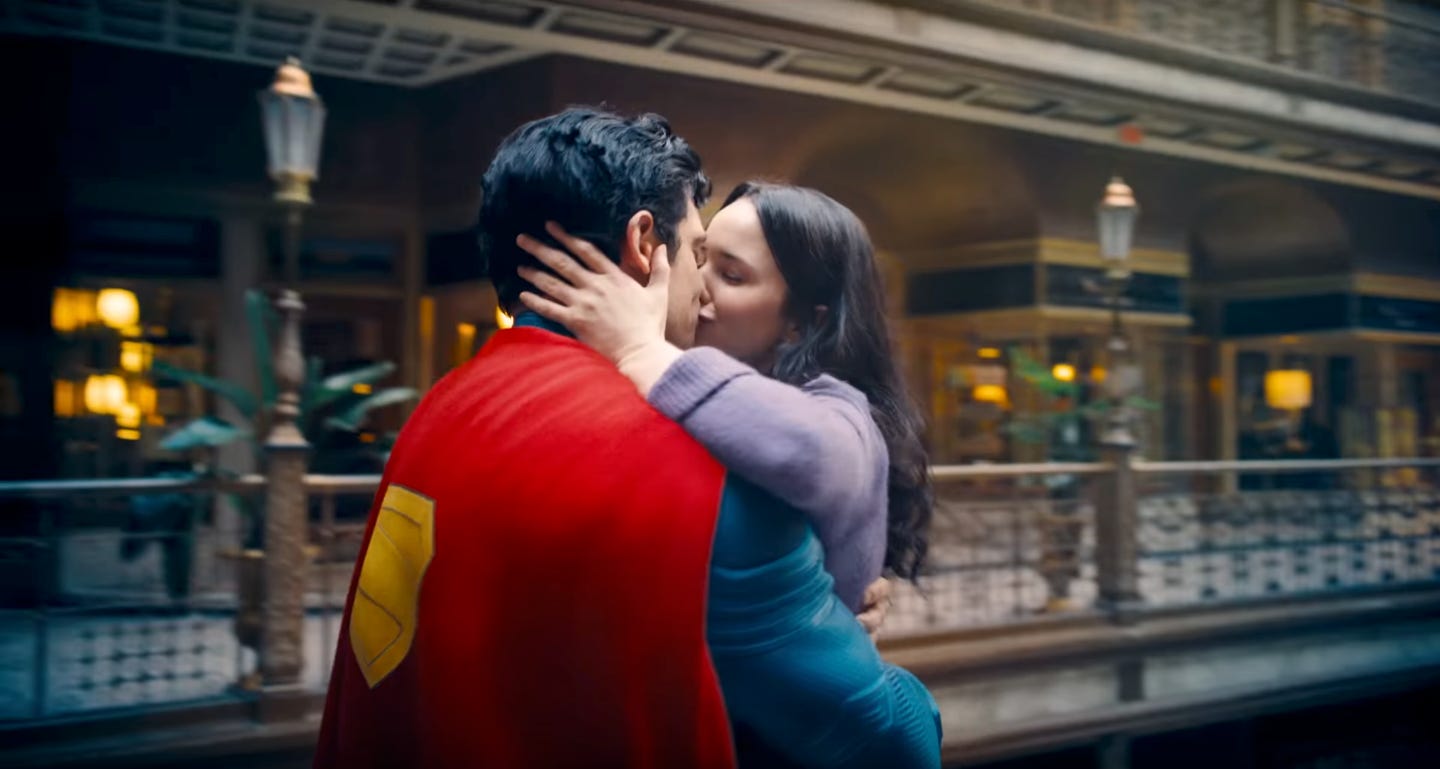
It's kind of Obama-era to talk about superhero movies being the modern Westerns, but I thought the comparison was apt then and I don't see why we should abandon it. The Western is a reductive genre that nevertheless led to some of the Greatest Films of All Time - will the same be true for the superhero movie?
Without getting into it deeper than I'm ready to swim, I think you can split the Great Western canon along a John Ford/Sergio Leon dichotomy. John Ford made relatively straight-down-the-middle Westerns that played within tropes but elevated them to high theater, playing out big ideas in front of enormous backdrops - for reference, (re)watch this iconic scene from The Searchers. Sergio Leone made postmodern Westerns that reconfigured tropes in bizarre and unsettling ways that transformed what time and space could look like in a movie - for reference, (re)watch this probably even more iconic scene from The Good, The Bad, and the Ugly. Ford uses preexisting tools to elevate the Western beyond the limitations of genre and created a handful of masterpieces. Leone blew up the limitations of the genre and created something that was previously impossible.
So - who is the John Ford and who is the Sergio Leone of the the superhero genre? In other words, do we have a superhero director who uses the classical elements of cinema to elevate their story outside the muck of the genre (à la Ford) or who mixes the tropes into something greater than their parts (à la Leone)?
Using the They Shoot Pictures, Don't They? list and the r/TrueFilm sub, I’ve put together a not-very-official short list of 21st-century superhero movies that could potentially qualify as “great cinema”:
M. Night Shymalan, Unbreakable (2000)
Sam Raimi, Spider-Man and Spider-Man 2 (2002, 2004)
Brad Bird, The Incredibles (2004)
Christopher Nolan, The Dark Knight (2008)
James Mangold, Logan (2017)
Phil Lord and Christopher Miller, Spider-Man: Into the Spider-verse (2018)
Todd Phillips, Joker (2019)
The Daniels, Everything, Everywhere, All at Once (2022)
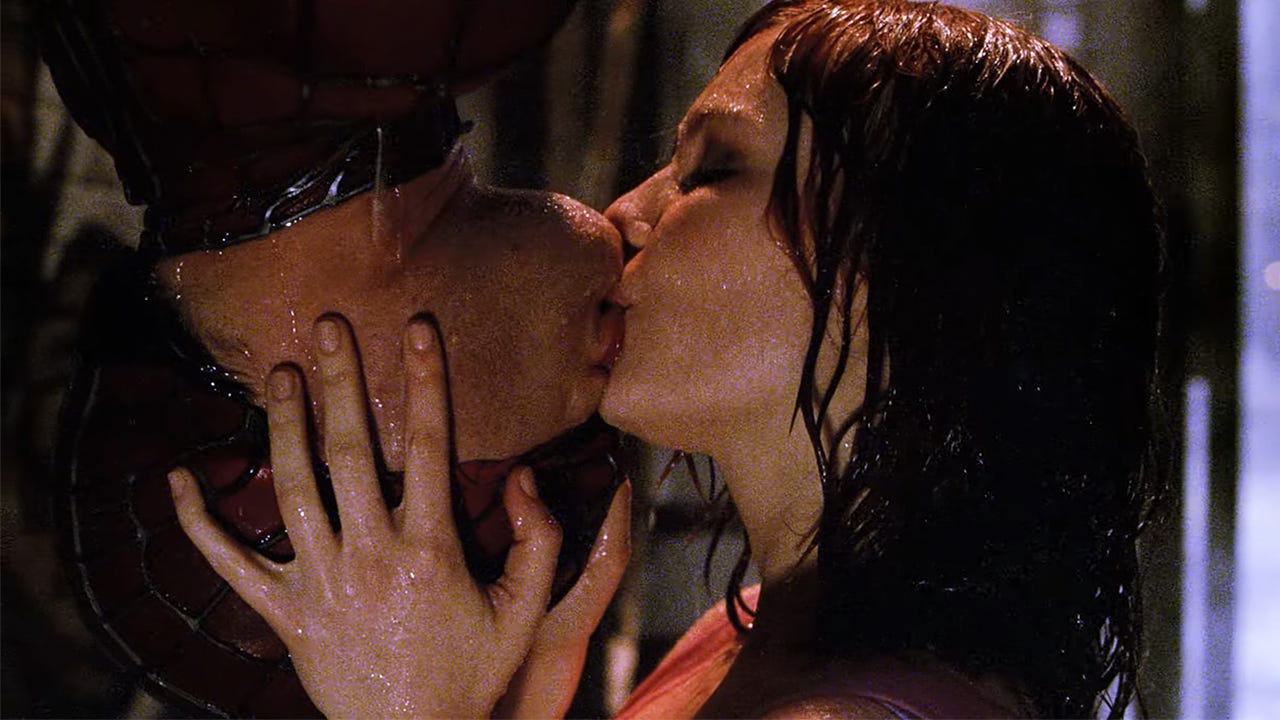
On this list, I'd put Raimi and Nolan on the clearest Ford side of things: two directors of genre trilogies that raised the bar and defined the possibilities of what a superhero movie could be. Spider-Man and The Dark Knight are very different films, but both of them are massive commercial properties that closely adhere the rules of the superhero genre. Spider-Man is grounded in campy imagery and storytelling, but it's remarkable to watch it in light of the MCU onslaught and realize what it’s like to watch a real movie made by a real director. Compare the artistry and timing in the train fight scene to literally anything from the later MCU. Or this scene. Or this one. Timing, impact, personality: Raimi’s organic direction is the result of an auteur working out real ideas through genre fiction. The Dark Knight leans into the edgier side of superhero expectations and invents the measured, sort of gritty, sort of symphonic style that we now associate with the bwaamp sound. I find its self-seriousness too annoying to watch in 2025, but the action sequences still look incredible despite the meme-y performances and the fascist script. Both Raimi and Nolan used cinematography to elevate their trilogies through and beyond genre limitations - probably not as great as The Searchers, but still, pretty great.2
I'd slide Logan and Joker into the Ford category as well, though I’d prefer to strike them off the list altogether. I'd also add Everything, Everywhere, All at Once, The Incredibles, and Unbreakable. All of these movies toy with audience expectations more than Raimi or Nolan, but they ultimately stay within the boundaries of the genre. Logan is fascinated with its own edginess but does little to push limits other than add some gore. Unbreakable is a beautifully shot film that has the misfortune of being written by M. Night Shyamalan. I have nothing to say about Joker. EEAAO is by far my favorite of this slate, and maybe the Fordiest of all of them - a movie that uses the tropes and cinematic style of the superhero genre to identify a profoundly moving human story, shot more or less thoughtfully without breaking any rules. You could say the same thing about The Incredibles: a well-acted family drama embedded inside a superhero movie. None of them break new ground, but all of them have something to offer to someone who doesn’t care about superheroes.
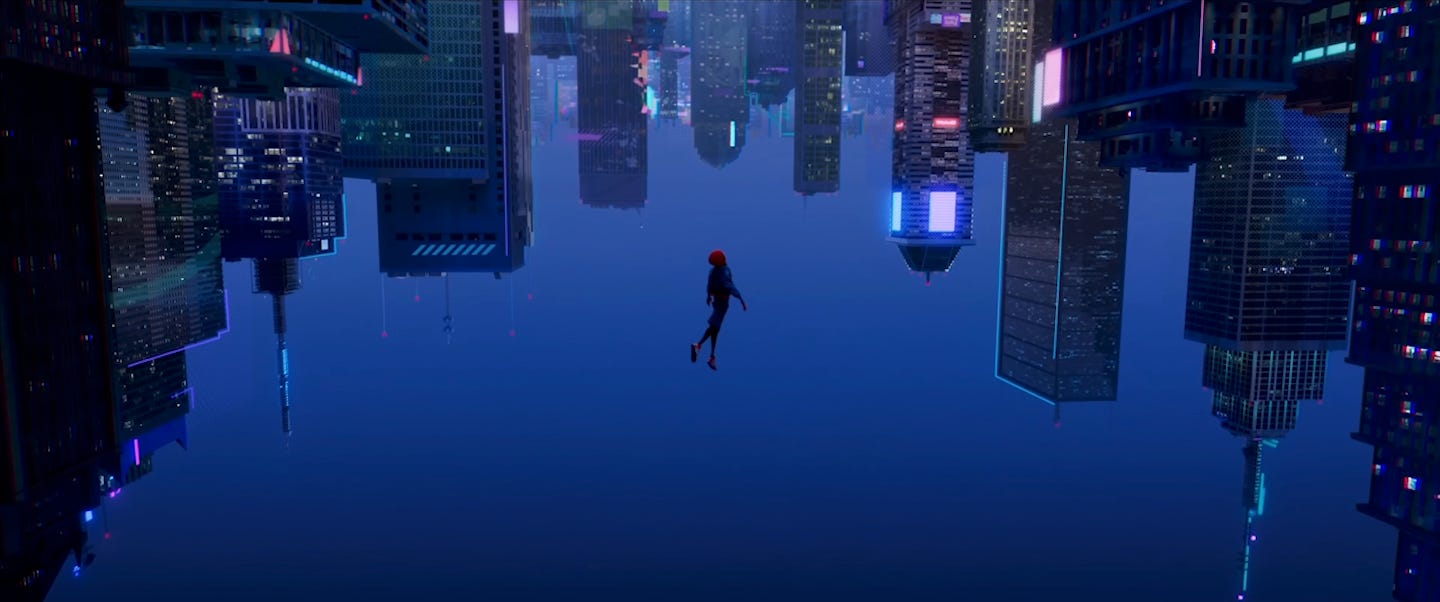
That leaves only one film to be our superhero The Good, the Bad, and the Ugly. Spider-man: Into the Spider-verse trains its audience to experience the world through a very 21st-century lens, blitzing us with overloaded content, mix-&-match visual style, rapid-fire referentiality, and - most remarkably - real-world, reality-based pathos. It looks like nothing else ever made. It paces itself at twice the speed of its peers but makes three times more sense than any of them. The upside-down New York shot of Miles Morales's leap of faith is legitimately breathtaking, a stand-up-and-cheer moment that breaks open the cinematic language of its genre and creates new possibilities for superhero movies and cinema in general. Leone busted open the Western when he cut from a montage of eyes and holsters to a wide shot; Into the Spider-verse busts open the superhero movie with shots that I don’t have words to describe.
Has any live-action superhero director follow Spider-verse’s ascent beyond the constraints of fandom? I don’t think so. You could argue that Spider-verse and its sequel can do crazy things because they're animated, but by this point every superhero movie is animated. There’s no reason that CGI swathing has to strive for hyperrealism. Any superhero film could slide into the mind-bending digital style of Spider-verse - but the Gunns and the Synders and the Whedons and the Russos and even the Cooglers have said time and time again that they aren't interested in visual experimentation.
I am pretty obviously not a fan of this genre, so I'm curious what my biases are making me miss. Is there a superhero film that transcends genre limitations and steps into the indefinite realm of "great cinema"? Is there a single iconic scene or shot in the entire Marvel/DC cinematic/extended universe - a moment that creates meaning outside the lore and fandom and meme-world of genre fiction? If there is, I want to hear about it. Send a tip to pitytherich@proton.me or toss out a comment. If I get some interesting responses maybe I'll break my boycott and come back to this topic the next time a superhero movie comes out. Surely there aren’t anymore coming this season, so we’ve got plenty of time to think.
Thanks for reading *life is disappointing.* If you found this newsletter slightly less disappointing than the rest of your life, consider liking, commenting, sending me money (thanks!) or subscribing. Subscribing will get you exactly what you get here but sent to your email inbox. We’ll be back next week with thoughts on what appears to be a real movie, Ari Aster’s Eddington.
I don’t think it’s wrong to assume that the entire audience already knows who Clark Kent, Lois Lane, the Green Lantern, and Lex Luther are - but implying that anyone unfamiliar with DC lore can shove it is a hell of a way to kick off a franchise. The refusal to provide background information is one of the most toxic elements of contemporary nerd culture. It puts everyone in the space of being a casual customer in a comic shop, and it rewards anyone who spends ten minutes shoving Wiki Fandom content down their craw so they can talk over anyone who engages them as if they’ve been studying it their entire lives. We need more space in our lives to be comfortably uninformed. But maybe I’m just dumb and I want people to be nicer to me.
For the record - I hate The Searchers. I think it’s boring and racist and I can’t stand its depiction of snow. But it means a lot to a lot of people, and the great moments in it are really great. It seems like one of those movies where you probably had to be there for. I trust the people that were.