
thieves like us
kelly reichardt finds the materialist humanity at the heart of the heist film in the mastermind

My goal with this newsletter is to write about new films as they reach general release, along with some seasonally appropriate commentary on other cinematic events and interests. I wanted to do a double-feature heist thing about The Mastermind and Roofman, but Roofman is only showing at suburban theaters and I’d have to ask somebody to drive me there, so here we are in Kelly Reichardt’s America. This newsletter comes out every Friday, which I’m feeling increasingly confident really means Friday.
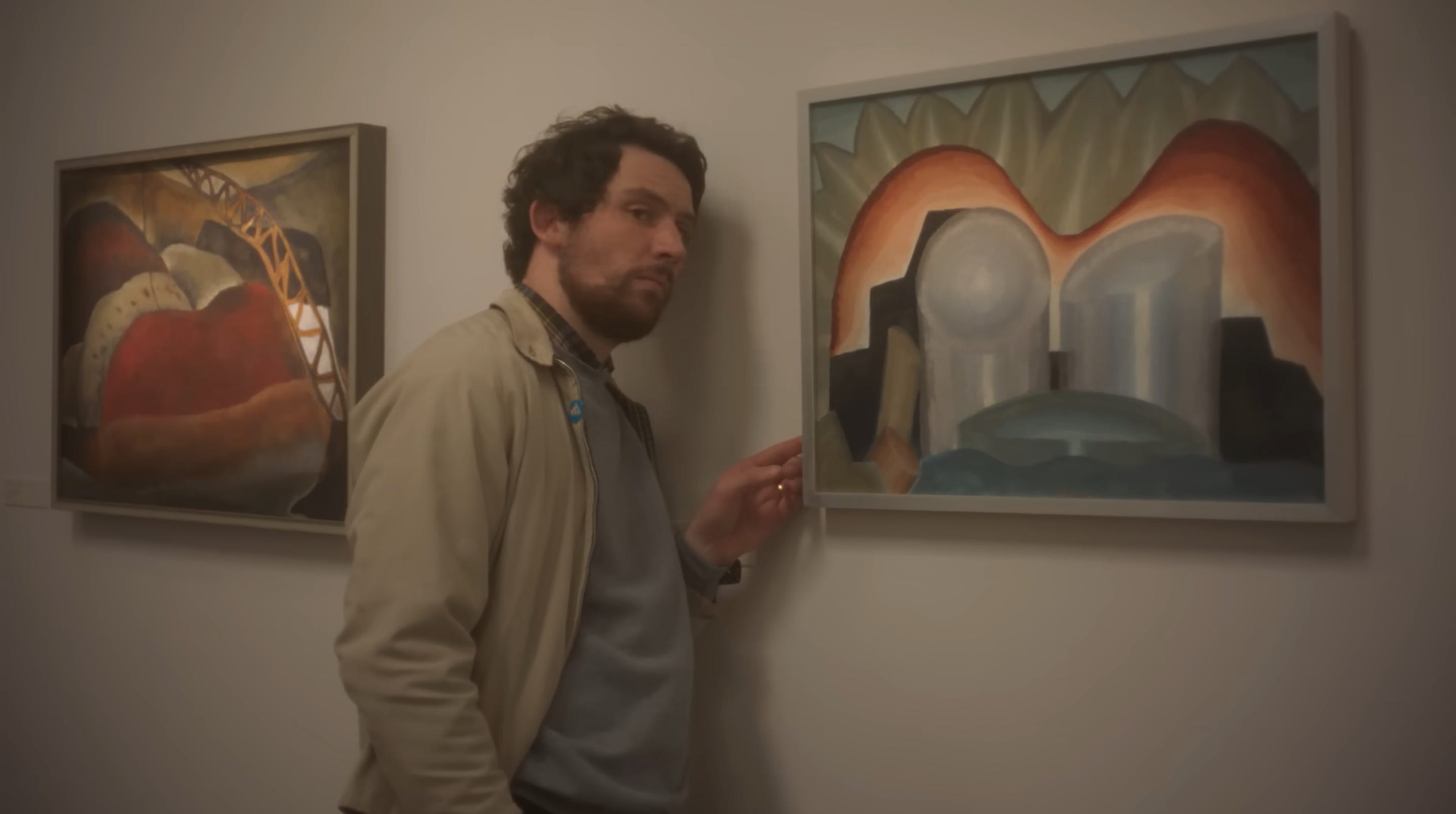
I’m not a heist critic, but my opinion on the Louvre crown jewels robbery earlier this month is that it was pretty good! It’s a shame that they dropped that crown, and it’s a shame that they already got caught, but overall this seems like a crime for the ages. It’s hard to feel too sad about the desecration of the French imperial jewels, but I am sort of bummed that some priceless nineteenth-century monstrosities have almost certainly been broken down for parts that will only earn a fraction of their original value. “C’est la vie,” as this guy probably said. If I’ve learned anything from heist movies, it’s that running away with riches isn’t really the point.
It’s certainly not the point of The Mastermind, Kelly Reichardt’s latest entry into the art-heist canon that came out the same weekend as the Louvre robbery. The Mastermind is another work of naturalism from Reichardt’s Temple Grandin perspective, less a film about the planning and fallout of a crime than an indifferent look at something that happened once, shot from the viewpoint of an extremely composition-conscious pigeon.
Reichardt couldn’t have planned for more hilarious promo than the Louvre robbery. If you were to take the basic theory of the Paris heist but make it uncool as possible, you might come up with the plot of The Mastermind. Instead of the Louvre, it’s the Framington State University art museum. Instead of Napoleonic crown jewels, it’s four abstracts by a not-very-famous painter. Instead of zippy little scooters, it’s a Buick Wildcat. But the basic principles are all there: waltz in during museum hours, grab the goods, make some threats, leave out the front door.
J.B. Mooney (Josh O’Connor), the titular mastermind, doesn’t seem to have much more sense about what he’s doing than Reichardt’s camera. He plots his big job because he’s out of work and doesn’t have anything else to do. He barely communicates his nonexistent plan to his asshole friends, and they barely manage to pull it off. He spends most of the film milling around in the aftermath of the heist, gradually losing touch with his family, his college friends, and his dignity. If you go into The Mastermind jazzed up on art heists and have never seen a Kelly Reichardt film, you’re in for a pretty boring time.1 But if you go in with some patience and some curiosity about what it means to watch a heist film, you might have a shot at some fun.
If there’s a meta-key to The Mastermind, it’s a series of shots - woven in and out as J.B. and friends execute their heist - of a high school girl skipping around the museum practicing French. The Mastermind is an American dork’s attempt at a French heist film, one part Jules Dassin2, one part Jean-Pierre Melville, and about three parts Robert Bressson. Not exactly a send up or an homage, it’s a participant in a legacy of materialistic crime films that reside somewhere between anti-heroic escapism and the thudding everyday of neorealism.
If this newsletter were actually my job, I would spend a lot more time exploring the critical history of heist films and their relationship to neorealist cinema. Since it’s not, I hypothesize, with no claims to originality or adequate research, that the heist film is an escapist step outside the typical boundaries of neorealist cinema that nevertheless adheres to neorealism’s materialist superstructure. In other words, it’s a movie about people living out a practical reality that, due to the laws of God, man, and physics, is ultimately untenable. The drama lies in the gap between physical possibility and practical reality, the conflict between what’s technically possible and what humans are actually able to do.
I don’t think it would be hard to back this up: good heist movies, like good neorealist movies, are all about minutia. What sets them apart is that their minutia is something that most people never experience. Where the day-to-day of a movie like Bicycle Thieves is the opposite of escapism, a heist movie transposes a comparable degree of realism into an antisocial fantasy, one where reality exists but rules don’t matter, where bullets hurt but consequences are irrelevant, where base selfishness can be indulged without any concern for man, God, or law.
Two supreme examples of this transgressive realism are Rififi and Le Cercle Rouge, both famous for thirty-minute silent sequences in which the protagonists wordlessly execute near-impossible jewelry heists. Rififi does for drills what Jeanne Dielman did for potato peelers, rolling out machine after machine and filming them in action without timelapses, cutaways, or dialogue. Le Cercle Rouge executes a similarly wordless heist that is incomprehensible until all the pieces come together in the final minutes, Both sequences are so deep into the weeds of burglary that anyone not currently preparing for a felony should fall asleep. Instead, they‘re exhilarating, the realism of the actions and the weightless perfection of the execution coming together in something close to transcendence.
Of course, that doesn’t last: pretty much every heist movie ends with someone getting caught. But the moralistic ending can’t take away the temporary joy of watching cool guys plan and pull off an impossible robbery. We love to watch heists because they’re really, really cool. We don’t get many in real life, and when we do we have to deal with the fact that celebrating theft leads to the collapse of civilization, etc. The heist movie gives us the opportunity to cheer without reserve until the downer pull of narrative brings us back to justice.
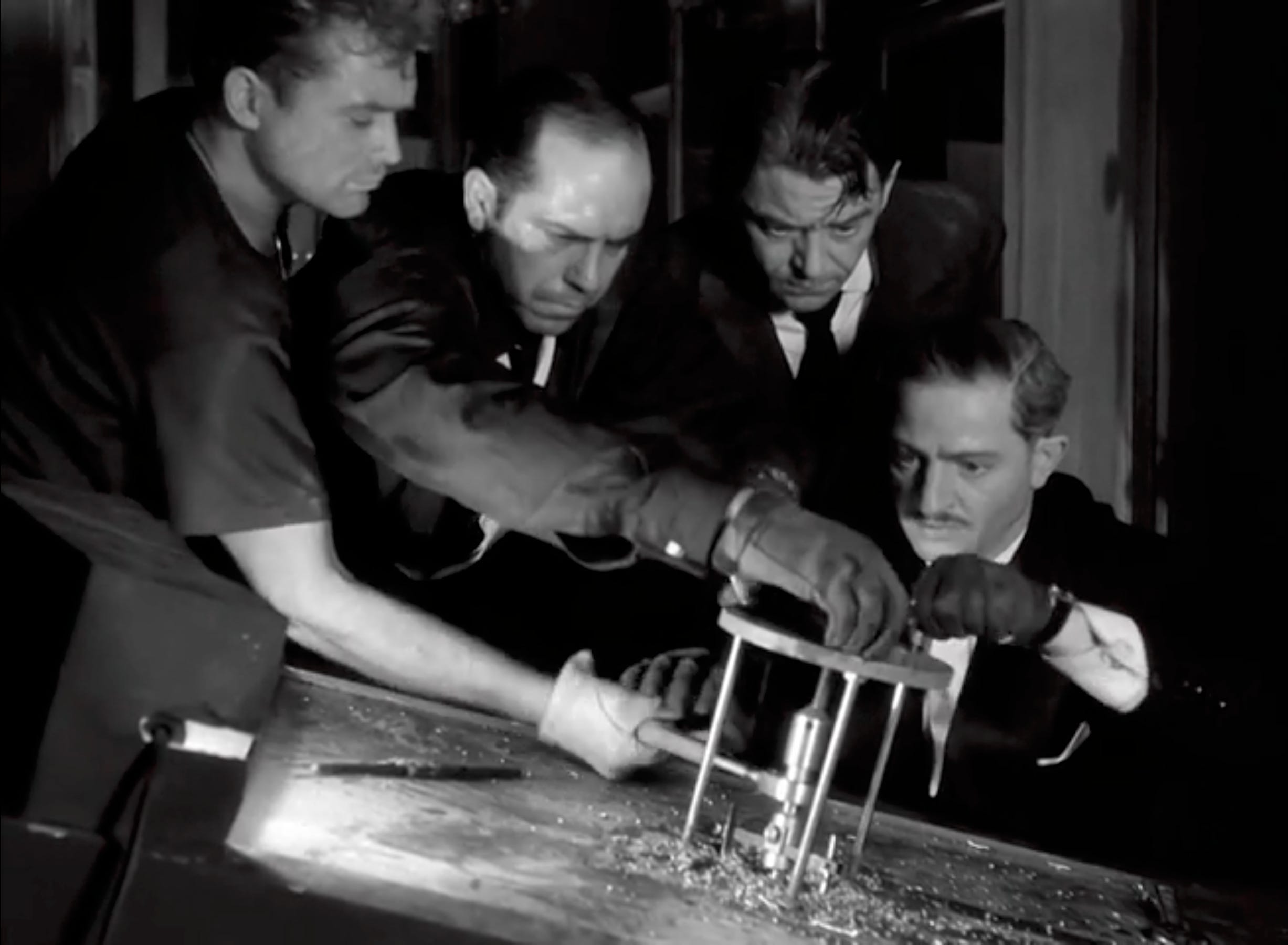
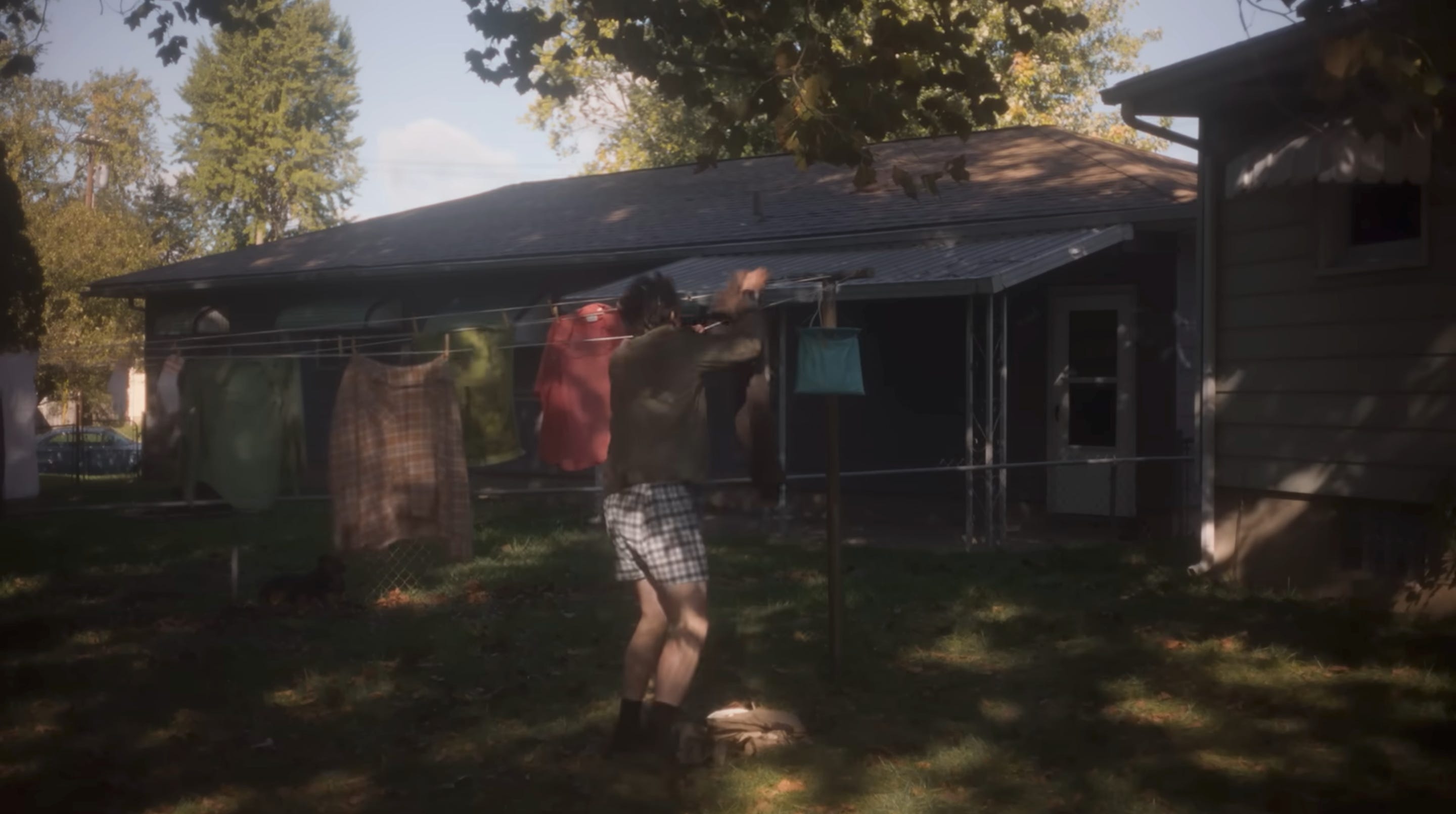
So Reichardt is acting a real psycho when she closes out her caper at the end of the first act with 75 minutes left to go. She barely puts any cinematographic effort into the heist at all: it plays out without consequence or narrative emphasis and is over in five minutes. Instead, the bravura scene, Reichardt’s response to Dassin and Melville, is a brutally boring follow-up in which J.B. lugs four sheet-covered paintings up a ladder to hide them in a barn loft. Reichardt refuses to sacrifice film grade for visibility and shoots in near total darkness. For more than ten minutes we get nothing but grunting and painting-shaped blurs stumbling across the screen. J.B., a cabinetmaker by trade, has constructed a beautiful wooden box to house his contraband; the climax of the scene comes when he drags the empty box up the ladder to re-store his paintings. It’s the inverse of Rififi’s perfectly lit drilling heist, every bit as minutia-driven but somehow stakes-free, a rolling-around in the inanity of a theft that has no time for glory.
In the end, neither the morality of the crime-doesn’t-pay downfall nor the weightlessness of the heist motivate Reichardt’s filmmaking. She films without judgment as a fairly ordinary criminal lives out the long tail of a fairly ordinary crime. The jazzy heist music cuts in at Bressonian random. O’Connor steps into shadowy corners where the camera can’t follow him. Lines are mumbled, motives are lost, the Vietnam War flashes across the TV but no one is really paying attention. Ambivalence dominates the universe, and Reichardt’s camera rolls on whether the action is in focus or not.
God will judge people like J.B. (or maybe he won’t - who knows?). The law certainly will. But as a human in the audience, it’s hard not to see a bit of yourself in him - to sympathize, to hope that he can pull it off, to escape the maw of historical indifference. You hate guys like this, but you also find yourself hoping that he’s going to figure it out and escape his comeuppance. Reichardt revels in this balance between escapism and reality: you see it in River of Grass, as the disappointment rushes onto Cozy’s face when she realizes that she doesn’t actually need to be on the run because she didn’t actually kill anyone; you see it in First Cow, as you watch John Magaro knock over his last bucket of stolen milk; you see it in Certain Women as Lily Gladstone realizes she probably shouldn’t have driven across Montana to see Kristen Stewart. Her characters want to be defined by their grasps beyond the edges of the ordinary, not the splat against the limits that her camera refuses to let you forget.
The heist movie is an attempt - and almost always a failure - to escape from that splat. We want to see a miracle happen at the boundaries of agreed-upon reality. The moral ending sweeps in because conventional narrative can’t handle the freedom that crystallizes at that point of near-transgression, but for a moment we experience the glorious verge. The Mastermind, which sacrifices both the climactic heist and the moralistic denoument, undercuts the possibility of transcendence but not the defining hope of getting there. It finds humanity not in the act of theft but in the near-universal experience of walking into a museum and thinking, “I could steal that” - and then, as you’re travelling home, of realizing no, I really couldn’t. The reality of the heist isn’t the reward, or the capture, or even the pride of a job well done. It’s the crown dropped on the floor, the wad of paper dropped in the safe, the ladder knocked to the ground. The truth of the heist is the fuck-up, the only connecting fiber of all human experience. We don’t need reality crashing in to bring down our dreams. It’s already there, always framing the edges of our fantasies, hammering us into the ground and reminding us that stumbling through material is the only life we’ve got.
The only thing you should be scared about this Halloween is that you have just two weeks to turn in your MAN // MACHINE bracket. This is some real weak promo writing, sorry - there’s a reason I never made it as a clickbait writer. But you really have no reason not to complete and submit your bracket immeadiately. We’re on track to have our biggest bracket year ever, which doesn’t mean anything for the prize pool, but does mean that the glory of winning will be even more spectacular.
If the fear of missing out on that oppportunity doesn’t satisfy your seasonal need for horror, consider watching this week’s Halloween gorefest double feature, Joji Iida’s Battle Heater, about a killer kotatsu, vs. Dick Maas’s De Lift, about a killer elevator. I find both of these objects fairly terrifying on their own, so I’m not sure if the added layer of demonic intervention increases or lessens the effect.
Side note: I have been haunted my entire life by the memory of a movie I watched as a four or five year old about broken elevators that plunge through their shafts and kill all of their passengers. I distinctly remember someone in my family saying, “it’s a movie about falling elevators” and gently encouraging me to look away (I did not). Circumstances most likely point to either young Kirsten Dunst’s Wonderful World of Disney film Tower of Terror or the opening of Speed, but I swear there is another not-very-family-appropriate plunging elevator plotline out there just waiting to be uncovered. I am 99% sure my family didn’t watch De Lift when I was a toddler, but it could be something similarly obscure. If you know what it is, please contact me immediately.
Happy Halloween. Submit your brackets. See you next week.
Thanks for reading *life is disappointing.* If you found this newsletter slightly less disappointing than the rest of your life, consider liking, commenting, sending me money (thanks!) or subscribing. Subscribing will get you exactly what you get here but sent to your email inbox. We’ll be back next week with thoughts on Yorgas Lanthamos’s Bugonia and Richard Linkletter’s Nouvelle Vague, two movies I am cautiously excited about.
At the risk of sacrificing all credibility, I will confess that this was the first Kelly Reichardt film I ever saw and that I fell asleep at least two times watching it. I’ve since seen a bunch of her movies and am now an expert on her vibe. She makes me really sleepy, which I think is totally OK: I love the surreal-ish space of low consciousness where I almost always end up watching slow cinema. If you know this is where you’re headed when you go into The Mastermind, you can probably allow yourself a better time than if you sit around waiting for something to happen.
Jules Dassin, I was shocked to learn, is not actually French - he’s a Jewish man from Connecticut who was blacklisted from Hollywood in the 1950s and spent the best years of his career in France, where I imagine everybody called him “Zsool Da-SEEN.”
As always, in this essay you reward your readers with intricate thoughts and witty prose, but it seems to me you let Reichardt off way too lightly.
Here’s what I mean about the former: "It’s the crown dropped on the floor, the wad of paper dropped in the safe, the ladder knocked to the ground. The truth of the heist is the fuck-up, the only connecting fiber of all human experience."
Nice!
But here’s what I mean about the latter: Way down in the footnotes, which only the hardiest of nerds like me ever read, you acknowledge, “I fell asleep at least two times watching it. … She makes me really sleepy…”.
Granted, you go on to say “which I think is totally OK: I love the surreal-ish space of low consciousness where I almost always end up watching slow cinema. If you know this is where you’re headed when you go into The Mastermind, you can probably allow yourself a better time than if you sit around waiting for something to happen.”
Okay, maybe you find sleep-inducing movies (shot partially in darkness) better than Ambien, but
don’t you think that for the rest of us, the MPA’s rating system should be expanded to include “SID” for “self-indulgent director”?
Your descriptions of The Mastermind add to my growing frustration with artists who forget a fundamental truth: by presenting their work, they are asking for the most precious reward we can offer. Not crowns or gems, but time. I don’t ask that all art be easy, but I have no patience for artists who waste my time to no good end "because it's art." (I'm looking at you, Lars von Trier.)