
things look pretty good up here
the science behind every scene in PROJECT HAIL MARY, explained

Sorry, I forgot to announce that last week was spring break. It’s April now and I’m back. My goal with this newsletter is to write about new films as they reach general release, along with seasonally appropriate commentary on other cinematic events and interests. This week I’m writing about Project Hail Mary, a movie supposedly about science. This newsletter comes out every Friday, which this week means Friday.

It might already be obvious, but I want it officially on the record that I hate space. I do not care about that place, I do not want to go there, I think it would be best if no one went there.1 I care even less about what people have to say about space who are not astronomers, i.e. podcasters, filmmakers, and tech entrepreneurs. Anyone can say anything they like about what’s going on up there because it’s just a bunch of numbers and words that have nothing to do with real life. Infinity gives you a lot of flex room for your bullshit.
If I were to pick my least favorite part about space, it would have to be aliens, which don’t exist, a perspective I will hold until I die even if it’s mathematically impossible. I guess fine, whatever, they do exist, but what they are up to is none of my business. If someone were to find an alien, my life would be exactly the same as it is now, which is some people saying “look, here is proof of an alien” and some other people saying “no way, that’s fake.” This extremist position has made 2026 in movies something of a distressing prospect for me, with five slated tentpoles about space and aliens. Dune, Star Wars, and Marvel are aliens that I have accepted and learned to live with, but I’m really not looking forward to the impending discourse surrounding Disclosure Day, and I’ve been dreading Project Hail Mary ever since the trailer started forcing its way into my Youtube suggestions last April.
It turns out I was worrying too much. Project Hail Mary is definitely about space and aliens, but it’s such an aggressively pleasant movie that even the weight of the limitless void can’t bring it down. Billed as a rigorous treatment of Andy Weir’s hard-science novel of the same name, Phillip Lord and Christopher Miller’s first movie in twelve years is so grounded in the basics of family-film storytelling that I never once had to think about relativity. It tells the story of Ryland Grace (Ryan Gosling), a middle-school teacher who gets called up by a mysterious organization to save the world from being frozen to death because the sun is dying. For reasons that are sort of explained, this involves flying alone to the far reaches of the galaxy and partnering up with an alien named Rocky. This isn’t a movie for stupid people, but it is a movie for everyone including stupid people, which is maybe all of us during March. It’s clearly working: families are flooding into theaters, Ryan Gosling’s career has been revived (even if his cheeks have not), and awards watchers are already creating fresh content about the 2027 Oscar season.
There’s plenty of commentary out there about the scientific plausibility of Project Hail Mary, but that’s not why you’re here. All I can offer is an analysis of its various components from the perspective of someone who is skeptical at best about the epistomological viability of the scientific method.
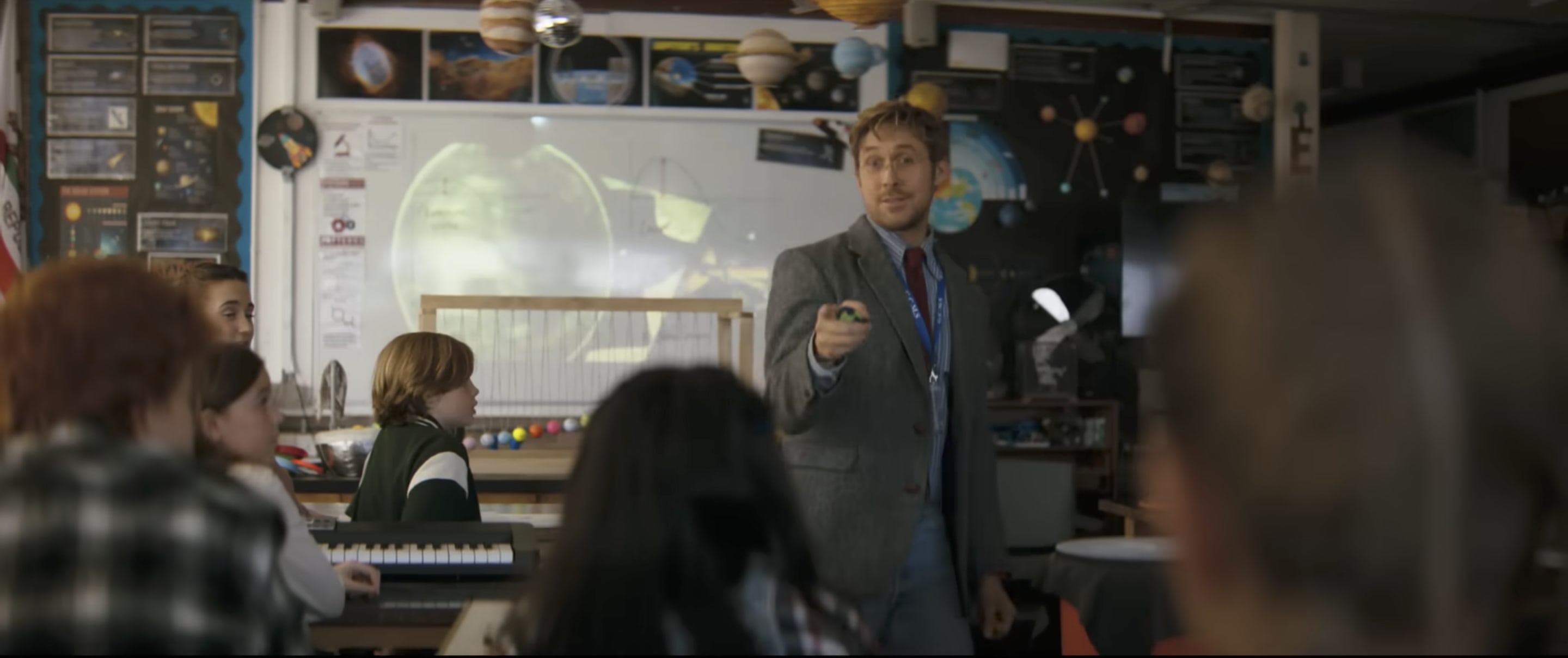
EARTH: Lord and Miller’s earth has very little to do with the planet I currently live on. For one, all the middle schoolers follow basic expectations and know how to read. Ryan Gosling’s classroom management is terrible, so I guess we have to chock his success to either good looks or a phenomenal elementary feeder in his district. Outside the classroom, PHM lacks many components of modern life: smartphones, hamfisted attempts to incorporate AI into the workplace, indicators of anthropogenic climate change, prop bets. The concept of “politics” doesn’t seem to exist. There’s a trans-governmental organization with unlimited money that’s able to put an international super-team into space, but it’s unclear if this is a UN-type operation or a SpaceX/Blue Origin situation.
I’m fine with this. The only thing worse than uninformed space talk is uniformed current-events talk. I do not want the guys who made 22 Jump Street to tell me what to think about global warming or genocide in Gaza. I want them to tell me how they would solve an imaginary problem about space bugs and whether or not it would include using their excrement to power a spaceship. We are better when we don’t trust MGM-Amazon with our opinions. The movies are sometimes for fun - or at the very least, movies can sometimes be made in hopes that they will continue to be watched after the completion of the current news cycle.
THE SUN: How on earth do we live in a world with two hard-science space movies about the premature death of the sun? I don’t find this idea unevocative, but as far as I understand it’s the opposite of actual science. Doesn’t the sun need to get hotter before it dies? I thought it was supposed to turn into a red giant or something. I don’t have any idea what’s wrong with the sun in Sunshine, but as far as I can understand PHM’s sun is being eaten by microscopic bugs. Ryan Gosling sort of explains how this works at one point, but I wasn’t paying attention. I don’t think you need to get it. I’m somewhat more charmed by the stupidity of Sunshine’s solution of just nuking the sun, but PHM’s astrobiological MacGyvering will give nerds stuff to argue about for years to come. If that’s you, great. If not, you can just accept that it’s beyond you and enjoy watching the beautiful man fix it.
SPACESHIP: Based on my experience of going inside a spaceship at the Air and Space Museum in D.C. for thirty seconds, I would say PHM features one of the most realistic spaceships I’ve ever seen. Lord and Miller do a beautiful job capturing the claustrophobic misery while also incorporating features that look sort of fun. All of the buttons seem to have a purpose. I didn’t quite figure out the room layout but there are several sequences of spacial exposition that convince me it exists. Overall the whole thing is much more in line with the tactility of analog movie spaceships than the glossy faux-intricacy of digital.
My only issue is that nothing ever seems to break. The whole thing looks so real that I kept expecting dysfunction à la Dark Star or Apollo 13. Instead everything seems to be in more or less working order. It’s crazy to me that a slob like Ryan Gosling can pull that off. He doesn’t even own a car, universal cinematic language for living in squalor - how has he not broken everything? I can’t even get my oven and stove to work at the same time. There’s no way this dork is both a better teacher and a better machine operator than me.
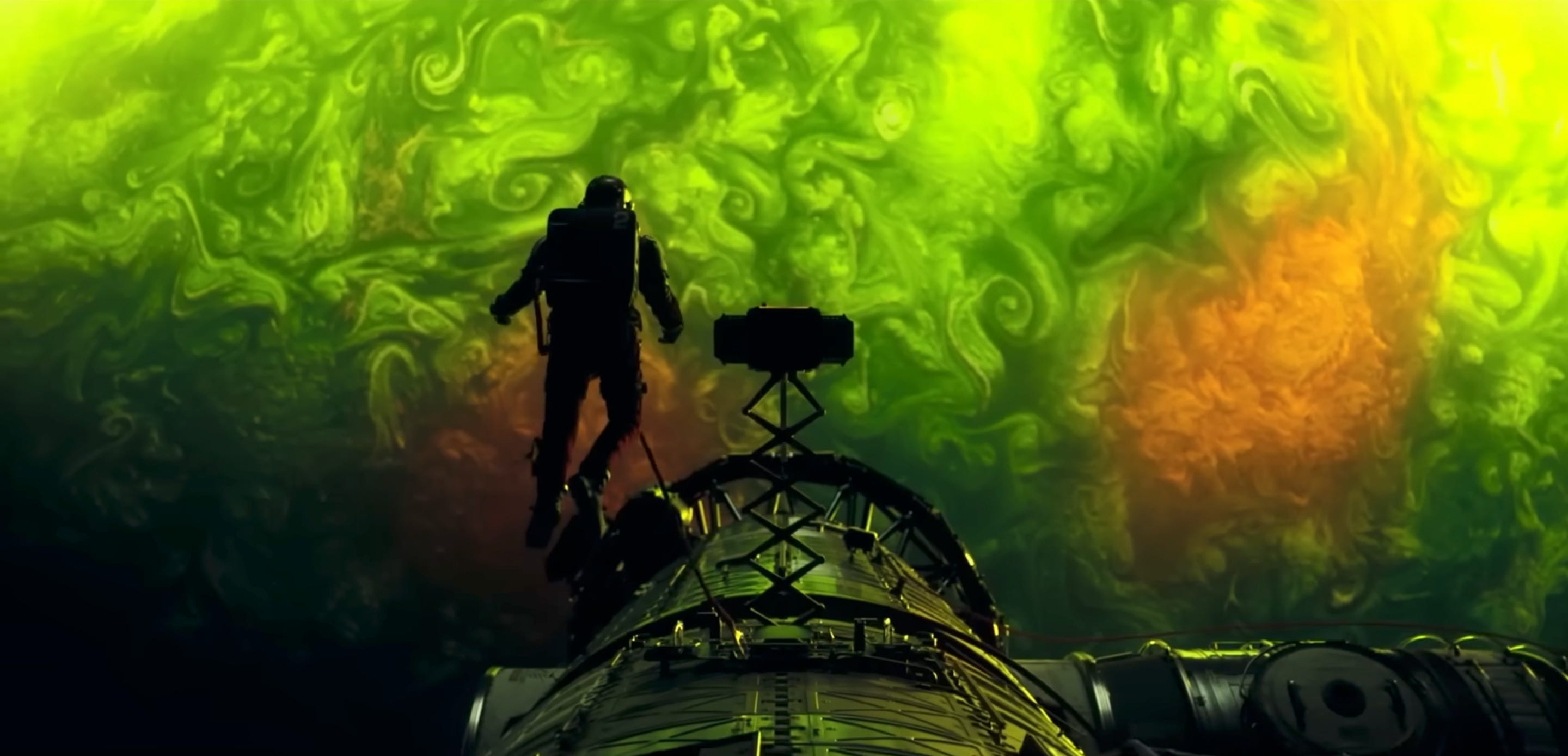
SPACE: It looks cool. Lots of black - but also, lots of colors. This is fun for the whole family, including the older brothers who candyflip.
ALIENS: There is really only one alien. I think everyone will like it. My coworker said it reminded her of her cat. Its name is Rocky. I believe it uses he/him pronouns. The alien, not the cat. Maybe the cat too. Grace cooks up a fairly believable computer hack that allows Rocky to communicate with humans that is evocative of E.T.’s Speak and Spell, and and the results are almost as cute. I know he isn’t supposed to be a linguist, but Grace at least could have run Rocky’s inputs through Grammarly to correct the translations for standard English syntax. Why do we have such an enduring love for characters who communicate without articles or copulas? Is it racism? Probably.
I appreciate the Rocky character because it doesn’t ask me to put any serious thought into the linguistics of intergallactic communication. We only need one Arrival - PHM lets us relax in the familiar beats of human feelings. If it explores any emotion with particular deftness, it’s loneliness. The bond between Grace and Rocky is sort of like Tom Hanks and Wilson. When you’re stuck alone and almost certainly going to die that way you open yourself pretty quickly to inanimate objects. Rocky and Grace serve as each other’s comfort volleyballs. They find each other baffling and stupid, but they stick together out of mutual appreciation for the other’s need for contact. Drew Goddard’s script never bothers with hazardous divergences in social values and linguistic structures; the closest we get is multiple jokes about fisting. This requires some literal universalism on Lord and Miller’s part, and some forgiveness from the viewer for their reliance on it. It asks the question, are least some people in the universe nice? and answers it “yes” almost immediately.

This is sort of the thing about Project Hail Mary. It’s not an intellectually challenging film. All it asks of its viewers is that they turn their brains off to cynicism for an afternoon. Which is a pretty big ask for some people, so that’s not nothing - but it starts off with a fairly easy-to-swallow hypothesis and finds nothing but confirmation as it runs through its trials. Can you deal with two intergalactic friends fixing space problem after space problem for two and a half hours? It’s nice, but it gets exhausting. There are at least twenty hail marys in here, a pretty stiff penance in any economy, and the conclusion would have hit harder it there had been just a few missed passes.
If it didn’t look so good - if the lights weren’t so pretty, if the ship wasn’t so real, if the puppet-looking alien wasn’t actually a puppet - that exhaustion would be the only thing to talk about. But instead, it’s all beautifully physical. Christopher Miller insists that none of the interior shots are greenscreened. The Rocky puppet is voiced by his puppeteer, non-actor James Ortiz. The whole thing is shot on Arri Alexas but transferred to filmstock and back to give it the textured warmth that makes you not want to rip your eyes out as you watch it. There’s something manipulative about that, but it’s also an acknowledgement from Lord and Miller of their audience’s increasing rejection of digital cinematography. Project Hail Mary might nerf its stakes, but at least it grounds itself in tactility.
I think that’s why I have to give it to this movie in the end. Lord and Miller have maybe made some bullshit about space, but they’ve also told a story about a human touching something. The most tender moments of this excessively tender film are Gosling and Rocky’s attempts at hugging. It’s impossible, because Rocky is encased in a geodesic sphere, and also he doesn’t have a face. But they do their best to touch one another in a world where touch is impossible. In a genre that increasingly relies on computers to artificially animate two actors who have never met into contact, even the attempt at touch - and the acknowledgement of the difficulty - drives home. Do I need to be manipulated into tears by Ryan Gosling pressing his cheek as close as he can to a puppet of a talking rock? Not really - but if it helps the filmgoers of America remember that saving the world requires actual physical contact with something, I’m here for it.

Thanks for reading *life is disappointing.* If you found this newsletter slightly less disappointing than the rest of your life, consider liking, commenting, sending me money (thanks!) or subscribing. Subscribing will get you exactly what you get here but sent to your email inbox. We’ll be back next week with some combination of The Drama, Miroirs No. 3, and a preview of MSPIFF 2026.
No disrespect to the people who are currently in space. Well, maybe a little bit.