
three movies about children with cameras
MSPIFF week two: chie hayakawa does the 1980s // carla símon does the 2000s // sophy romvari makes the Great Young Millennial Film

Last week we had four old people - this week we’re back with three young ones. I saw a mostly great mix at week two of MSPIFF 45, but the ones that stuck out to me were three very different films about childhood memories of loss. One remembers being a preteen with a dying father in late 1980s Japan, another remembers being a young adult uncovering family secrets in early 2000s Spain, and the last remembers early childhood before unimaginable loss in the 1990s. All three are some of the best films I’ve seen this year, and one might be the definitive film of our generation. Stick around until the end to see how you can get in on that game before it hits wide release.
Thank you to the MSP Film Society for letting me go to this festival! We are really lucky to have this organization in the Twin Cities. I am so grateful for the existence of the Main Cinema, a theater where I can’t even imagine someone pulling out their phone in the middle of a movie. If you live here and you go to movies, you should become a member. It is not very expensive and it pays back almost immediately.
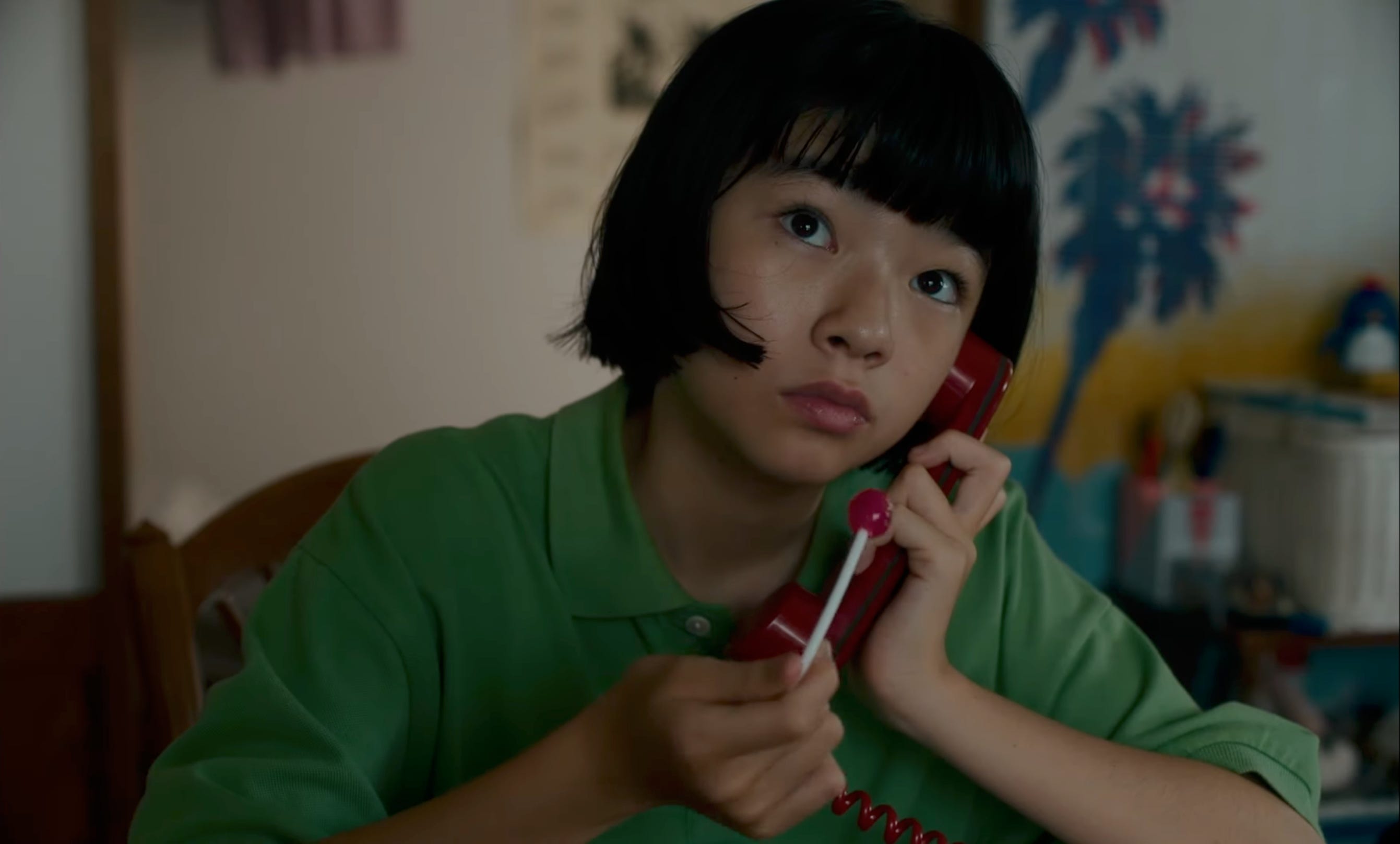
Chie Hayakawa’s Renoir opens with a grainy VHS compilation of children crying, sort of a G-rated Faces of Death but arguably more upsetting. Hayakawa never quite gives us an explanation of where the tape comes from or who’s watching it. Was it created out of empathy? Sadism? Perversion? Either way, it forces the audience to admit that we’re here to watch a movie about sad children. There’s something mystifyingly relatable about the misery of a person who doesn’t know why they’re miserable. “What kind of creep would watch that?” one character in Renoir asks. Turns out, it’s all of us.
Most people can remember childhood sadness, but it’s harder to recall its causes. I have a friend who came home one day from school and broke down sobbing for hours because his mother asked him how he liked his new backpack. To this day I don’t think he knows what got to him, but I assume it had very little to do with weight distribution or center of gravity. Narrative realities don’t click when you’re missing most of your prefrontal cortex. You react to all the wrong stimuli, and your feelings come out in all the wrong ways: school essays about how you wish you were an orphan; fixations on news stories about parents murdering their children; unexplained affinities for French portraiture. To be a child is to check a dozen emotional boxes and somehow never hit the right answer.
Renoir is a movie about something that should be sad - a father dying of cancer - and a child living out her life as if it isn’t happening. Eleven-year-old Fuki might be experiencing grief, but she’s never seen The Babadook and she doesn’t have the words to identify it. As her father scrambles for life, Fuki and her mother silently prepare for his death. Black dresses show up in wardrobes without discussion. Fuki drifts around Tokyo, lashing out at people who dote upon her and making risky decisions about dating hotlines. Her mother explores romance with an anger-management coach/miracle-cure salesman. No one talks about what the current situation might have to do with their their feelings or what those feelings might have to do with their decisions.
The result is a film that sometimes feels aimless and overstuffed, but how else can you tell a story about beating around the bush? Things happen (or don’t) with no narrative purpose - potential plot lines rise and fall, sometimes with edge-of-your-seat stakes but more often with no clear resolution. About two-thirds in, Fuki comes across a Renoir print that for a moment feels like it’s going to be the lynchpin for the entire film. It’s nothing of the sort. There’s a Mouchette quality to all of it, a sense that something is going to happen followed by an almost completely unrelated episode that reminds you that it will not. We never get tears or acknowledgement or true catharsis. In a more Sundance-y movie we’d have some sort of breakthrough moment where Fuki finally breaks down. It probably would have been satisfying, but then we’d be back to the crying tape, the perverse desire for children to mirror our grown-up need for comfort.
Adults who don’t spend much time with children often say that kids are always speaking their minds in bold and obvious ways. What we forget is that childhood is confusing and unsatisfying and almost immediately forgotten. Kids drift from the joy of new socks to the meanness of exposing their neighbors’ affairs to wishing their parents were dead to being distracted by a magician on TV, and none of it sticks because they haven’t learned the big narrative plot points yet. Someday most of them will look back on their childhoods and put those plot points into place to make all their actions cue up with their feelings. But a few will become filmmakers who pick out isolated memories of Impressionist prints that ought to connect to the death of their parents but don’t - and, in doing so, they’ll remind everyone who’s watching that grief, just like love and horror and joy, doesn’t need to make sense.
Renoir was picked up by Film Movement last fall and will be hitting a few more festivals before a theatrical release in late May.
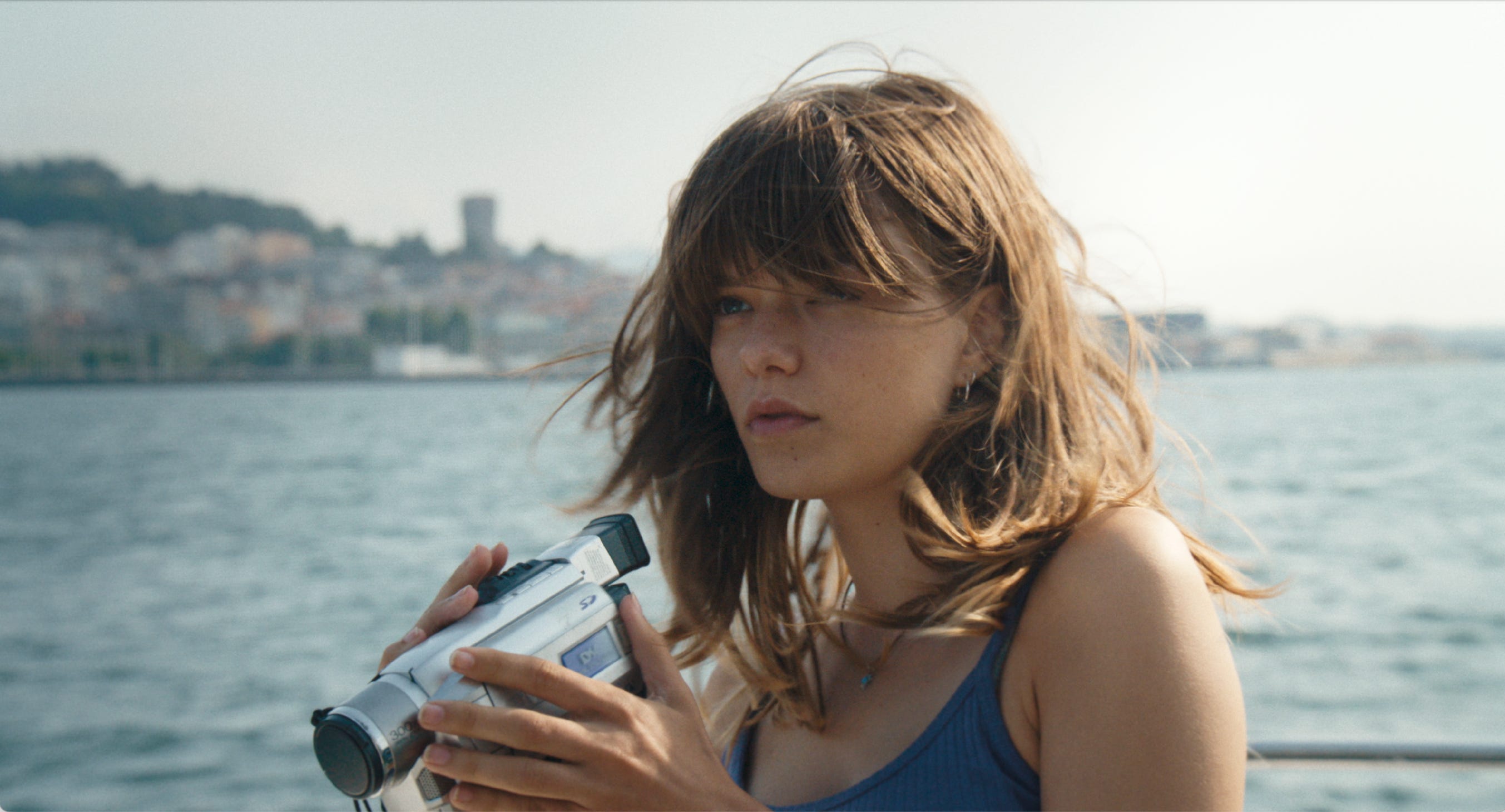
It’s one thing to dig into your own memories, and another to mine someone else’s for what you’ve forgotten - but to dig into your memories of trying to mine someone else’s memories is the sort of meta exploration you only get at film festivals. If Renoir is a formally conventional look back at a parent’s death, Carla Simón’s Romería is an explicit interrogation of the semiotics of loss. Set in 2004, her third film recreates a trip she took at age 18 to learn about her parents, both of whom died of AIDS before she was six. Armed with a digital camera and her mother’s diary, Marina (played by first-time actor Llúcia Garcia) arrives in Vigo in hopes of uncovering the story of her birth. Framed as sort of a neo-realist mystery, Marina encounters obfuscation after obfuscation from her aunts and grandparents, whose useless answers flounder against the blunt reality of Marina’s camcorder footage.
Like most 18-year-old cinematographers, Marina’s footage isn’t very good - and like most real-life mysteries, her secret backstory isn’t especially exciting. Simón doesn’t insult our elevated sensibilities with a puzzle box. Marina meets family member after family member and gets fed bits of nothing: sometimes lies, sometimes muddled memories, never anything useful. Even the most dramatic revelations are treated with documentarian indifference - whenever we think we might be treated to an emotional reaction, Marina retreats into her camera, which she mostly focuses on ocean waves and long shots of the Galician hillsides.
The easy thing to say about Romaría is that it’s boring. Explorations of family history are, more often than not, unfulfilling. We might be personally excited by what we find, but when we recount them to anyone else it’s hard to keep them interested. The story behind Marina’s father’s death is meaningful to her, but it comes off as woefully typical to the gossip-hungry audience. Marina brings her camera to Vigo to document something memorable. What she gets instead are sleepy shots of the beach.
Soporifics make for poor cinema, and Símon knows it, so Romería makes a fourth-act turn that breaks from contemplative realism and finally gives the audience what we think we want. In a dreamlike sequence, Marina steps into her parents’ story and embodies the role of her mother. As another actress’s voice narrates her mother’s banal diary entries, Gracia plays out Marina’s imagining of her origin story through the classic beats of a heroin movie: naked idylls on the beach, psychedelic experimentation, boyfriend shooting up, girlfriend getting hooked, fighting, withdrawal, pregnancy. The imaginary sequence is almost as banal as the diary, a drama that we’ve seen a hundred times in drug movies, mercifully different than Marina’s quiet pilgrimage but so typical that it leaves you longing for a return to realism.
I didn’t particularly enjoy Romería in the moment. There are limits to how meditative and unsatisfying a film can be, and as much as I want to resist anti-intellectualism, I do see the benefits of a movie that keeps you awake. But the more it sits with me, the more I think Romería achieves something that only a boring movie can achieve. There’s more truth in fading in and out of attention than there is in explicit plot exposition based on lies and memories and empty diary entries. If there’s truth to be found, it comes from documenting the present and letting it resonate against whatever tone it wants to for whoever wants to hear it. Words and stories are fallible, but an exploration captured on a camcorder is only beholden to the lies of exclusion inherent to the frame. It’s not the whole truth, but its one unhindered by the limitations of memory.
At the very least, falling asleep in a theater and waking up to footage of dolphins clipping through the Ría de Vigo is about as pleasant as it gets on a cold Friday afternoon. I’d like to re-watch this one when I’m not exhausted, even it just means falling asleep to it all over again.
Romería will be distributed by Janus and will supposedly be coming to New York in June, followed in theory by national expansion.
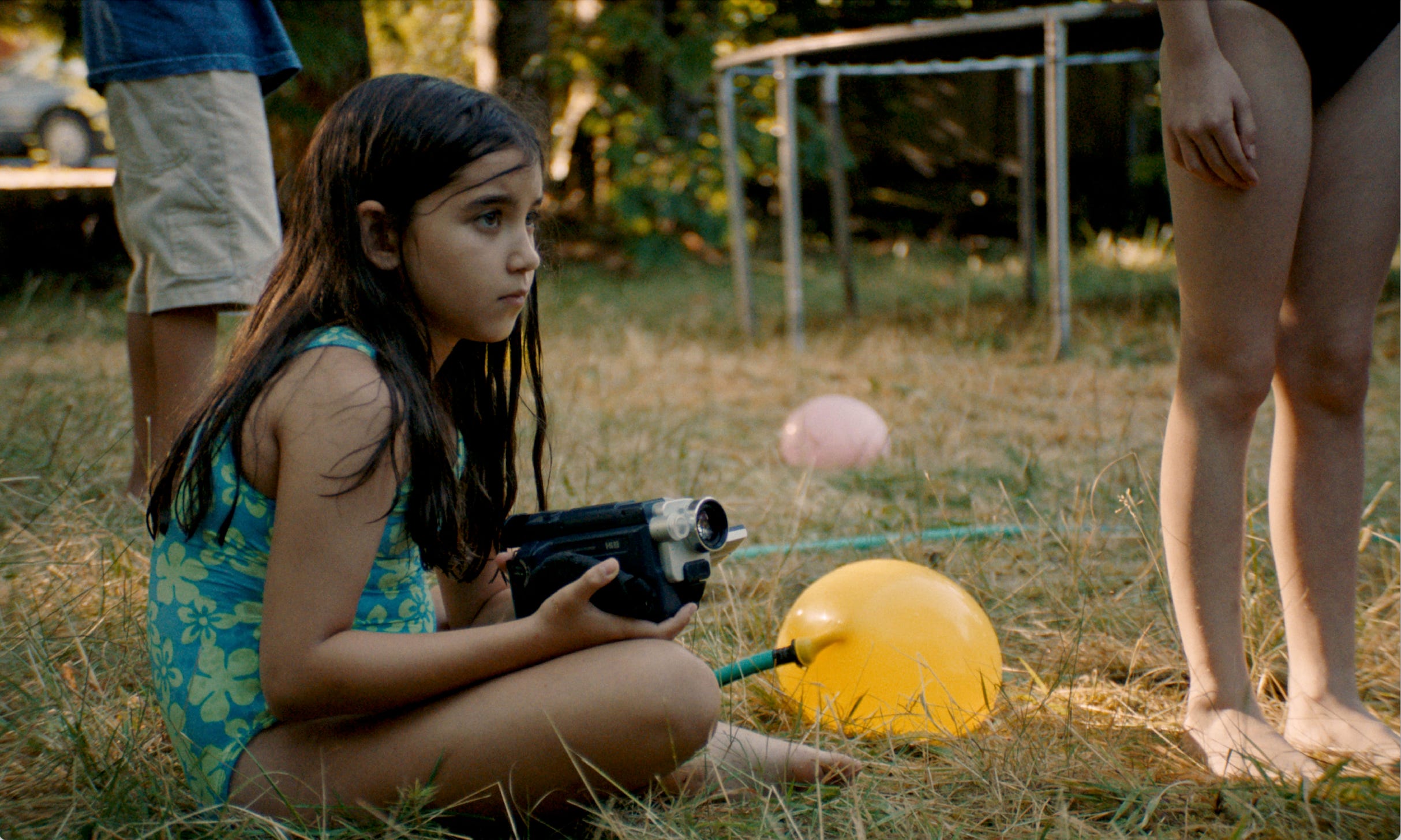
I was struggling to place why everything in Blue Heron was hitting me like a ton of bricks until it clicked that Sophy Romvari is exactly the same age as me. Not only are her memories of the late 1990s made up of all the same stuff as mine - the same mechanical pencils, the same Tex Mex sofa cover, the same older brother with the same glasses and haircut - but she’s remembering it from the same seven-year-old perspective, with all the same gaps, perspectives, and confusions. Young millennials have long been accused of our nostalgia for the ‘90s, but up until now that’s come out in our enthusiasm for imitations of ‘90s media, re-creations of a teenage experience we only saw in TV shows and movies that we were too young to be watching. We’re in our 30s now, and we’re finally old enough to make movies about pre-Y2K childhood as lived by pre-Y2K children. High school class of 2009 - this is our time.
If Blue Heron was just the first great movie about ‘90s childhood, it would already be an accomplishment.1 That it’s also a groundbreaking work of meta-cinema puts it in a larger conversation that includes Kiarostami and Tarkovsky, which is a really rude place to put a relatively young person making their directorial debut but whatever, I think Romvari can hang. Blue Heron an immaculate childhood film until its midpoint, when it takes a Panahi-esque turn that takes us quite literally out of the movie and asks us to renegotiate not only everything we’ve seen, but what we’re doing in the act of seeing it. I think some people will hate that: like a lot of people in my screening, I was luxuriating in the beauty of the first 40 minutes and didn’t want to leave it. To be told to do so, by means of one of the paradigmatic and most hateful signifiers of modernity, is a direct affront to Blue Heron’s aesthetic sensibilities. Romvari makes her way back, but when she does, the framing is broken, the artifice is exposed, the project has already defeated itself.
Blue Heron is so many things, but one of them is an interrogation of our longing to remember and our compulsion to recreate. We want to go back to the past because we love the parts that we remember, but also because we want to fill in the parts that we didn’t understand, and to find an explanation that makes everything that happened afterwards finally make sense. We want to be a social worker for our vulnerable pasts, ushering our child selves into a VHS haze that will hold together forever. What hurts is that we can only fulfill that role as viewers from the future who know the points where everything will go wrong. To feel the joy of nostalgia is to know that nostalgia is necessary, to know that the memory has limits and that these limits are essential to their capacity to cause pain.
If Letterboxd is any indication, I think a lot of people spent this weekend trawling through every short film Sophy Romvari has ever made and wishing that they’d bought stock in her career back in 2016. This is your chance to get in the game before you see the movie. The miracle of Romvari’s work is her ability to immediately create and exploit parasocial relationships within the traditional frame of cinema. The story behind Blue Heron was first introduced in her 2017 short “It’s Him” and brought to a head in her NYU thesis “Still Processing.” Blue Heron is something of a sequel to those films, and it incorporates many of the elements that people who have been watching for a few years are now familiar with: family photographs, one-sided phone calls, glowing Macbooks. I don’t think I’ve ever encountered someone who can develop this intimacy between director and viewer so quickly and deploy it so effectively. The economy of Romvari’s filmmaking is a frequent discussion point with regard to her shorts, but the world isn’t ready for how hard it will hit in Blue Heron. By the end I not only felt that Romvari was my friend but also that I care deeply for everyone in her family even though I have only met characters who I have been made explicitly aware to be shallow echos of the people they represent.
This isn’t emotional manipulation: this is a direct interrogation of the role of the writer/director in the creation of a memory, an open question about the utility of looking back on a past that is entirely beholden to what the writer/director focuses on and what they leave out. Which is to say that it questions what cinema is and what it can be in a way that I don’t think has been previously questioned. Which is to say that I feel completely undramatic saying that this movie is Important. Paul Schrader talks about seeing Pickpocket and not being able to write about anything else for weeks. I won’t do that, but I don’t really want to do anything but keep thinking and talking about Blue Heron. Listening to people chatter about Cinemacon and stressing out about whether or not Disclosure Day is going to make money when this is out on the streets makes me question the entire enterprise of commercial film criticism. I have been waiting my entire life for this movie. Drive to New York to see it.
Or just wait until it comes out in more theaters in May. It’s called Blue Heron and it’s directed by Sophy Romvari and it’s distributed by Janus. In the meantime you can and should watch everything Romvari has ever made on the Criterion Channel.
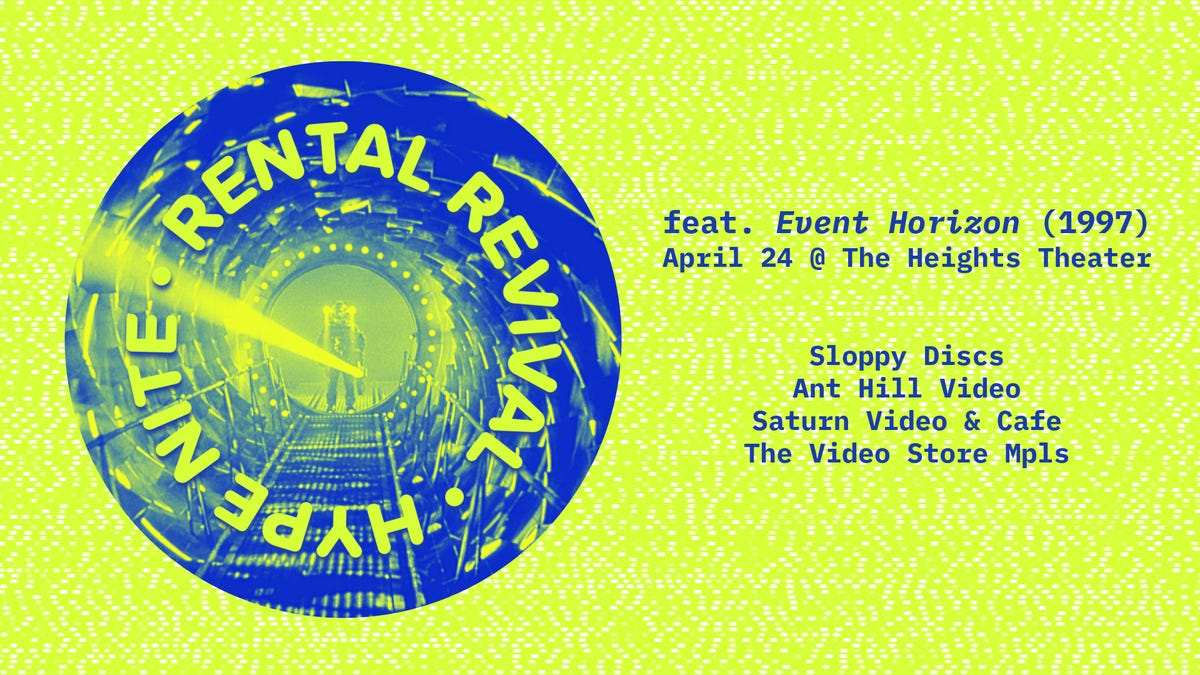
One more thing before I go - tonight is Rental Revival Hype Nite at The Heights, the other best theater in the Twin Cities. Four physical media rental services are coming together to screen MAN v. MACHINE also-ran Event Horizon starting at 8:30pm. Veterans Sloppy Discs and Ant Hill Video will be there, but they’ll be joined by upstarts Saturn Video & Cafe and The Video Store Mpls, two future brick-and-mortar establishments in the hype-and-fundraising phase of their assent. If you’re in town, check it out. If you aren’t, check out whatever is happening in the rental revival scene in your municipality. Rental physical media is arguably good for the environment, probably good for your brain, and absolutely good for your viewer experience of cinema. There are people out there who love movies and who want to make your life better. Go be friends with them.
Thanks for reading about movies you haven’t seen these past two weeks. Remember to comment, review, subscribe, etc. I will be back next week with thoughts on Mother Mary, a movie you can actually see in theaters right now.
I don’t want to be guilty of Charlotte Wells erasure - the first great movie about‘90s childhood is Aftersun. But an 11-year-old perspective of 1999 is quite a bit different than a 7-year-old perspective of 1997. I swear I’m not trying to pedantic.