
too many feelings i dont need to share
breaking up with yorgos lanthimos // falling for kpop demon hunters // a french fling with linklater // coming back home to scorsese

My goal with this newsletter is to write about new films as they reach general release, along with some seasonally appropriate commentary on other cinematic events and interests. I watched too many movies this week and had feelings about all of them: wrath/disgust for Yorgos Lanthimos’s black-pilled Bugonia, admiration for KPop Demon Hunters and the new participatory cinematic experience, misdirected nostalgia for Nouvelle Vague, and a whole mess of stuff I should probably go to therapy to process for Mr. Scorsese. This newsletter comes out every Friday, which this week means Saturday.
Remember that this is the last week to submit your MAN // MACHINE brackets! Do you want glorious winnings? Do you want straightforward glory? Submit now!!!!
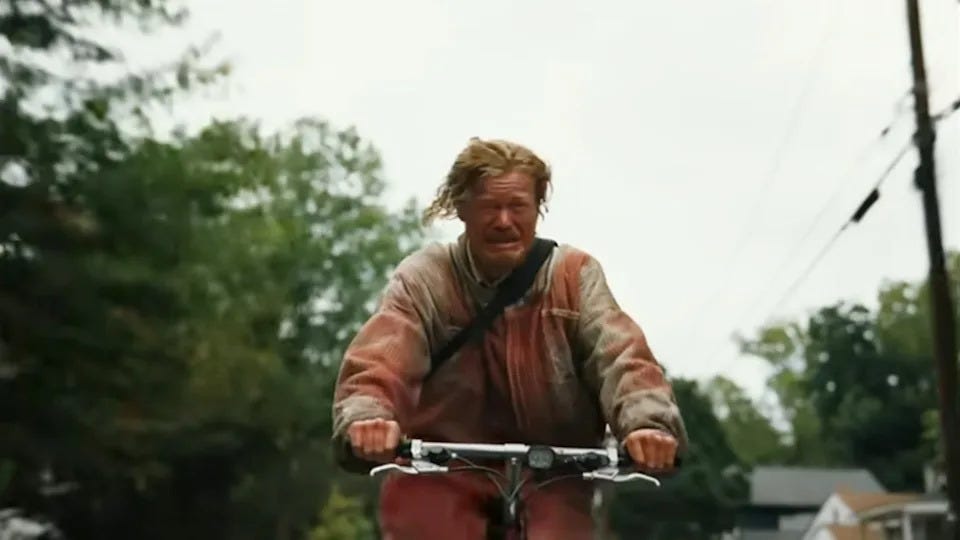
I’ve been working hard lately to not say mean things or jump to hyperbolic superlatives/curse words whenever I get mad. You probably haven’t noticed, mostly because I’m not doing a very good job. Feelings are overwhelming, shit-talking is fun, and people are really bad at not turning blind across bike lanes. But saying cruel things seems to have an overall negative impact, while kindness/patience/understanding generally makes things better, even if it bulldozes the opportunity to expose to other people what disgusting pieces of shit they are. Sometimes all you need is an adjective tweak and a couple extra compliments to heal some wounds. A little bit of rhetorical consideration goes a long, long way.
Yorgos Lanthimos’s new film Bugonia is interesting - viscerally, intellectually, spiritually. It delivers a more challenging argument about humanity than Eddington and a more imaginative perspective on dinosaurs than Jurassic World: Rebirth. It’s about as shocking as a late entry in the Saw franchise, as funny as a 2025 Onion article, and rigorous as a thirteen-year-old’s argument about power structures after he’s been told he can’t go to the mall until he finishes his homework. By that I mean it’s very raw and very honest. For two hours straight, it abuses its audience, its characters, and the beautifully restored VistaVision camera used to connect them - which is exactly what we’ve all come to expect from our “favourite” Greek director. It’s a difficult movie: one that took me to places I didn’t necessarily like but certainly didn’t expect.
Bugonia, which is not a mispelling of “bougonia” but a peculiar metaphor about bees, is Lanthimos’s follow-up to Poor Things and Kinds of Kindness, a paranoid thriller about a disturbed young man (Jesse Plemons) who convinces his cognitively disabled cousin to help him kidnap the CEO of a biochemical corporation (Emma Stone) because he thinks she’s an alien. After some light-hearted repartee, he chains her down in the basement and Iraq-War-style tortures her until he ekes out a confession. I don’t want to reveal other details because there are a lot of people reading this who probably want to go in blind. People really like Yorgos, and a lot of people have significantly more tolerance for nihilism, torture, and disability-as-comedy than I do. If that’s your boat - I love you and I respect you, and I genuinely hope you have a great time at the movies.
By far the most interesting thing about Bugonia is Lanthimos’s decision to use VistaVision for a film largely composed of close-up interior shots. This is idiosyncratic enough on its own, but cinematographer Robbie Ryan shoots on a close-focus concave lens with no depth of field that undoes the widescreen clarity of his massive film stock. The edges are distorted, the backgrounds are blurred, and the only thing accurately rendered is the nose in the middle. A malfunctioning camera designed for wide shots, used almost exclusively to capture claustrophobic close-ups, fitted with a lens that dramatically distorts the edges of the frame toward a hyper-focused center while blurring out any grounding context - get it? It’s about the internet. This is pretty clever. But it reinforces a somewhat obvious point and comes off a bit heavy handed, not unlike some other elements that went into making this movie. Now is a great time to say that Jerskin Fendrix’s score is phenomenal, and that Stone’s and Plemen’s performances are worthy of Oscar nominations. I hope they all win!
Sometimes it’s right to gracefully part ways with someone when you realize a relationship isn’t working out. It’s not a judgement on them - it’s something that just needs to happen so both of you can thrive. It’s always hard though to look back on your time together and identify all the moments that could have been the end. I could have listened to my gut when I first heard what Dogtooth was about and said there was no chance I would ever be watching that. I could have listened to my mother-in-law when she said she didn’t love The Favourite. I could have listened to the backlash army that said Poor Things was somewhat insensitve. But now I finally know: Yorgos Lanthimos just isn’t for me.
My feelings aside, it’s great that there are directors out there who are pushing the limits of narrative and utilizing all the elements of cinema to tell simultaneously entertaining and discombobulating stories. And it’s great that American audiences are willing to check them out. Sometimes it’s worth it to try something difficult, even if it makes you uncomfortable. The value is in the journey and the discovery, even if you don’t ultimately like it. If that seems worth the work, go see Bugonia.
Fuck this movie.

I wasn’t planning on watching KPop Demon Hunters, but my wife1 had it on when I got home after Bugonia and I had no other choice. And you know what? it’s pretty undeniable. “Soda Pop?” Good song. “Golden?” Maybe the best song not by Geese of 2025? I was all in on Sinners getting the Song Oscar, but it’s pretty obviously going to these guys. Beyond the soundtrack, I thought KPop Demon Hunters was a mostly competant and morally reasonable children’s film. The choppy rendering is charming, the cartoon gags are clever, the characters are likeable and fleshed out beyond the focus-grouped stereotypes you usually get in this sort of thing. I have no problems with young people being all-in on this. Monoculture is still alive in kidworld, and that’s OK!
KPop Demon Hunters came back to theaters last weekend in its hugely successful singalong format. I’m curious to see the long-term effects on the young people - and I imagine there are a lot of them - whose first two theater experiences were KPop Demon Hunters and A Minecraft Movie. I don’t think either of these movies are great works of art, but it’s fascinating that a new generation of people are experiencing the theater not as a sacred sensory-deprivation chamber but as a noisy space for communal experience. While their parents are complaining about their fellow theatergoers laughing too much, the kids are running through the aisles, dancing and singing and throwing popcorn at the screen. The birth of cinema culture was supposedly people rolling around on the floor screaming about trains. Is it so bad that we’re coming back around to that? There’s a kid out there who is going to spend the rest of his life trying to recapture the transformative experience of a Chicken Jockey riot. He’s going to go to film school, and he’s going to make movies that honor audience participation as a necessary component of the cinematic experience. Francis Ford Coppola won’t live to see it, but he’ll roll over in his grave and smile.
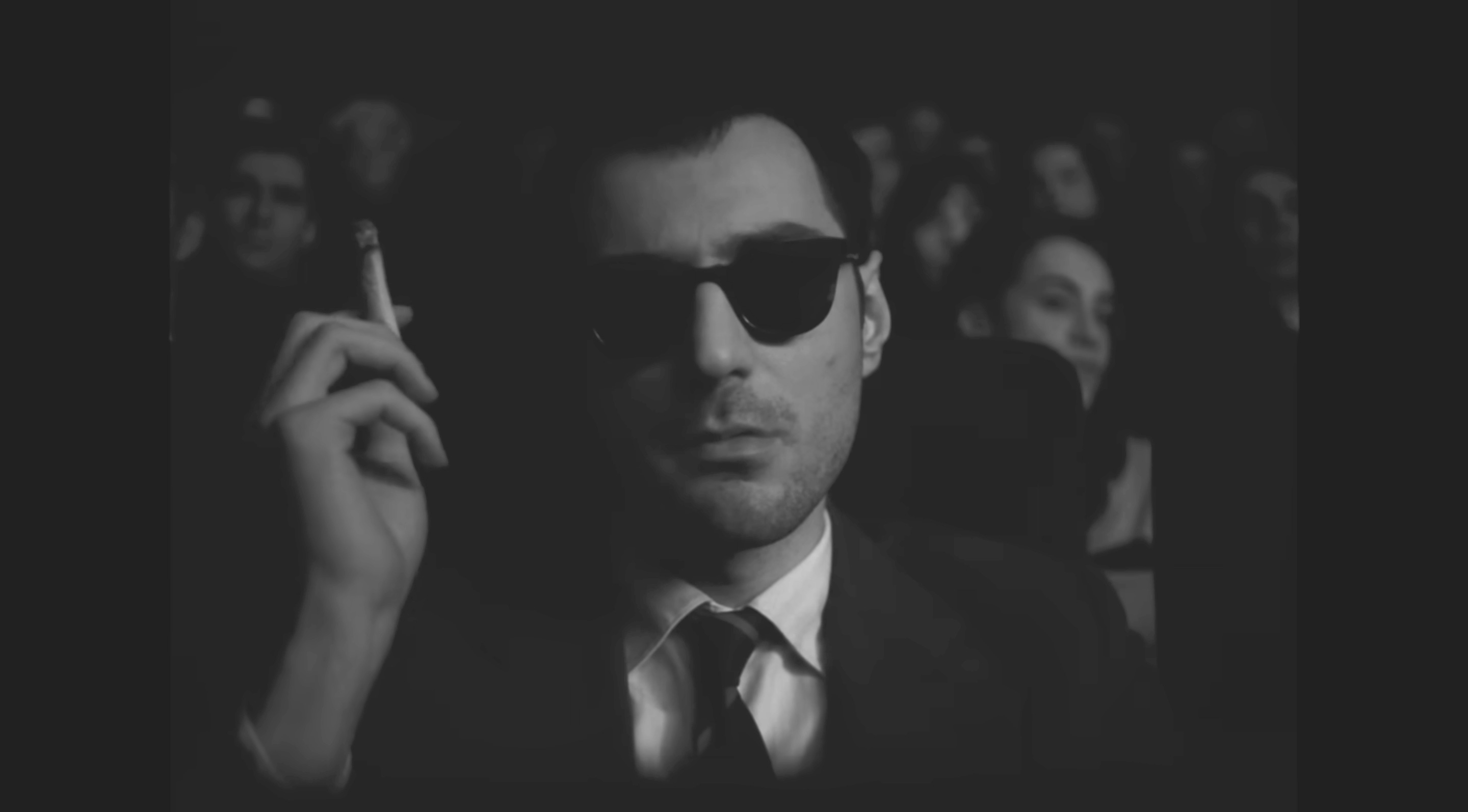
Speaking of theartical social experiences: Nouvelle Vague begins with a pan shot of François Truffaut, Suzanne Schiffman, Claude Chabrol, and a sunglasses-wearing Jean-Luc Godard in the front row of a theater, smoking cigarettes and loudly criticizing the movie they just watched. Afterwards they go across the street to a café: they keep smoking cigarettes, they keep complaining about movies, and Godard keeps his sunglasses on the entire time. Life used to be beautiful. Where did we go wrong?
In some ways, Nouvelle Vague, Richard Linklater’s retelling of the making of Breathless and the birth of the French New Wave, is the exact sort of recreation-of-history movie that doesn’t need to get made. Breathless exists, you can watch it, you probably should on a semi-regular basis. In that Nouvelle Vague recreates the style and look of Breathless so accurately that Linklater says he has a hard time remembering what the original cast looks like, Nouvelle Vague is very close to something I regularly complain about. We live in a world where deepfakes supposedly exist and all media is available for basically free. Is it worth anyone’s while to put time and energy into recreating 1959 Paris when we can already see the real thing?
But what can I say? I loved it. What Nouvelle Vague has to offer that a typical Hollywood biopic does not is a glimpse into an aspirational lifestyle where people were smart and cool and fun and did things that were smart and cool and fun. Never once does Linklater try to explore Godard’s inner pain, or chalk up a love story, or indulge in anyone’s bravery. He just thinks these guys were beautiful and let’s his camera prove it.
I have no idea how much of this story is true. Did Godard and Georges de Beauregard actually get in a wrestling match in a Paris cafe? Was Bresson actually filming Pickpocket around the corner from where Godard was filming Breathless? Did Godard actually wear sunglasses into the movie theater? I really don’t care, especially since I already idolize these people and will choose the most aesthetically pleasing version of their legend whenever I think about them.
What I didn’t realize before watching Nouvelle Vague was how badly Godard et al. wanted to create the New Wave. Cahiers du Cinéma was throwing the term around in the 1950s, grasping at elements from American b-movies and avante-garde Italian films, praying for a cinematic revolution. It wasn’t a de-centralized art movement that later got lumped into a critical construct - it was a movement led by critics who desparately wanted to change the world because they desparately believed in the art they were writing about.
Nouvelle Vague is much more a love letter than a call to action, but done right those ought to be the same thing. Are we on the cusp of the New New Wave? I can’t contribute to making it happen because I’m not that cool and I don’t know how to operate a camera. But I’m happy to write reviews that make out like it’s coming, and I’d be more than happy to buy a couple trim jackets, establish residency at a theater that lets me smoke cigarettes, and gossip about it afterward on the patio with all my beautiful friends. Wearing sunglasses to the movies is psychotic. But if the movement asks it of me, I’ll do it.
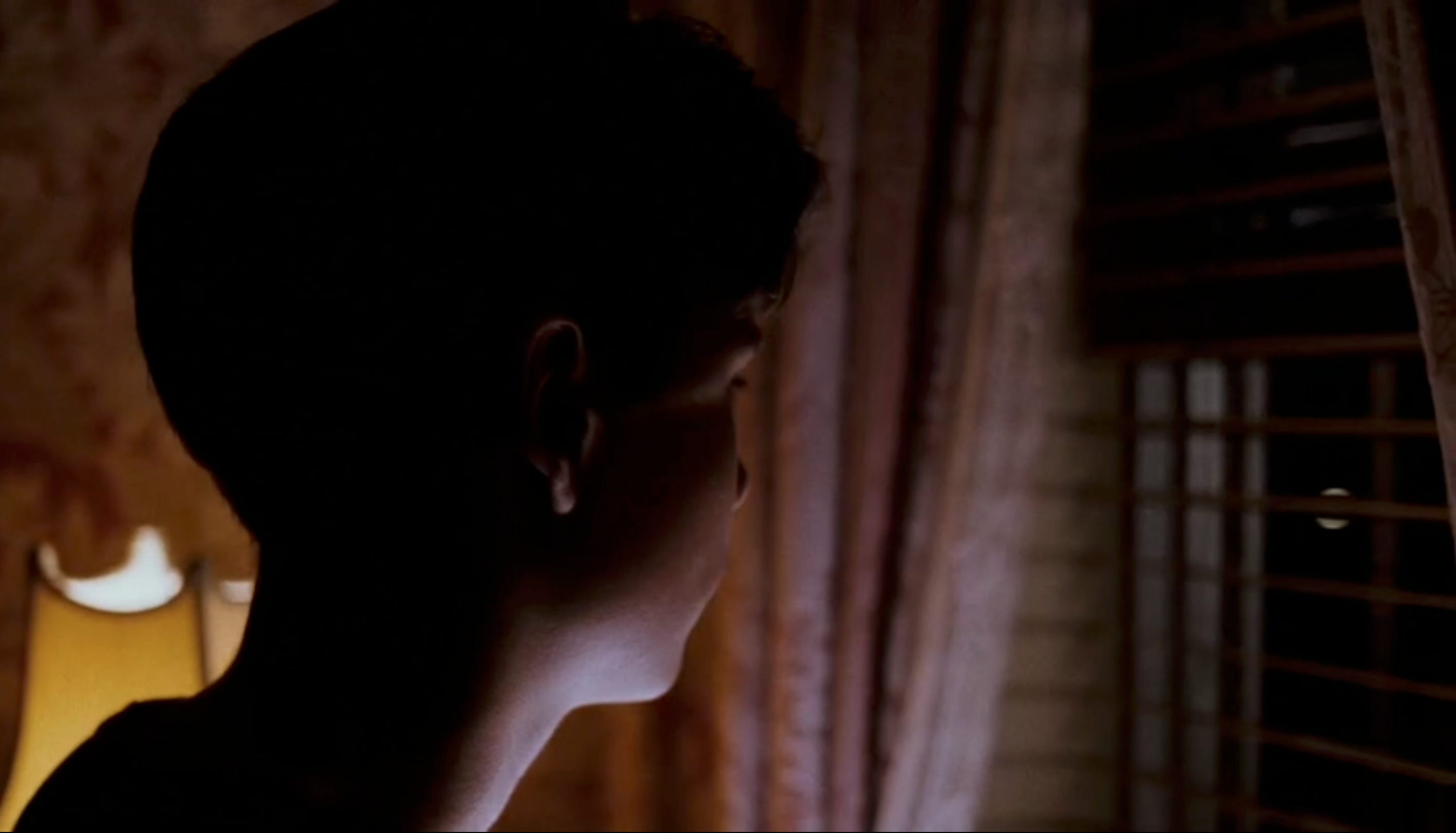
If I was ever going to make it as the reincarnation of Jean-Luc Godard, it was when he was still alive and I was living in New York. I only eked out one year on the East Coast, and I spent most of that time avoiding my heroin-coated apartment in Bed-Stuy by hanging out on at-the-time fashionable Elizabeth Street working at a long-since-closed semi-luxury shoe store. I was a terrible employee and the store was a doomed enterprise, but I was depressed and broke in Manhattan and that was a certain form of a dream. I spent hours and hours standing in the doorway and not selling anything, feeling relatively pleased with myself, staring out across the street, waiting for something to happen.
What I didn’t realize then was that I was staring at the childhood home of Martin Scorsese - and that 70 years before he was doing the exact reverse, staring down at my shop from his third-floor living room, steaming under a blanket for asthma treatment and - as he reveals in Rebecca Miller’s incredible five-part documentary Mr. Scorsese - dreaming up the signature crane shot he’s been using in movies ever since. Thank God he had something more interesting to look at back then than Midwestern kids and luxury stores. I don’t think there’s anything less deserving of a sweeping overhead shot than a loser failing to sell shoes.
I knew I was going to love Mr. Scorsese, but I wasn’t prepared for how moved I would be at levels I’m not used to being moved. The personal bits are broken up by some of the insane stories you would expect in a retrospective about the guy who invented modern mob movies (the appearance of a character named Sally Gaga, pronounced gaGAH, is one of the most satisfying reveals of the year). But the central Scorsese myth, the sickly kid who couldn’t play ball and had to hide in refridgerated movie theaters in order to literally survive the summer, is the heart of the documentary. Movies saved a life that Elizabeth Street would have ended, which is pretty much the only way you end up with a career like Scorsese’s. Is any of it true? Once again, I really don’t care. The legend establishes a story, and it works.
Miller’s persistent interviewing exposes Scorsese as every bit the psycho you’d guess he is, a short guy consumed by repressed wrath and what James Joyce refered to as “the cursed jesuit strain, only injected the wrong way.” His movies speak to a particular mix of moral and self-obsessed striving that can only end in death or prescribed daily meditation exercises. I found the whole thing painfully personal, less like a conversation about art and more like an older relative telling me that I better watch myself.
Not that this resonance is particularly unique. Scorsese means a whole lot to a whole lot of people. It’s embarassing to feel so emotionally connected to an artist who is so incredibly out of my league. What fundamentally separates us - beyond him being old, Italian, one of the greatest filmmakers of all time, and maybe unaware that Minnesota exists - is a certain sort of striving that will necessarily lead to cutting off the rest of the world, an obsessive pursuit of a cinematic sacrament that will only end in the destruction of your health and your relationships. It starts as a relatable sort of emptiness, but where normal people can solve that with something as simple as moving back to Minnesota, the maniac artist has to go to hell and back in pursuit of the tracking shot he dreamed up when he was six. I feel blessed that I’ve got some part of my brain intact that can plug up that longing, but I can still remember what it felt like staring out that doorway, waiting for the equivalent of that tracking shot to hit me. There’s some depravity in nostalgia for an open wound, but there’s part of me that misses it.
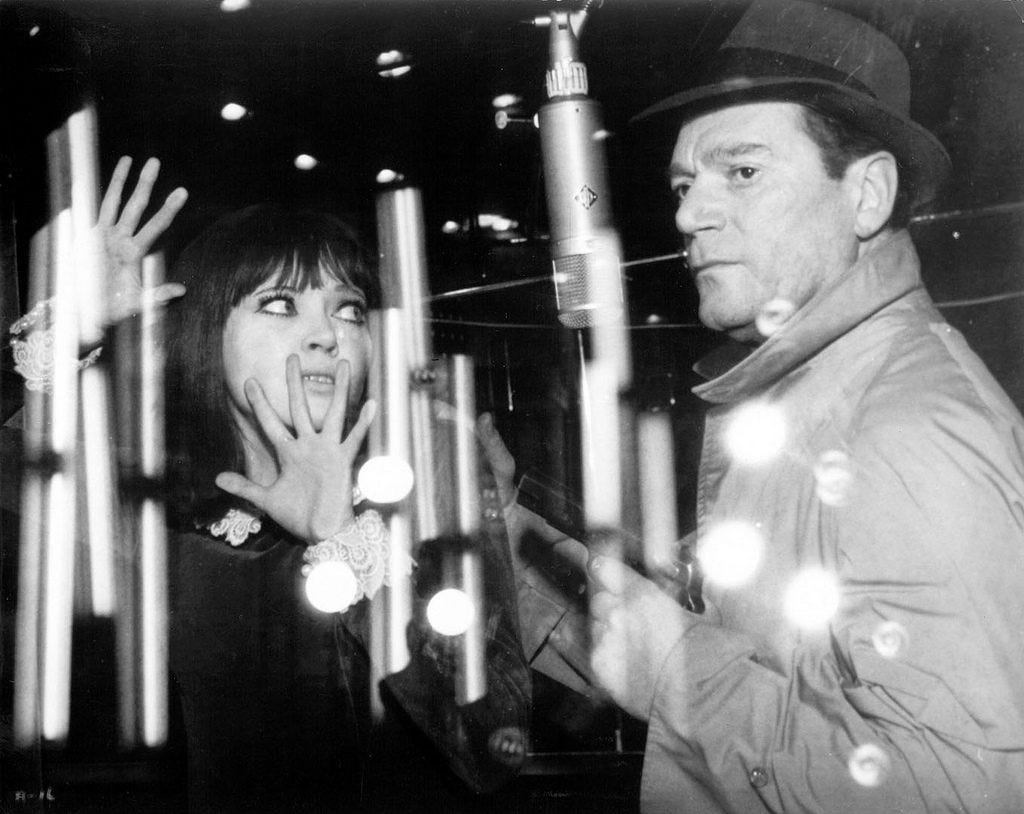
Well that’s enough vulnerability for one week. Remember that this is the LAST WEEK to submit your MAN // MACHINE brackets. In honor of Jean Luc Godard, this week’s match-up is his 1965 pioneering sci-fi noir Alphaville vs. George Lucas’s nutty first film THX 1138. It’s basically impossible to find THX 1138 in its original format: Lucas smeared CGI all over it in the mid-2000s and that’s what you have to watch now unless you can track down an old VHS or a terrible rip somewhere on the internet. But Alphaville is a funny introduction to Godard if you haven’t spent any time with him - probably not a very representative example, but maybe one of the most entertaining.
Check them out, get those brackets in. Download them here. Submit them right here. They’re due on Thursday 11/13.
Thanks for reading *life is disappointing.* If you found this newsletter slightly less disappointing than the rest of your life, consider liking, commenting, sending me money (thanks!) or subscribing. Subscribing will get you exactly what you get here but sent to your email inbox. We’ll be back next week with thoughts on Train Dreams and the official launch of MAN // MACHINE voting.
I refer to this person fairly often in this newsletter but I really don’t like calloing her as “my wife” b/c a.) it makes it seem like I’m 45+ and b.) I worry that at least one person reads it in their head with a Borat accent everytime I write it. From now on I will refer to her by the first name that comes up on a random name generator that is not the name of someone I already know, which is Florine. “I wasn’t planning on watching KPop Demon Hunters, but Florine had it on when I got home after Bugonia and I had no other choice.” (Florine is a big advocate for fluorinated toothpaste and is the only reason I have successfully scheduled a dentist appointment for the first time in an unspeakable amount of years, so I think this is an appropriate pseudonym.)
Wonderful stuff from start to finish ... including the footnote. Thanks!