
two for folding the laundry
darren aronofksy finally makes a dumb movie // david mackenzie (almost) goes analog with relay

My goal with this newsletter is to write about new films as they reach general release and to feature seasonally appropriate commentary on other cinematic events and interests. This week we’ve got Darren Aronofsky’s ninth feature Caught Stealing and David Mackenzie’s latest thriller Relay. This newsletter comes out every Friday, which this week means Saturday.
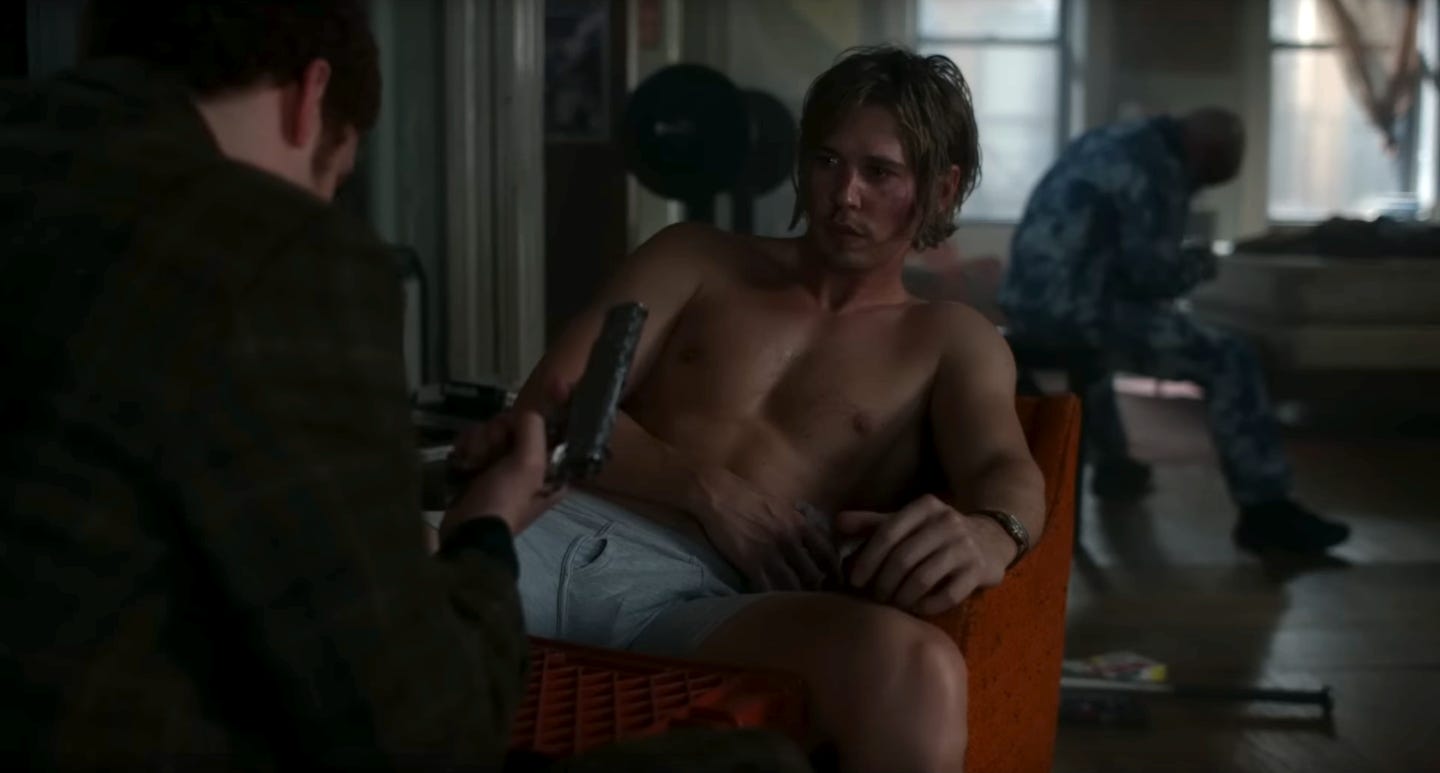
If you had told me when I was seventeen that Darren Aronofsky was remaking Snatch but set in pre-9/11 Lower East Side, I would have said “that sounds tight.” Aronofsky played a big role in my teenage performance of intellectualism, a real director-philosopher who made films about concepts that adults just didn’t get, like “the infinite digits of pi are basically like God” and and “modern medicine is basically like the search for the fountain of youth.” It worked until I hit legal drinking age, at which point I started to realize that maybe the reason adults don’t stay awake all night talking about these topics is because they’d rather go to sleep.
So thumbs up to Caught Stealing for accepting itself as a stupid movie for teenagers. More or less an American rehash of a Guy Ritchie movie1 but with more emphasis on kidney issues, it's a chase caper about an alcoholic baseball player (Austin Butler) who catsits for the wrong neighbor and ends up in a terrible case of mistaken identity. There are crazy Russians, there are menacing hasids, there are London punks with liberty spikes, there's Bad Bunny with a perm. In case you were here for a good time, Aronofsky throws in a car-crash-trauma backstory that intrudes in flashback form every twenty minutes to bring down the mood. But he gives you a cute cat sidekick to bring it back up.
If Guy Ritchie movies work2, it’s because they're so stylized you lose track of the humanity of the person getting their head blown off and embrace the rim-shot comedy of the violence. This is probably bad for the soul, but great for entertainment - it would be unwatchably sadistic if the viewer registered the disposable henchmen as living organisms. Aronofsky has always equated humanity with the capacity to exude bodily fluids, and they flow so freely across his 1997 New York that I can’t help but mourn every time a new orifice opens up to exude them.
Against its nonsense plot, Caught Stealing is shot with painful realism that emphasizes the trash, the scars, and the vomit that make up life in the big city. Aronofsky’s New York looks like New York, and his apartments are almost as shitty as real New York apartments. Within that environment, he efficiently establishes that injuries - to heads, to organs, to paws - hurt. When a kidney ruptures, Aronofsky revels in the animal consequences, lovingly capturing the urine pooling around Butler’s head as it slowly fades to red. For about twenty minutes, Caught Stealing feels like a punishing thriller where no one will make it out alive. When it flips to a Mexican stand-off black comedy at the 45-minute mark, we’ve already seen staples ripped out of surgery scars, an execution-style murder of an innocent character, and violence against a cat - too late a turn to shake the vibe that violence is bad, gross, and tragic.
Matthew Libatique's dialectic cinematography (back from last week!) adds to the inconsistency. He starts out on dark, grainy film to capture the ‘90s dinginess of pre-Bloomberg Manhattan. But he switches to well-lit drone shots the second Butler starts doing parkour on fire escapes. It's not quite as jarring as his work in Highest 2 Lowest, but it speaks to Aronofsky’s uneasiness about what this film is supposed to be. Either Butler is limping down Christie Street leaking puss over fast stock, or he's Jason Bourne-ing through Flushing Meadows on digital. Both are fine, but you have to choose one unless you’re Doing Something.
And I don’t think Aronofsky is Doing Anyhing. Maybe for the best. He has a lot of deep-seated pretensions to hurdle over to become the populist filmmaker he aspires to be, and he just barely clears them. Caught Stealing looks just good enough, and has just enough sweetness, to rise above the muck it's set for itself. It’ll be too gross for some people to finish and not clever enough for many people to re-watch. It wants to be a populist love letter to a lost New York. It wants to be a dumbass movie about a guy, his cat, and a big bag of money. And it wants to be that without saying anything about humanity, art, or the nature of the universe. By the end, it gets there. It's finally a film worthy of Aronofsky's intelligence.
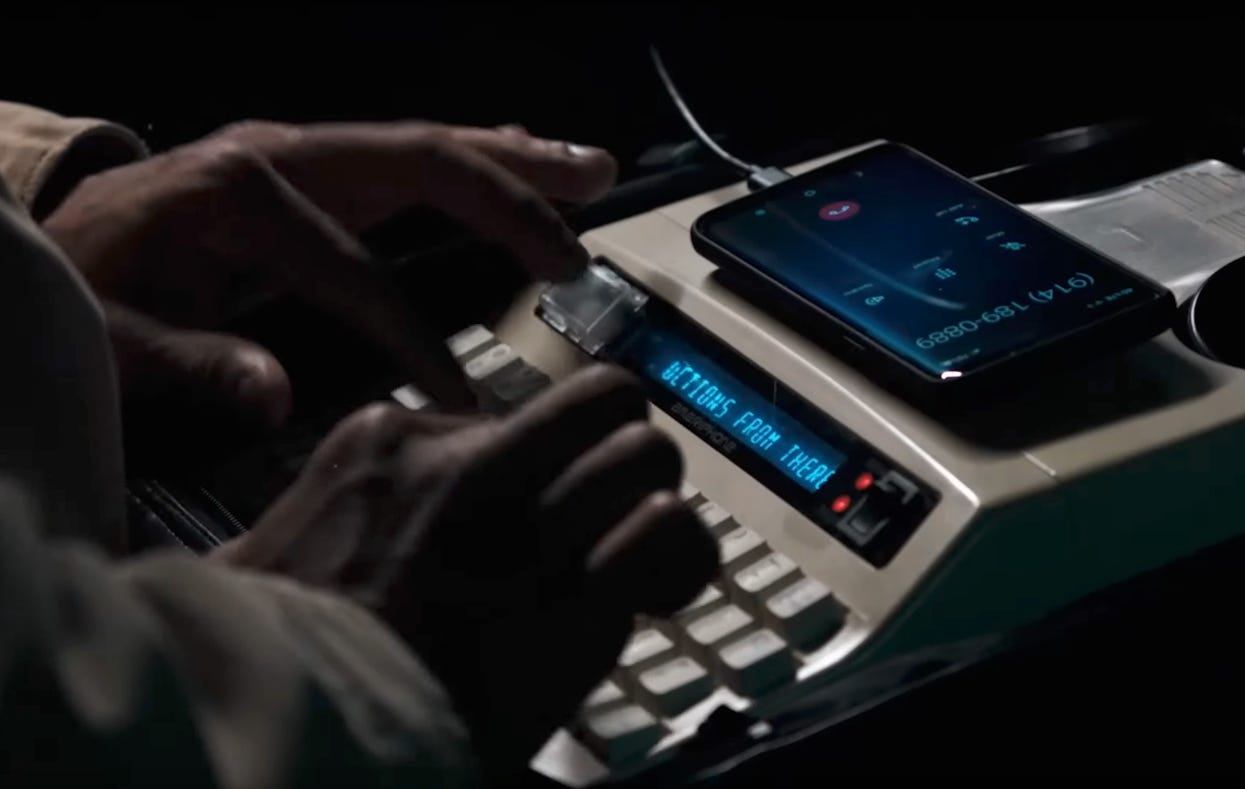
Relay is another New York chase movie, also shot on location and also toeing a line between analog and digital to questionable effect. Where it succeeds, it’s the kind of small thriller that you wish there were more of. Where it doesn’t, it’s a thriller that looks a whole lot like everything else.
The most interesting object in Relay is the telecommunication device for the deaf (TDD), a machine as inexplicably clunky as its name. Sort of an electric typewriter crossed with the E.T. Speak-and-Spell, it translates text messages to speech and vice-versa via the relay service, a human-powered operator system that probably exists in your state so long as they follow federal ADA mandate (always a potshot these days). Riz Ahmed spends much of Relay using his TDD to communicate with whistleblowers who want to return stolen documents to their former bosses. TDD calls are impossible to trace (at least in this film's universe) so the relay service is a critical component of Ahmed’s jerry-rigged plan to get scientist Lily James out of hot water with a biotech firm that has resorted to blowing up her possessions after she threatens to go public about an evil wheat grain they’re distributing. That David Mackenzie can make enough sense of this convoluted conceit to build a 100-minute story is one of Relay’s crowning achievements.
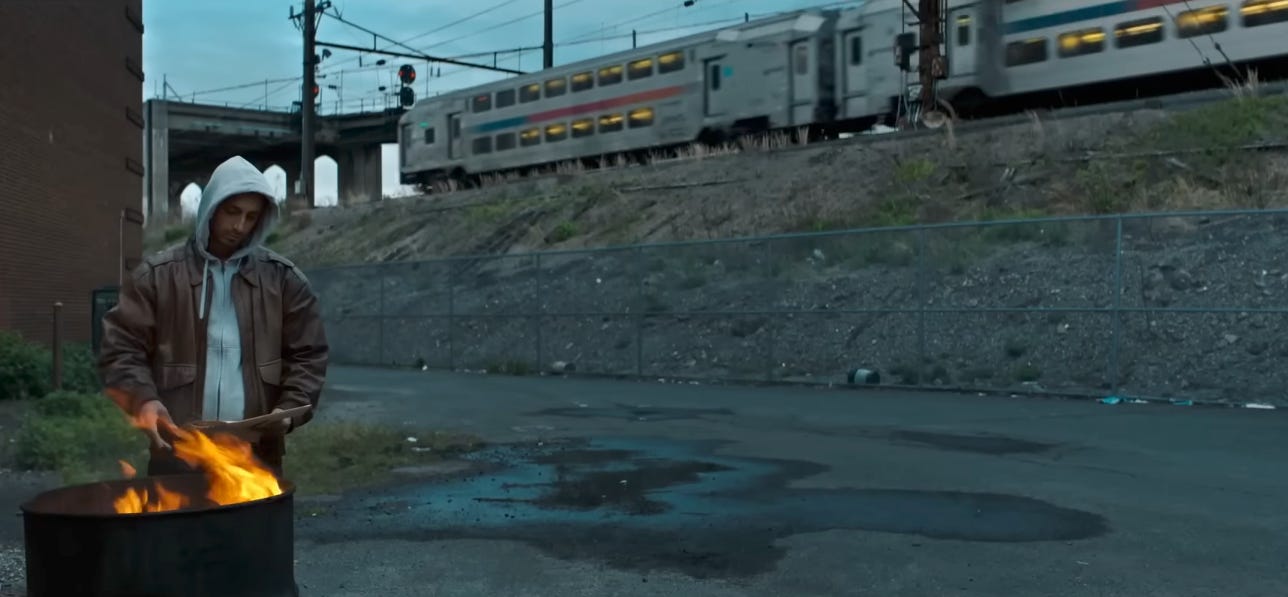
The other is watching Ahmed string together analog tech solutions to hyper-modern surveillance problems. The key lies in his belief that the only way to beat an ever-present grid is to stick to the still existing analog channels that work outside it. There are regular trips to the post office, loving shots of binders and manila envelopes, and a Village People array of New Yorker disguises. Most of Relay is a cat-and-mouse came between James and the goons that are chasing her. The facial-recognition scans and the wireless tapping and the micro-trackers of the black ops guys are no match for Ahmed’s ingenious use of clunky machinery.
I wish this script-level opposition to digital translated to Giles Nuttgens’s cinematography. Relay has a retro trailer that got me hopeful that it was going to have a look similar to the film stock scenes in Caught Stealing. I was disappointed when it opens with a digital steadycam shot of a very crisp Midtown intersection. Relay looks like a mid-budget streaming show, and the cinematography bleeds over to the plot. None of the sets, the characters, or the action sequences are particularly believable. Partially that's because the acting and blocking are solidly good-not-great. But the art of a great paranoid thriller hinges on the cameras communicating the power surveillance tech that's driving the plot. Relay's smooth cameras don't capture the stiched-together quality of Ahmed’s gadgets or the hacked surveillance of James’s pursuers. It’s a film about the constraints of technology, but it looks like a 2025 action movie in which anything is possible.
And - pretty much anything is possible. Riz Ahmad can run, shoot, bicycle, purchase affordable plane tickets on short notice, and romance Lily James on the power of his logistical text messages alone. Just once I want to see a chase movie about a nerd who has to get ushered around like the key guy in Matrix Reloaded. Why do these computer dorks have to rise to the challenge when given the opportunity to kick a guy out of a moving truck?3 Just once I want to see a thriller about a pale loser who isn’t strong or coordinated enough to pull off guerilla warfare techniques. Relay has a smart enough premise that it doesn't need to climax with an alley-chase gunfight sequence. It’s a bummer that it lacks the confidence to avoid it.
As it is, Relay is a solid example of the impact of technology on narrative. If Mackenzie had been more comfortable hobbling himself to the annoying limitations of film - or at the very least, those of less conventional digital - Relay could have contributed to the classic paranoid thriller conversation. Instead, it’s sentenced itself to a short stint as an airplane movie before shifting over to Tubi and eventually becoming even more unsearchable than it already is. It’s a movie all about the importance of analog records. There’s some irony that its message will inevitably be lost in the digital mush.
Thanks for reading *life is disappointing.* If you found this newsletter slightly less disappointing than the rest of your life, consider liking, commenting, sending me money (thanks!) or subscribing. Subscribing will get you exactly what you get here but sent to your email inbox. We’ll be back next week with a big feature on the state of the Dakota Johnson romcom in a post-Materialists landscape.
Did you know that Guy Ritchie has a film out this year called Fountain of Youth, a heist movie about the Fountain of Youth, the central object of Aronofksy’s 2006 magnum opus (in his opinion) The Fountain? If Aronofsky’s next feature is a Sherlock Holmes movie and Ritchie responds with a ballet psychodrama then we’ll know something is up.
Do Guy Ritchie movies work? Or is that another thing I used to like that doesn’t stand up to life outside a mirror darkly?
I think this is basically the premise of this spring’s The Amateur, but, based on the extremely comprehensive trailer, that’s a movie all about how Rami Malek does rise to the challenge when he has to cross a tightrope over Broadway or whatever.