
YEAR OF THE LUCKY STAR
MARTY SUPREME sets the tone for two thousand twenty six // new year's resolutions, plans, and calls to action

Happy New Year from *life is disappointing*. I wrote this before a bunch of crap started going on in Minneapolis, and it feels a little stupid putting it out now. But life goes on, and movies keep coming out, and this is a movie newsletter. So here are some thoughts about Marty Supreme and some plans for two thousand twenty six. **SPOILERS FOR MARTY SUPREME.** Also spoilers for ANORA, if you’re concerned about that. This newsletter comes out on Fridays, which pretty much always means Friday.
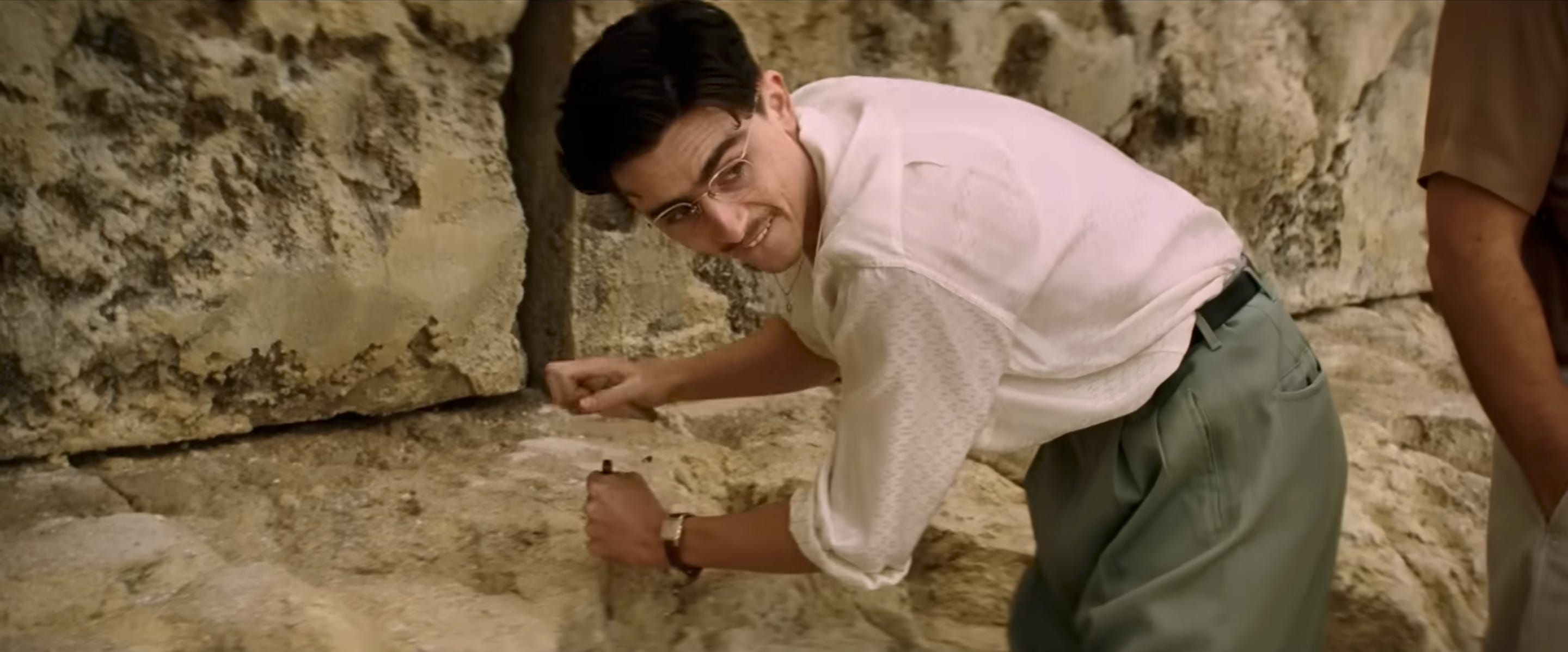
Marty Supreme is the kind of movie that makes people say “they don’t make movies like this anymore,” a sentiment that comes up about twelve times a year and usually refers to all the movies people actually want to see. It’s probably time to concede that they’ve always made this kind of movie, whatever it is, and that they’ll continue to make it, and that it will continue to remind people that they’re unhappy with the state of present cinema because good movies as a rule are better than average ones.
Josh Safdie’s first major solo feature is a breakneck picaresque about a scammer racing across a cross-class sectional of New York as he scrambles to pull off a low-stakes scheme, achieve his dreams, and maybe even get the girl. This is what movies used to be about: huge, hilarious, harrowing, heartwarming. On one hand. Marty Supreme strives for and achieves this sense of lost classicism. On the other, it’s an intensely modern movie with a Gen-Z star, vaporwave soundtrack cues, and the de-centered anxiety that comes when screenwriting abandons the guardrails of romanticism but maintains the basics of sympathetic characterization.
Marty Supreme is hardly the first film to blend zany escapism with anxious realism in the past few years. Dana Stevens at Slate has picked up on this sand refers to it as “the Safdie school,” a genre of film that “make[s] a point of putting their audiences through the same anxiety-producing wringer of the protagnoist themselves.” Stevens identifies the purpose of these films as an attempt to “transfer the anxieties of a film’s characters onto its audience,” a practice she finds to be “an annoyingly draining approach to moviemaking” that “generally fails to provide enough substance to leave me with thoughts any deeper than ‘Well that was an ordeal.’”
I share Stevens’s general distaste for anxiety-as-art, but I’m curious about what’s going on with these movies that cause so much distress in one half of their viewership and great delight in the other. I’d like to expand Stevens’s microgenre to a broader trend that internet criticism sometimes likes to label “screwball.” “Screwball” traditionally refers to a 20th-century style of fast-paced romantic comedy, but its modern application tends to describe anything that includes physical danger, frantic editing, and lots of shouting. It occupies a space where high anxiety and comedy merge into one and sincerity, when it breaks through, is at constant risk of being transformed into an opportunity for someone to get shot in the face. A more apt name would be “stressball,” which is a cute enough name that I’m going to run with it.
The flagship neo-screwball/stressball comedy is Anora, a film Marty Supreme mirrors almost to the point of parody1. On the lighter side are outright comedies like Friendship and Splitsville. On the darker end are the funny parts of Ari Aster and the less upsetting aspects of Yorgos Lanthamos. The sillier side of PTA hits a lot of the beats. Caught Stealing sort of fits, as do the long line of Guy Ritchie small-crime thrillers it rips off. A seminal text might be Meet the Parents, and there are deeper antecedents in nihilistic ‘90s comedies like What About Bob, So I Married an Axe Murderer, and the Happy Madison catalog2. But the Safdie Brothers are the undisputed champions of the genre, and within their orbit lies the misery-inducing trilogy of Good Time, Uncut Gems, and this year’s If I Had Legs, I’d Kick You.3
The purpose of the old screwball was romantic escapism - tension entered only by means of the will-they-or-won’t-they, the result of which was only ever going to be “they will.” The stressball translates that romantic tension to life-or-death anxiety. Rarely are we particularly invested in whether or not Marty and Rachel are going to kiss: we’re much more concerned that we’re going to see Rachel get blasted in the baby by a shotgun. There’s a sense of escapism in the wild entertainment, but its framed by a possibility that everyone is going to end up dead, sort of like if Howard Hawks let us worry that the escaped murderer in His Girl Friday might spring out of the roll-top desk and murder-suicide himself and Rosalind Russell, or if Baby might get weird and eat Katherine Hepburn’s face off. Safdie’s characters are too fully realized not to care about them, but we no longer trust the safety of the Hollywood convention that says dogs, pregnant women, and babies - much less heroes - are safe.
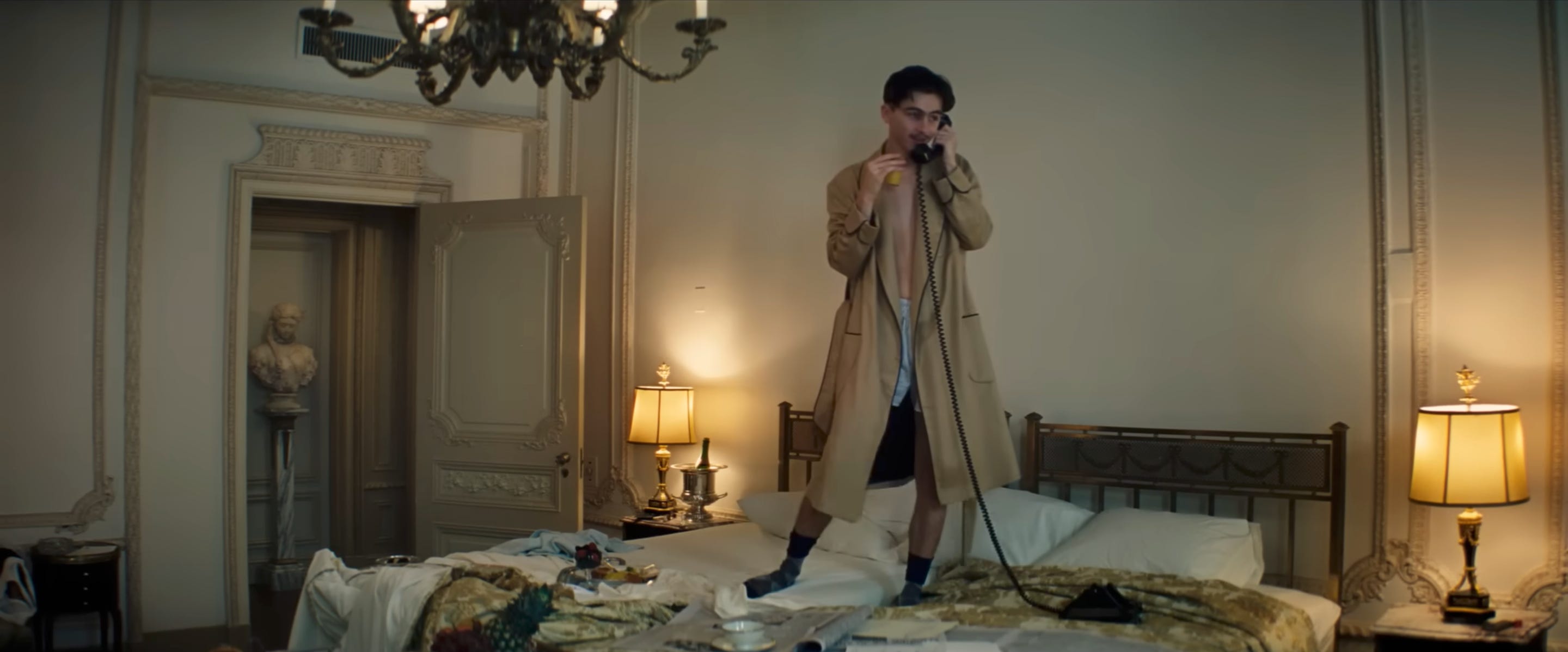
In other words, the stressball dispenses with the traditional comedic framing that says physical violence is funny (/ the traditional thriller framing that says human life doesn’t matter) and introduces a physicality too similar to our own to outright defy it. Marty Supreme’s most spectacular comedic setpiece, the scene when a bathtub and the Chalamet contained within falls through the ceiling into another bathtub, is undercut by agonizing realism: there’s a dog in the second bathtub, and Abel Ferrara’s arm is eye-covering-ly crushed. This was one of the funniest things I’ve seen all year, but I was immediately faced with the consequences of physical reality. If a bathtub actually fell through the ceiling, it would probably kill some asshole’s dog.4
Is this “supposed to be” funny, or is it “meant to be taken” seriously? If you’re too online you might assume that the whole point of this pseudo-comedy is to create discourse cycles where people write way too many words about how “everybody missed that this movie is supposed to be [funny/harrowing/about xyz historical injustice]”. I would say this was about the dumbest line of criticism possible if our current critical discourse wasn’t so replete with brain-rot analysis, but it’s not that much more a waste of time than arguing about the impact of mergers on the multiverse or whatever. Probably the most discussed scene in Anora is the sequence when Mickey Madison, tied to a chair by Russian thugs, repeatedly screams “rape.” A lot of commentary tried to reduce this to a gender shiboleth - men found it funny, women found it harrowing - but at least based on the laughter in my theater and the quarter million conversations I’ve had since, I’d say it falls much more along the line of whether you find this key of danger liberatingly hilarious or horrifying. There’s no right answer, because Anora’s success hinges on the drastic tone shift of the final shot, which comes as either a shock (if you’ve been having fun) or a long-time coming (if you haven’t). Either way, there’s no ambiguity about how you’re supposed to feel at the end. Whether that devastation comes accompanied by fulfillment or excoriation is up to you.
Marty Supreme shares much of Anora’s reaction ambivalence. I found it pretty much hilarious from start to finish with no real moments of concern. But I concede there are plenty of scenes that play on that fine line between comedy and horror with at least the severity of the Anora “rape” scene: the rural New Jersey mob out for blood that surrounds a Jewish man and a black man in the middle of the night; a stand-your-ground hoarder shoot-out; an NYPD shakedown in Central Park; the Auschwitz honey scene. Overall I think it made a lot of people feel fist-pumpingly triumphant and a lot of other people miserable. That this isn’t an abnormal confusion for 2025 moviegoers to experience is at the very least evidence of A24’s curitorial perversions.
What to make of it? You could call it a collapse of the thriller or a depletion of the comedy. We know that thrillers aren’t real and we’ve heard too many jokes to find comedies funny, so the remaining emotion is the weird space where we laugh at anxiety and find tension in the ratcheting up of unseriousness. It would be way too easy to make this into a “these times” type of argument - it’s just as easy to say stressball comedies are a reflection of stressful times as it is to call them a necessary reaction to times when we have nothing to stress about. It would be similarly lazy to write them off as nihilistic. Yes, they acknowledge that bad feelings exist, force you to dwell in them for awhile, and ask you to laugh at them without offering any route forward. But there’s at least one school of therapy that says this is a good way to deal with your problems - they aren’t actually going to get better, but at least you can accept them and find some levity, both in their absurdity and also in the fact that other people feel them too. I am way too teleological to accept that attitude toward life, but I get that Christ/Marx/KonMari isn’t everybody’s path to salvation. Even so, I have trouble believing that actively ramping up anxiety is a politically/spiritually/artistically useful way to go - especially when the only release is temporary laughter before a meaningless death.
But I loved Marty Supreme - not because it follows the stressball formula, but because I think it’s one of the handful of films that transcends it. In this group I have to include Anora, even though I have major problems with it - films that take the stressball one step further by telling us, in their final shots, what we’re allowed to feel something beyond amused despair.
In Anora, it’s the raking agony of how fucked up and empty this entire Cinderella venture has been. We don’t know what comes for Ani tomorrow - it might be a whole lot more of the same - but in the context of the film, the narrative is undercut as relative transcendence seeps through via a raw moment of emotional honesty. In Marty Supreme, it’s the release of Marty’s me-first sociopathy via the outpouring of powerlessness that one supposedly experiences upon encountering their firstborn child.5 Florine says all she felt watching Marty sob was “he’s going to be a terrible father.” Obviously she’s right, that baby is screwed. But that’s outside the range of Marty Supreme’s project. It’s a film about the particular stakes of a dream that is ultimately revealed to not matter. At the heart of the Marty Supreme ball is an ooze ready to goop out in messy puddles at the first hint of a rip. You can laugh in the theater as you squeeze the exterior and watch the smiley face printed on it distort hilariously to your momentary anxieties - but once it’s popped you have nothing left but to go to the bathroom and cry.
I think this release launches Marty Supreme above its peers and into the more AFI-list-ready sphere of “movies they don’t make anymore.” It’s an of-the-moment movie that captures a very contemporary depiction of stress, but it’s able to undercut that trendiness with catharsis in the classical style. Marty, frustratingly, wins - he defies the Shark Tank guy, becomes a vampire, proves himself as the greatest ping-pong player in the world. Instead of the conclusive bullet through Adam Sandler’s brain, he gets to lie flat on his back in all-white like a US Open champion. And then he’s transported back to a Lower East Side maternity ward to sob amidst the babies, forced to realize that, in the face of his role in the continuation of human existence, none of his accomplishments matter. Not unlike another panic-stricken Christmas screwball of Marty’s era, he’s reminded that no man is a failure - or a success - who has family.
This is really cheesy stuff, which is why the real nihilists think its cheap and the true romantics find it empty. It’s a feel-good movie for people who don’t believe in feeling good. Write it off if you’re a good cynic or call it false if you think bad people don’t deserve redemption - but Marty Supreme is 2025’s last suggestion of the year’s most pervasive cinematic theme, that in a world where everything moves to fast to acknowledge that any of it matters, the most everygreen truth is getting your shit rocked by the people you love.
But 2025 is over, and the augurs have spoken - it’s 2026, the YEAR OF THE LUCKY STAR. It’s a good year to get married, a good year to be a child, a good year to reject fatalism and embrace unexpected opportunities. We’re off to a pretty crap start, but 365 days is a long time and I’m not going to let the first eight set the tone.
This newsletter will continue to disappoint with weekly reviews of new movies and other cinematic stuff I feel like writing about. 2026 already has some big tentpoles lined up that make me tired (Spielberg alien bullshit, Ryan Gosling spaceship bullshit, an unnecessary sequel featuring too much Fincher, another featuring too little) but there will surely be all sorts of beautiful, surprising things to make up for it. I’ll be announcing a new movie bracket sometime in MARCH. I have the theme picked out and I’m going to figure out some sort of interactive component that will also incorporate Letterboxd (follow me on that!), so be on the lookout for that.
My film-focused New Year’s resolution, if you care, is to fill in some blind spots I have in the history of French cinema. My goal is to work through one director a month (sometimes two) and hit on at least a handful of their most interesting works (here’s my list through June). I can’t imagine anyone else is interested in participating in this endeavor, but I also know people experience decision fatigue and sometimes want someone on the internet to tell them what to do - so if anyone wants to be part of this French film club, let me know? Maybe I can set up some sort of chat feature or get an email chain going or something.
I would love it if YOUR New Year’s resolution was to like, comment, subscribe, and share this newsletter. Some of these kids on this site get ten, even twenty, likes a post, and I know for a fact that at least that many people are reading and enjoying this one. I don’t think your public support will end up in your FBI file. It might even make you look interesting and cultured on a background check. But even if you’d rather limit your support to a burner account, I would love to give the appearance that someone actually reads this so I can show it to successful people and they can say “wow cool we will connect you with our boss and make sure you get a resident critic job with retirement security and life insurance." I know we are not about supporting one another’s creative pursuits in Minnesota. I love that about us. But I also want this project to go somewhere and I NEED YOUR HELP.
See you next week. Very excited to talk about Resurrection, less excited to talk about No Other Choice.

New York hustler played by Gen Z ingenue gets in over their head, runs across New York through increasingly dangerous and outrageous antics (/needle drops), almost comes out on top, but ultimately falls to pieces in heaving, Oscar-worthy sobs. A friend said rather astutely that Marty Supreme is basically Anora meets The Brutalist, which sounds like a nightmare but somehow works.
This kind of movie has probably existed forever and you could continue to dig for its origins, argue about what qualifies, what doesn’t, so on and so on. I’m not trying to make the argument that something novel is necessarily happening - I’m more interested in what Marty Supreme and comparable films are doing, regardless of historical circumstance.
I really tried to watch If I Had Legs, I’d Kick You before writing this but could never quite muster the drive to ruin my day.
Florine used to regularly think about furniture falling through the ceiling when we lived in a first-floor apartment. We live on the second floor now and she’s worrisomely unconcerned.
Some cool podcasters say that this film is incomprehensible to anyone who hasn’t had a baby. So sorry for wasting your time.
As a devotee of the stressful/hilarious movie experience I appreciate this categorization, but I think the bounds of my version are a bit different from yours. Even so, you've given short shrift to PTA's importance here. The second half of Boogie Nights, much of Magnolia, and particularly Punch-Drunk Love are urtexts here (just ask the Safdies).
Also I've just got to say I'm skeptical of your dedication to KonMari.